How to sell Kotex,
a page for trade
publications, probably early 1920s,
U.S.A., and "Your
Image is Your Fortune!," Modess sales-hints
booklet for stores, 1967 (U.S.A.).
Selling Playtex tampons to retailers,
1970s.
See a prototype
of the first Kotex ad.
See more Kotex items: Ad 1928 (Sears and Roebuck
catalog) - Marjorie
May's Twelfth Birthday (booklet for
girls, 1928, Australian edition; there are
many links here to Kotex items) - 1920s
booklet in Spanish showing disposal method
- box from about
1969 - Preparing
for Womanhood (1920s, booklet for
girls) - "Are you in the
know?" ads (Kotex) (1949)(1953)(1964)(booklet, 1956) -
See more ads on the Ads
for Teenagers main page


|
THE MUSEUM OF MENSTRUATION AND WOMEN'S
HEALTH
Kotex
brochure for retailers, U.S.A.,
1960s
"Your
'Keys' to More Profits"
As you'll discover in this
glossy publication for stores that
sold such products, Kotex
menstrual pads - or maybe you
already knew it - were the #1
seller in the U.S.A. in the 1960s
and probably for decades before
that. I'm not sure why Kotex felt
it had to go to this expense.
People even today say Kotex for
menstrual pads regardless of brand
just as they say Tampax for
tampon. Both were the biggest
sellers in their fields from the
beginning even they were not the
first.
Do you object to the profits
mentioned here? Prices for
commercial sanitary napkins made
poor women make
or buy cloth pads from the
beginning in the same way that
women had made them for millennia
before. Early Kotex advertising
usually featured well-to-do
ladies, perhaps because
because those women bought the
magazines that carried Kotex ads.
But even women of means make their
own pads today or buy
washable ones.
The publication bears no date. I
deduced from the absence of self-adhesive
pads, the many belts shown
within, sanitary
panties, and the hair styles
that it appeared in the 1960s.
By the way, speaking of cash
registers, as we soon will,
let's say they're part of the
administration of a store. When
the museum was open in my house
a radio station in Texas
interviewed me over the phone
(stop me if you've read this
elsewhere on the site). The
producer of the travel show,
Johnny -, had called me up the
day before to chat and arrange
the time.
The time arrived. The
older-sounding male host of the
travel show introduced me
something like this: "Well,
folks, we have Harry Finley on
the line. He runs a museum in
Washington, D.C. Harry, I was a
bus-ad [business administration]
major in college and really
liked those ol'-timey
typewriters, you know, the ones
with the big keyboards. Do you
have any of those in your Museum
of Administration?"
I thought, "Oh, God!"
"Um, it's actually the Museum
of Menstruation. Menstruation,
not administration," I muttered.
"The WHAT? Johnny, you
did this intentionally! What
will our sponsor say?"
I could hear Johnny laughing
in the background.
But the host recovered and I
got to pitch MUM. Also, the
sponsor was a camp-ground chain
and the host had the presence of
mind to ask me if there was one
near MUM. I didn't know.
See also How to sell
Kotex, a page for trade
publications, probably early
1920s, U.S.A., and "Your Image is
Your Fortune!," Modess
sales-hints booklet for stores
similar to the one below, 1967
(U.S.A.).
I thank Tambrands, the former
maker of Tampax, for donating
this brochure of its rival to
the museum.
|
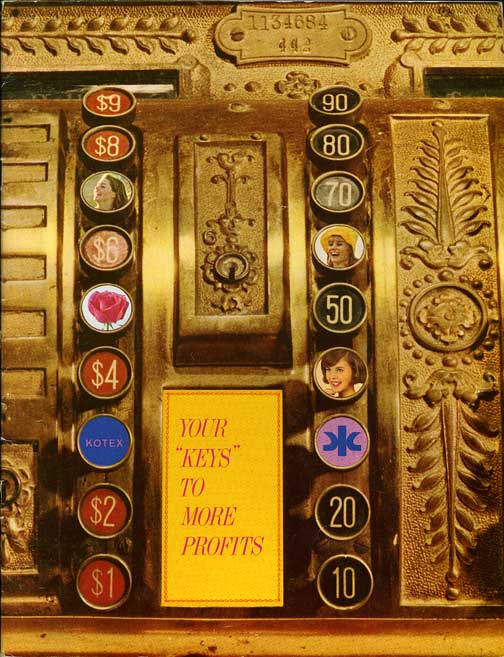
Below:
The front of the 8-page (2 covers
and 6 internal) 8.5 x 11" (20.6 x
27.9") brochure. The paper is
glossy and very thick - expensive.
|
 |
|