Visit the odor
page.


|
Museum of Menstruation and Women's Health
Menstrual
huts
Guide for this museum
This page gathers up and points
to menstrual hut pictures,
information
and a map plus related items
on this site.
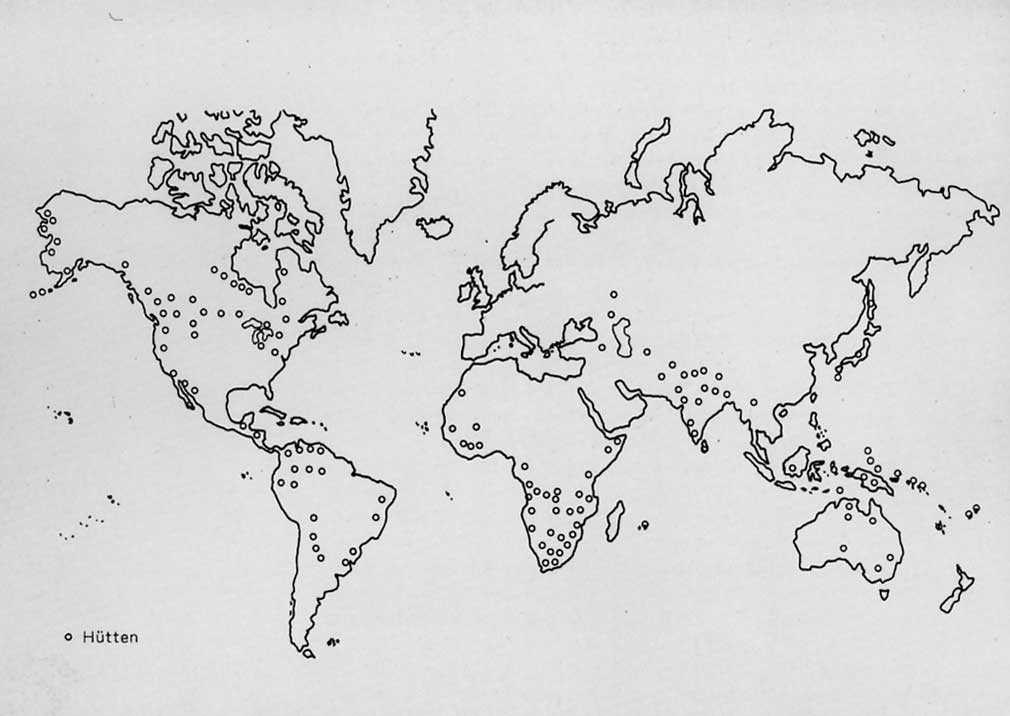
Menstrual huts of course separated
menstruating women from their
community in many
cultures as the map below shows.
See two photos of them below the
map.
Isn't it interesting that women
should live apart just because of
the monthly bleeding? In a sense
this still happens everywhere they
use menstrual pads, tampon,
sponges
and cups.
Some women today do bleed into
their clothing both in mainstream
America and elsewhere because of
poverty or just because they want
to, maybe for political reasons.
More women than you think did so
in the past.
Menstrual
seclusion and pads in today's
INDIA:
Washable menstrual pads
for women in Almora,
Uttar Pradesh state,
India, giving them more
freedom (1999).
Teaching girls about puberty,
menstruation and
how to make washable menstrual
pads, in rural
India.
Visit the odor
page.
|
 English
CAPTIONS for
the 19-photo
series on menstrual huts
in Nepal
in the Frankfurter Allgemeine
Zeitung, 8 March 2014: "Frauen
in Nepal: Jeden Monat in die
Verbannung" ("Women in Nepal:
Banishment Every Month"). English
CAPTIONS for
the 19-photo
series on menstrual huts
in Nepal
in the Frankfurter Allgemeine
Zeitung, 8 March 2014: "Frauen
in Nepal: Jeden Monat in die
Verbannung" ("Women in Nepal:
Banishment Every Month").
Photos by Navesh Chitrakar;
no author given for the German
captions but the photographer must
have had input. I (Harry Finley)
translated the German text to
English, below.
Photo #1: During
menstruation women in the
mountains of Nepal are regarded as
unclean. They're banished from
society and must sleep in exposed,
bare huts. 14-year-old Uttara Saud
waits here for her evening meal.
[That's her in
her hut at left, a section of
photo #3.]
2. Nine
years ago Nepal's highest court
forbade this tradition but in some
regions women are still outcast
like in the village Legudsen in
the Achham district.
3. Uttara lives in this hut
[left] when she has her period.
She is pretty much at the mercy of
the weather and wild animals.
Women may not enter houses and
temples during Chaupadi
[the custom banishing women during
menstruation].
4. Aishi Devi Saud is in
the traditional dress of the women
in the mountains of Legudsen.
Chaupadi is still part of the
culture there.
5. The shadow of Uttara on
the outer wall of her house in
Legudsen.
6. Uttara's Chaupadi is
over and so is her banishment.
She's taken a bath and is combing
her hair.
7. Uttara stands in
front of her house after the bath
that has ended Chapadi. The shy
14-year-old misses school every
month because of her period.
8. Teacher Rup Chand Shah
is among the few who ignore the
custom. She continues to teach the
students even as she's bleeding.
9. In the village of
Bailpata 15-year-old Sanu Bhul and
16-year-old Nirmia Kadayat dance
during explanatory classes about
Chaupadi. Rupa Shand Shah also
teaches such classes.
10. Suntali Devi Saud
washes her clothes. During
Chaupadi the other villagers avoid
her.
............................................................................................
A
Girl Gets Her Period And Is
Banished To The Shed: #15Girls
Read a later (January 2017, New York
Times) article about menstrual huts
in Nepal, In
Nepal, a Monthly Exile for Women
- a curiously
similar title to the
earlier article, above.
CNN
story about deaths in
menstrual huts in Nepal (July 2017).
|
11.
Tradition says that menstruation
makes women unclean. This towel,
which was washed because of
Chaupadi, lies on a rock to dry.
12. Some prohibitions make
life very difficult for
menstruating women. Dhuna Devi
Saud relates how hard it is for
her to sleep in the hut on cold
nights. The room has no windows
and a narrow door and is too small
for a bed.
13. Dhuna Devi Saud
prepares for the night in the hut.
She's almost defenseless against
the animals that live in the
surrounding mountains.
14. A family member brings
food to menstruating women. The
dishes the menstruating women
women use cannot be touched during
the period.
15. During menstruation the
20-year-old Surja Devi Saud sits
in front of her house in the
Achham district.
16. Bhogu Devi Saud
has finished the menstrual
banishment. Even women who reject
the custom must adhere to it
because it's so firmly entrenched
in her society and a violation is
unthinkable.
17. The tradition is life
threatening for women and girls. 15-year-old
Sarmila Bhul was found dead in
this hut; her parents don't
know what killed her.
18. Sarmila's parents
Yagraj and Ishwora Bhul sit in
front of their house in the
village of Ridikot one year after
the death of their daughter.
19. Yagraj Bhul holds a
photo of his dead daughter
Sarmilla. He says she was a
healthy girl and a good student. |
Below:
A map showing the places where
people have used menstrual huts.
On the map, Hütten
means huts.
The map is from the catalog of
the German exhibition
"Menstruation: Monatshygiene im
Wandel von 1900 bis heute"
("Menstruation: The Changing
Menstrual Hygiene from 1900 to
Today")
that occured between November 26
1998-July 31 1999 in the Lorsch
section of the Hessian State
Museum, Darmstadt. Sabine
Zinn-Thomas and Walter
Stolle wrote the catalog and
museum text. The original comes
from E. Püschel's
"Die Menstruation und ihre Tabus,"
("Menstruation and Its Taboos")
1998.
|
 |
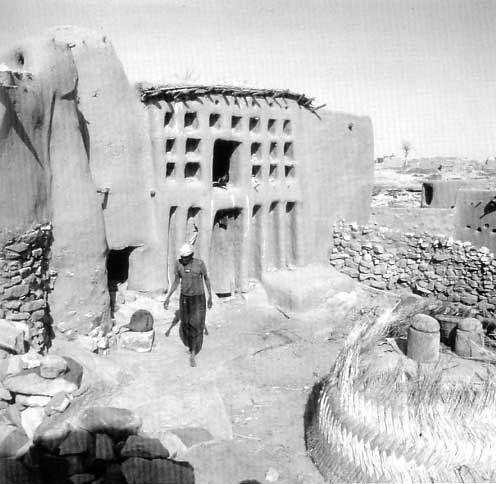
Below:
Farm with
menstrual hut in Mali, Africa
("Gehöft mit Menstruationshütte,
Mali, Afrika").
Also from the above exhibiton
catalog.
|
 |
Below:
Menstrual hut (reconstructed) in Waimea Falls,
Hawaii.
Read more about this below the
picture.
|
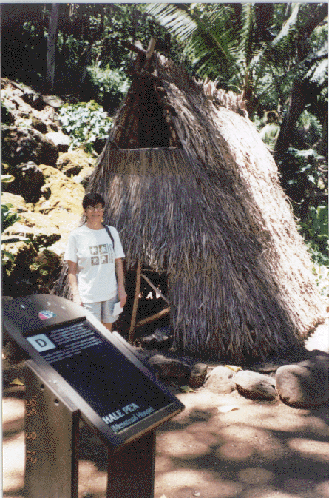 |
A menstrual house -
hale pe'a in Hawaiian
(above) - segregated
menstruating women from
the rest of the
community in many
cultures. Katherine
Nachod,
two-time visitor to MUM
in my house and a
great supporter of the
museum, sent this photo
of herself above next to
a reconstruction of such
a hut in the Hawaiian
Islands.
The park, Waimea
Falls, is a private
enterprise.
One of my
ideas for a
brick-and-mortar
menstruation museum is
to place an
actual menstrual hut
on the museum grounds
that visitors can
enter.
By the way, different
cultures had different
reasons for this
segregation, a subject
widely discussed in the
anthropology of
menstruation.
See also the work of Dr. Beverly Strassmann and read
what Professor Sally
Price, the Dittman
Professor of American
Studies at The College
of William and Mary, in
Virginia, U.S.A., has written
about menstrual huts and
read one of her comments.
|
A Hawaii resident
e-mailed me in February,
2008, about Hawaiian
customs and the meaning
of taboo:
Dear Mr. Finley and
Mum Staff,
Thank you for
assembling your
collection of
menstrual materials
for viewing on your
website. I have
enjoyed reading the
scanned printed media.
Many of the ads are
overtly obsessed with
hygiene. It is with
the issue of hygiene
that I feel as though
I need to clarify the
menstrual huts in
Polynesia,
particularly in
Hawaii. I have read an
except of the
non-fiction book 'The
Polynesian Family
System in Ka'u,
Hawaii' written by
Handy & Pukui'*
regarding the taboo
placed on menstruating
woman and their
segregation. These
taboos were a far more
pleasant time in a
woman's cycle than I
feel is being
portrayed on the
MUM.org site. Taboo
does not, in fact,
refer to menes in
particular, but is a
very broad term
signifying sacred,
holy, concecrated,
forbidden, keep out,
and priveleged area.
Kapu reaches all parts
of society via
agriculture, medicine,
dining, foodstuffs,
healing, hunting,
fishing, geneology,
marriage, the
Polynesian
(lunar)calendar, ect.
The word kahapouli
refers to mentruating
women and their time
within the hale pe'a
(mentsrual hut).
While kahapouli
literally means place
of dark night, the
atmosphere and
activity in and around
the hale pe'a placed
emphasis on relaxation
and recentering the
mind and body of the
menstruating woman.
Women rekindled family
and friendship ties
(ohana) while she was
given a needed break
from homelife and
children within the
hut. Kahapouli took
precidence over all
other womens kapu. For
example, when it was
her kahapouli time, a
nursing mother placed
her child with a
nursing relative. The
menstrual blood that
collected on fine wood
fiber and such was
then buried and a kapu
of sacredness placed
on the spot. The woman
to handle this task
was also kapu.
Incidently, the word
for moon, Mahina,
refers to the godess
Hina. The moon
represented all things
female.
Lastly, since much
of the Polynesian
belief systems relied
heavily on the support
and input of other
family members, the
elders were revered
and rarely
unquestioned.
Mahalo nui loa,
****
|
|
Menstrual
seclusion and pads in today's
INDIA:
Washable menstrual pads for
women in Almora,
Uttar
Pradesh state,
India, giving them more
freedom (1999).
Teaching girls about puberty,
menstruation and
how to make washable menstrual
pads, in rural
India.
Visit the odor
page.
|
|
© 2011 Harry Finley. It is
illegal to reproduce or distribute
work on this Web site in any
manner or medium without written
permission of the author. Please
report suspected violations to hfinley@mum.org
See also
Australian
douche ad (ca. 1900) - Fresca
douche powder (U.S.A.) (date ?) -
Kotique
douche liquid ad, 1974 (U.S.A.) -
Liasan (1)
genital wash ad, 1980s (Germany) -
Liasan (2)
genital wash ad, 1980s (Germany) -
Lysol
douche liquid ad, 1928 (U.S.A.) -
Lysol
douche liquid ad, 1948 (U.S.A.) -
Marvel
douche liquid ad, 1928 (U.S.A.) -
Midol
menstrual pain pill ad, 1938
(U.S.A.) - Midol
booklet (selections), 1959
(U.S.A.) - Mum
deodorant cream ad, 1926 (U.S.A.)
- Myzone
menstrual pain pills ad, 1952
(Australia) - Pristeen
genital spray ad, 1969 (U.S.A.) -
Spalt
pain tablets, 1936 (Germany) - Vionell
genital spray ad, 1970, with
Cheryl Tiegs (Germany) - Zonite
douche liquid ad, 1928 (U.S.A.)
The Perils
of Vaginal Douching (essay
by Luci Capo Rome) - the odor page
|
|