Many visitors are curious
about the person who started the museum, so . . . .
 |
At left, Harry Finley, founder and
former director of the physical MUM in his
house, and creator of this Web site.
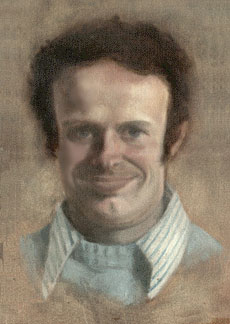
Many years ago I painted this
self-portrait in my kitchen, in Heidelberg,
Germany, (in oil, looking into a mirror)
before I lost much of my hair, not entirely
due to the effort required to create and
develop this museum.
At the bottom
of this page see a much later
self portrait as founder of this museum.
|
During World War II, in 1942, I was born in Long
Branch, New Jersey - Winslow
Homer, maybe America's greatest artist, once
limned the beach, famous in his time - where my mother
was waiting for my father to return from the war in
the South Pacific.
I attended nine schools in the twelve years before
high school graduation, including three high schools,
so peripatetic because of my father's career in the
Army. He was a colonel, an engineer, and a West Point
and Cornell graduate, who oversaw the construction of the largest building
in the world (the VAB), by volume, at Cape
Kennedy, Florida. My older brother and fellow artist,
George, long the leading caricaturist of the Army,
also graduated from West Point. My father's brother,
my namesake, wrote witty newspaper columns in Atlantic
City, New Jersey, and HIS father, Alexander Finley,
president of a five-state newspaper circulation
association, allegedly thought up the Miss America
contest. Muscular dystrophy crippled and at 21 killed
my little brother, Jim, who,
remarkably, loved to laugh - but wit helped him
tolerate the intolerable.
Read about what almost
broke me as a teenager but throws light
on the creation of this museum.
And read a bit about my mother ("And a
Letter From Your MUM to You").
Besides having a B.A. in philosophy from Johns
Hopkins - so what else could
I do but start a museum of menstruation?
- I dabbled in masters degrees in German, geology and
philosophy but woke up and fled to Europe before
finishing them to work mostly as an self-taught
artist. By the way, my older brother now earns much of
his living as a watercolorist and oil painter, in
Germany, Scotland and in the U.S.A., besides
voluntarily collecting and driving tons of medical
supplies and toilets to Ukraine in his spare time
(Rotary International gave him an award for that) and
founding the first Ukrainian solar energy
organization; he's illustrating a book about solar
energy for Ukrainian children. Recently he established
the American section of the town museum of Schwäbisch
Hall, Germany, (his wife's birthplace is nearby) and
contributed documentary footage to a German TV film
about the end of World War II. My brother has inspired
me since we were kids.
I clung to Germany 13 years, mostly as a graphic designer, cartoonist,
painter and illustrator, and in the 1980s
returned, with regret - still fresh - to the United
States, where I made graphics for the federal
government in Washington, D.C., until my retirement in
2004. Now I paint portraits, read, and work on MUM,
with the goal of establishing MUM again as a physical museum. (See much more of my art here.)
The histories of astronomy (especially spectroscopy
in the 19th and early 20th centuries) and medicine
fascinate me, as do languages (I read a few, speak two
and am teaching myself Japanese), cultural history,
art history, biography, painting (mainly faces),
creating picture-stories, making cartoons for people,
The New York Review of Books, The New Yorker, die
Frankfurter Allgemeine Zeitung, and sitting around,
dreaming stuff up. I usually walk miles every day.
Actually, if I had had the chance to pick my genes
and interests, I would now be creating classical
music, which I love, but haven't a tune's worth of
talent for.
Read more in my entry in Who's Who in America
and Who's Who in the World.
How does this qualify you to run a museum of
menstruation?
I had the nerve to create it, buttressed by my
interest in the cultural history of menstruation. And
I researched and constructed exhibits by trade. MUM
was my first Web site.
Before I started MUM, I had to decide if I wanted to
suffer the criticism it would of course bring (and
criticized I have been); the enterprise had to be
worth it. I've had no reason to regret my MUM,
although it's been very hard. (Read my plans
for the future public museum.)
Man muß sich
für eine gute Sache eben beleidigen lassen. -
Stefan Zweig
"One must be willing to suffer
insults for a good cause." (My
translation.) Stefan Zweig, Austrian Jew, the most
translated writer in the world in the late 1930s,
was a fabulous writer, especially of short
biographies. He killed himself before the war was
over, having fled from country to country to
country. He thought the Nazis would win.
and
"Ja, det er
[Martin Luther's] Storhed, at han var bange. En
nerveløs raa Børste,
en vild Landsknægstjael, en Fanatiker med Galskab
luende i
Øjene, sagtens træde op imod Kejser og Pave, men
det er
Stordaad af en Mand, der skælver af Frygt."
Translation below.
(From "Ved
Reformationsjubilæet," (1936) in Himmel og
Jord - Heaven and Earth - writings by
Kaj Munk, a Danish pastor, writer, and
playwright opposed to the Nazi occupation of
Denmark and murdered and dumped in a ditch in
1944.)
My translation:
"Yes, that's Martin Luther's
greatness, that he was afraid. A nerveless crude
fellow, a wild country bumpkin, a fanatic crazy in
his eyes, can easily rise up against emperor and
pope, but it's a great thing for a man
who shakes with
fear."
.....................................
Below:
Well, I've aged some, huh?
I submitted this oil self portrait, almost life size,
to the Smithsonian's National Portrait Gallery
portrait competition for 2015. (It did not make it to
the semi-finals, possibly because of the title: Self
Portrait of the Founder of the Museum of
Menstruation.)
Do you recognize the thing
hanging at right
and the white objects at left?
What's in my hand?
It's hard to stand still in front
of a mirror with
a cat digging her claws into
me.

© 1998, 2001, 2006 Harry Finley. It
is illegal to reproduce or distribute any of the work
on this Web site in any manner or medium without
written permission of the author. Please report
suspected violations to hfinley@mum.org
|