Belt topics
See how women wore a belt
(and in a Swedish ad). See a
modern belt for a washable
pad and a page from the 1946-47
Sears catalog showing a great variety - ad for Hickory belts, 1920s? - Modess belts in Personal Digest
(1966)
See a Modess True or False?
ad in The American Girl magazine, January 1947, and
actress Carol Lynley in "How
Shall I Tell My Daughter" booklet ad (1955) - Modess . . . . because ads (many
dates).


|

The Museum of Menstruation and Women's Health
|
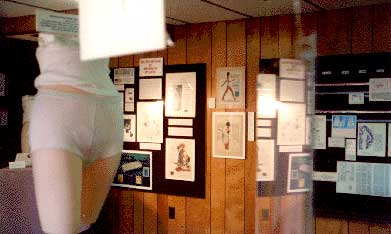
Welcome to the former interior of MUM - it
no longer exists - and tour part of it!
(See
another, much
bigger tour of the former
museum. And read a comic strip
- unfinished - about a fictional trip a
conservative family makes to this museum.)
Located in the basement of my house from the
end of July 1994 to August 1998, I designed
and built the only museum in the world devoted
exclusively to the culture of menstruation.
People around the world saw it on television, read about
it in publications and heard about it
on the radio.
I closed it because I
opened it to visitors almost every weekend for
four years; hosted
radio, TV, and video crews, almost
always using my vacation time; and worked a regular
job. I
was exhausted and desperate for free time
and was worried about someone's tripping on
loose carpet. AND I was worried about a
false charge of sexual harassment: I'm a
male. Neither cause for worry happened. Nine
months after closing I had to have coronary
angioplasty, although I don't know if that
was a consequence of the stress.
Read my plans for the future museum.
At top is part
of the wall showing some advertising history
from Europe and America, and a time line of
the development of menstrual protection.
The truncated lady at the left (truncation
saves money; MUM was built with the meager
funds of one average person) wears pad-holding
underpants from the 1970s, part of a large
gift from a Minnesotan. It was one of eight
mannequins at MUM.
The museum has expanded its collection to
include non-European
cultures.
Enjoy!
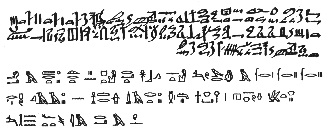
About 1550 BCE an
Egyptian described how lint (fetet) inserted
into the vagina could prevent conception (left).
Is this the first description of a tampon?
(Read a German MUM contributor's essay
about menstruation
in ancient Egypt)
MUM has copies of old Greek and Hebrew
inscriptions also describing the use of
tampons for contraception, which possibly
means that women also used material as tampons
to control menstruation.
The o.b. tampon
company (o.b. means
"ohne Binde," without a pad, in
German - read proof of this; it was a
German company before Johnson & Johnson
bought it) in its print
advertising has made much of ancient
Egyptian women using tampons (so have others),
but they couldn't tell me where they got the
information.
Consumer Reports
didn't reply to my letter when I
asked the the same question, after they had
repeated the same assertion in its last
article comparing pads and tampons.
But a friendly reader of this site reminded
me that Hippocrates wrote of tampon usage in
the ancient world, although about 1000 years
after the above Egyptian writing. As soon as I
get chapter and verse I will put what I find
here.
Helen King has written the most thorough discussion
of Greek menstruation and its tampons
that I've read here.
© 1998, 2014 Harry Finley. It
is illegal to reproduce or distribute any of
the work on this Web site in any manner or
medium without written permission of the
author. Please report suspected violations to
hfinley@mum.org
|
|