Belt topics
See how women wore a
belt (and in a Swedish ad).
See a modern belt for a
washable pad and a page from the 1946-47 Sears catalog
showing a great variety - ad for Hickory belts, 1920s? - Modess belts in Personal
Digest (1966)
See a Modess True or False?
ad in The American Girl magazine, January 1947, and
actress Carol Lynley in
"How Shall I Tell My Daughter" booklet ad (1955) - Modess . . . . because ads
(many dates).


|

The Museum of Menstruation and Women's Health
|
|
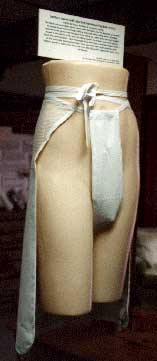
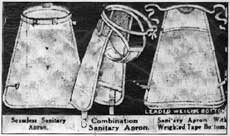
Imagine having to wear this sanitary apron (left)
to prevent menstrual blood from leaking to
your clothing! Sears, Roebuck offered this
and other models for many years in its
catalogs; this one is a facsimile of a
menstrual apron from the 1914 catalog (below). See more sanitary aprons.
Dr. Ann Wass,
who has created
costumes for the Folger Shakespeare
Theater in Washington, D.C., made this
menstrual apron on commission from MUM.
|
(Above) The menstrual
apron and pad holder in front are
cloth-covered rubber. The wearer pinned
absorbent cloth, such as bird's-eye diaper
cloth, onto the inner side of the holder. Of
course, the woman wore the whole contraption
"backwards," under her dress, and over her
buttocks, to keep the menstrual blood away
from her clothing.
A black American
visitor to MUM said that she knew of many
women today who would buy one! She said
black women tend to gush in the early days
of their menstrual periods.
|
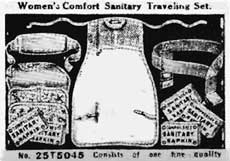
Sears offered at the same time a nifty traveling kit for
menstruation (below),
consisting of a simple apron, together
with several washable menstrual pads and
belts, and a waterproof pouch to carry
used pads so they could be washed when the
traveler returned home.
|
What DID women
do when they were traveling? In
1914 virtually every woman used cloth
menstrual pads; commercial
tampons for menstruation did not
appear until the late 1920s or early 1930s
(Tampax appeared about 1933), but they
were not popular. Apparently women either
(1) took the sanitary napkins home to wash
them (or used the facilities where they were
staying, but that seems problematic); or (2)
burned them in a fireplace in the room they
were occupying. There
were also special portable burners
available as early as the 1890s in England
specifically to
burn menstrual pads!
|
© 1998 Harry Finley. It is illegal to reproduce
or distribute any of the work on this Web site in any
manner or medium without written permission of the
author. Please report suspected violations to hfinley@mum.org
|