|


|

THE MUSEUM OF MENSTRUATION AND WOMEN'S
HEALTH
Is this the first Tampax
menstrual tampon? Or
the first menstrual tampon,
period? (Sorry.) (U.S.A., about
1931-33)
Below:
Boxes (1931-33) and two
newspaper ads (1934, bottom of
page)
Next
pages: Tampon,
tampon
unwrapped, and instructions
In May, 2005, a woman in Texas
wrote me that among the effects of
her 83-year-old mother-in-law, who
had just died, was an odd-looking
box of Tampax. She sent me a scan
of the front. Did I know how old
it was?
I knew that the first Tampax
Inc. was in Denver,
Colorado, and that city
appears on this box. Before I
consulted my own Web site (this
one) I guessed that one of the
patent numbers was for Dr. Earle
Haas's Tampax patent, his
"catamenial device" (catamenia is
a medical term meaning
menstruation).
Well, I wanted the box, which
seemed to predate the 1936 box of
Tampax (here)
that Tambrands itself had given me
as part of a huge gift of material
from its archives (read more here). I
offered to buy it and the owner
accepted.
But when I checked the patent
numbers I didn't find the famous
one, just two of Haas's earlier
patents from the 1920s. The words
on the box "OTHER PATENTS PENDING"
must have included the famous one
and meant that this box appeared
before the patent office had
approved it.
Whoopee! The box was older than
I thought, which I conveyed to the
delighted seller.
Here's
how I dated the box. Dr.
Earle Haas, Tampax's inventor,
stated to the U.S. Patent and
Trademark Office
(www.uspto.gov/) that he first
used the name Tampax in commerce
on 1 December 1931; the
trademark was granted on 14 June
1932. That office granted him
the "catamenial device" patent
for the two-tube menstrual
tampon on 12 September 1933
(#1926900, first page here).
So the box shown here must have
been made between those dates,
or shortly afterwards, since the
box does not show the number of
the Tampax patent (the two
numbers it shows are for a
similar device to insert powder
into body cavities). On 16
October 1933 he sold his patent
and trademark to a group headed
by Gertrude Tenderich, a Denver
businesswoman who immigrated
from Germany and who herself
would sell the Tampax company in
1936 after failing to make a go
of it because of lack of cash.
(Kimberly-Clark was thinking of
buying it but its sales manager
wrote that it would be "just
like throwing money right out
the window." [From "Shared
Values: A History of
Kimberly-Clark" by Robert
Spector, 1997, p. 67]) The buyer
would make Tampax successful
before selling out to Procter
& Gamble in the 1990s. (Most
of this information comes from "Small Wonder,"
(here),
the history of Tampax
commissioned by Tambrands.)
Earlier I believed that perhaps
fax tampon was the earliest
commercial tampon MUM had. Now it
looks as if Tampax not only is the
oldest in the museum, it is
probably the earliest American
commercial tampon of all. (But see
my 2006 considerations about Nunap
and fax here
based on a reading of "Shared
Values.")
|
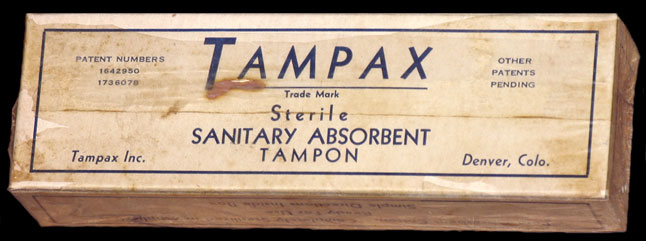 |
The cellophane
covering is discolored and ripped.
It looks as if something dripped
onto the package. The box
measures 5.5" long x1.75" high
x1.125 deep " (14x4.3x2.9 cm). The
color in the photo is pretty
accurate, the lettering being deep
blue - almost Kotex blue, a
favorite in the American
menstruation trade of the 1920s
(read about this here) -
and the box tan, which might be
the effect of oxidation.
The reverse side has identical
information and blue lettering.
I wonder why the package does not
mention the applicator, which was
the genius of Tampax. Maybe
because this was the first
commercial menstrual tampon and
the consumer would not have known
there would be a tampon without an
applicator - which characterizes
most of the early tampons (see fax,
for example, which didn't even
have a string to pull it out of
the vagina! And the fax
package calls its tampon an
"internal sanitary napkin,"
referring to something the user
would be familiar with, thus
declaring its early appearance.)
All images
copyright 2005 Harry Finley
|
 |
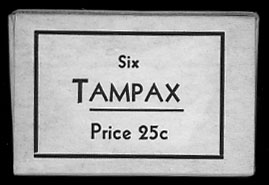
Both long sides (above)
have the same information and blue
lettering. (Black and white image)
|
|
|
Each tampon cost
about 4.2 cents, roughly what Lox would
cost at the end of the 1930s. A
little later other tampons were
much cheaper, like Tamponettes.
Both ends (above) have the same
information and blue lettering.
(Black and white image)
|
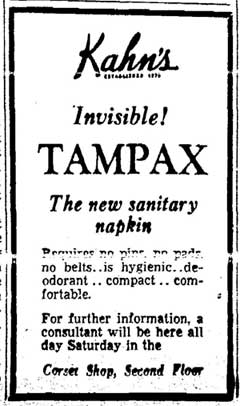 |
Above:
Newspaper ad from the
Oakland [Cal.] Tribune,
Friday, May 11, 1934,
bottom of page 9 next to a
perfume and toiletries ad.
Tampon
companies often called
their products sanitary
napkins since women
might not have been
familar with the word
tampon. I thank
very much a genealogy
researcher for this scan
and several others of
tampon ads! She wants to
remain anonymous.
|
|
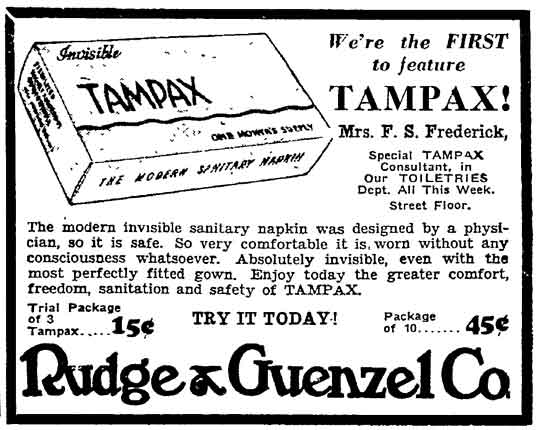 |
Above:
Newspaper ad from the Lincoln
[Nebraska] Star, October 24, 1934.
"[D]esigned by a physician, so it
is safe" plays on the trust people
had in doctors; the ad would not
have said that in the 19th
century, when patent
medicine companies probably
enjoyed a better reputation, and
maybe not today. And just as with
Wix tampons,
Tampax sent out Mrs. Frederick and
others to explain this wonder to
customers.
|
NEXT: The wrapped tampons -
the tampon
disassembled - instructions
© 2006 Harry Finley. It is illegal to
reproduce or distribute any of the work on
this Web site in any manner or medium
without written
permission of the author. Please report
suspected violations to hfinley@mum.org
|