Later Kotex tampons: Fibs (started 1930s)
and Comfortube
(1967).


|

The Museum of
Menstruation and Women's Health
Nunap and fax: the first
Kotex menstrual tampons?
Maybe the first commercial tampons
anywhere?
(Early-to-mid 1930s, U.S.A.)
Introduction
and boxes (below)
About 1997, I think, I held a contest
on this site, offering $500 to the
person coming up with the best
date for the fax tampon,
and another $500 to the person
sending photocopies of the most
advertising for fax (s)he
had found in publications of the
1930s (or whenever).
Boy, was I
excited! The ten-month or
so contest period drew down to the
final weeks. Contestants were
guarding their findings very
carefully, not wanting anyone else
to see what they had found and
thereby giving away any advantage
they had for that 500 bucks! I knew that
because so far I had not
received any entries.
Well, the date for submission of
entries came and went. No one sent
a thing. No one even tried,
apparently, because I got no
e-mail saying, "I looked and
looked! Are you kidding? Was fax
even on the market?"
I write this partly to explain
the uncertainty of the date for fax
(and Nunap), partly to vent at the
possibly easy money that had lain
there for someone, and finally to
complain that maybe no one was
even looking at this site! I'm
still mad.
I've now
calmed down and feel better.
Thanks, thanks, for your
sympathy. No, no, that's enough.
Stop. I'm OK.
I had always assumed that Fibs,
which appeared in the late 1930s,
was the first Kotex tampon - does anyone
else even think about these
things? - but I
believe our two tampons of the
hour may have been the first, or
at least very early ones. At the
time of the contest, I believed
that fax might have even
been the first commercial tampon.
And now - February 2006 - I read
in "Shared Values: A History of
Kimberly-Clark" by Robert Spector
(1997), which K-C (the maker of
Kotex) sent me in thanks for doing
research for them, that Fibs was
indeed its first tampon - at least the
first one it mentions by name.
But in the early 1920s
(according to the book) a young
Kotex employee stuffed a condom
with Cellucotton (cellulose), the
business part of Kotex, punctured
the sides of the condom and
suggested selling it as a tampon.
He showed his father, the first
medical consultant for Kotex. The
physician was "aghast" and told
him to not show anybody because of
potential legal problems. (K-C
confessed it made a huge mistake
by not buying Tampax when it was
offered by Gertrude
Tenderich about 10 years
later.)
Kimberly-Clark, the company that
allegedly created Kotex from
left-over bandages they made from
Cellucotton (cellulose) for World
War I American soldiers (read
their first
ad), started the Cellucotton
Products Company (in Chicago) to
make and sell Kotex rather than
associate the K-C name with
menstruation. Later, they wrote on
the side of the Fibs box
"sponsored by the makers of
Kotex," again distancing
themselves from the tampon in a
curious way.
I don't know why they did it -
to test the market without
involving the names of K-C or
Kotex? - but my feeling is that
K-C created two companies, Neway
Manufacturing Company, and
Sanitary Products Company, both in
Chicago with the same address -
both had "south" preceding the
street name, as did the address
for Cellucotton Products Company -
to make Nunap ("new napkin") and fax.
(A listener to the Howard
Stern radio show I was on a
few years back suggested that the
name referred to the word "facts"
on some advertising for it, not
reproduced here.) I think I show
convincingly that both tampons
used Cellucotton for the tampon
plug (the part that's supposed to
absorb the menstrual blood.) For
example, look at the crepe-like
material in both tampons, here;
the book refers to the "creped
wadding material that went into
Kotex pads" (p. 67). The
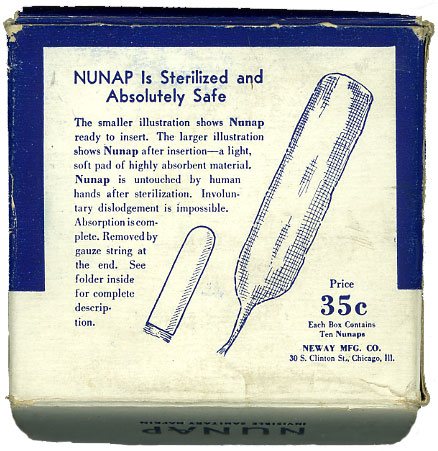
instructions on Nunap say it does
use Cellucotton (here)
and the instructions for fax
say the product is made of
cellulose (here),
which
is what Cellucotton is. It could
be that the two companies
represent two attempts at
different times to market a Kotex
tampon.
(As
I've said later, the addresses
for perhaps the world's first
commercial tampons years
afterward - I suspect from
Kotex -,
Moderne
Woman, Nunap
and
fax, are all today
within 9-15 minutes
driving distance of each other
and of the address on this ad
(at bottom),
as was at least one
other Chicago Kotex pad
address in 1922.
The tampon company names are
not associated with
Cellucotton Products Company,
Kimberly-Clark or Kotex.
All are within a tight
radius in Chicago.
Who was the master behind
these innovative products?
Um, Kimberly-Clark I bet.)
You'll see in the instructions
how the companies explained to
women what tampons were, and to
reassure them. These tampons were
essentially little Kotex pads they
inserted into their vaginas - at
least that was the pitch.
And like Kotex pads they had
very coarse gauze, and even no
string, features indicating to me
their position at the very
beginning of the development of
commercial tampons. (The company
repeated its gauze mistake in
making Kotams.)
(Modess pads early on also used coarse gauze.)
The
Procter & Gamble company
generously donated the Nunap
box to the museum as part of a
fabulous larger gift;
and a woman living near
Chicago, who wanted to remain
anonymous, gave the museum the
fax box as well as many other
early tampon items.
|
|
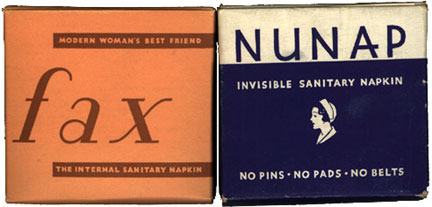
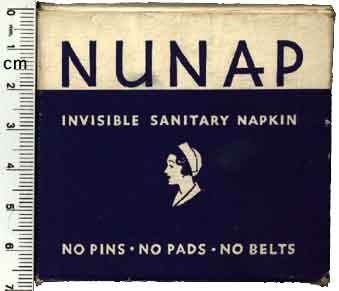
The boxes are the
same size and from the same
company and have identical
tampons, except that Nunap is
slightly larger.
|
|
|
|
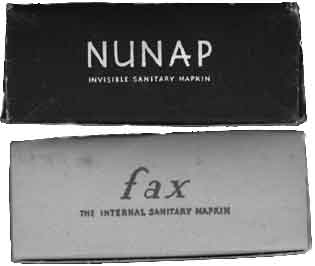
Above:
The bottoms of the boxes.
|
|
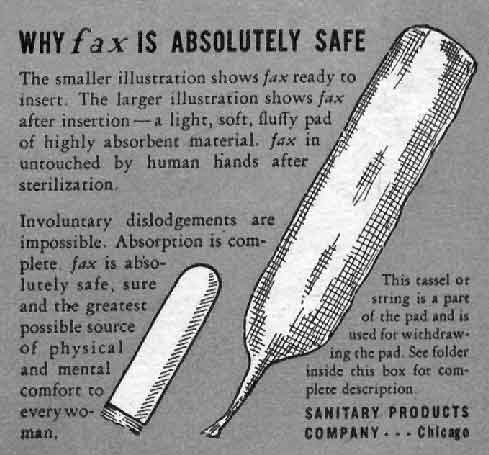
The back of the fax
box, above.
There was no separate folder in
the box; instructions appeared on
the two paper bags inside, each
containing five tampons (see instructions).
Compare the back
of the Nunap box, below.
|
 |
|
© 2006-8 Harry Finley. It is
illegal to reproduce or distribute
any of the
work on this Web site in any
manner or medium without written
permission
of the author. Please report
suspected violations to hfinley@mum.org
|
|