Later Kotex tampons: Fibs (started 1930s)
and Comfortube
(1967).


|

Nunap and fax: the first
Kotex menstrual tampons?
(early-to-mid 1930s, U.S.A.)
The tampons
The Procter & Gamble
company generously donated the
Nunap box to the museum as part
of a larger gift;
and a woman living near Chicago,
who wanted to remain anonymous,
gave the museum the fax box as
well as many other early tampon
items.
|
|
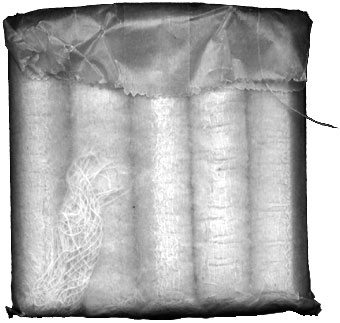
Above:
Each Nunap
box held two of these translucent
packages of five tampons each.
|
|
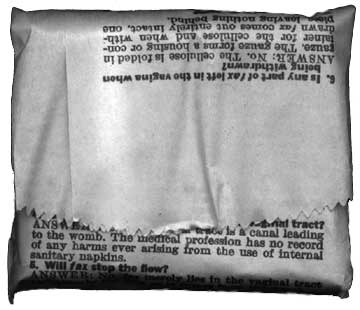
Above:
The fax
box contained two of these
packages, paper folded over, on
which the user read the
instructions (readable
view).
|
|
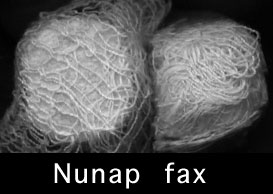
The ends of the
tampons look similar.
|
|
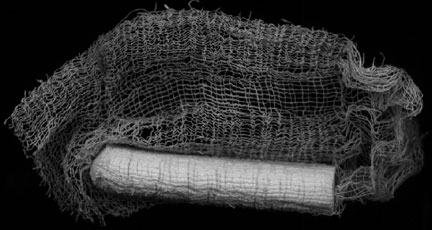
I peeled part of
the gauze covering off the Nunap.
Pads of the time often had a
similar gauze covering that women
complained about and mentioned in
the Gilbreth
report.
|
|
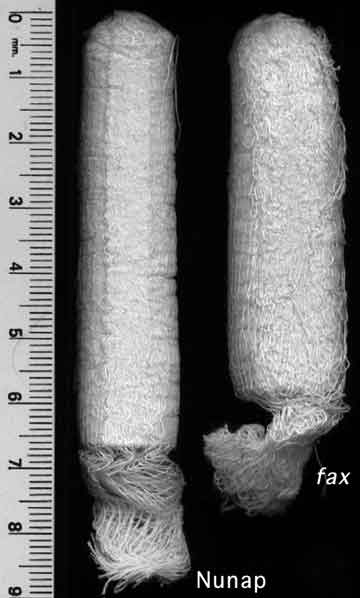
Nunap is a bit
longer. The user pulled on the
loose gauze at the bottom to
withdraw the tampon. The gauze
"string" on the fax is
about 4 cm. ( about 1.5") long
(about the length of Nunap's),
much shorter than the usual string
of today.
|
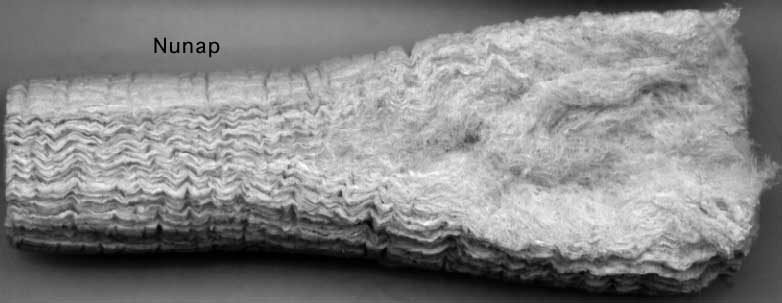
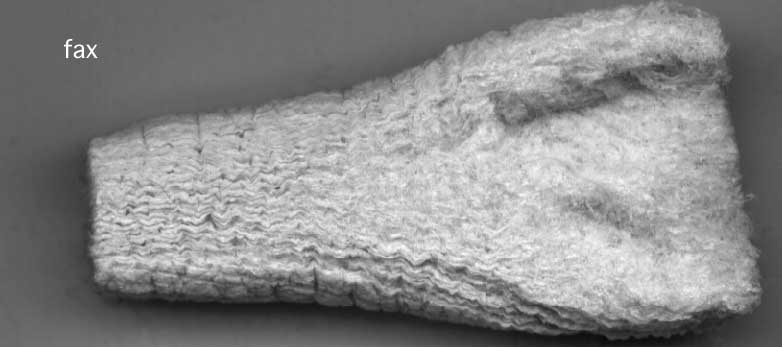
Below:
After taking the gauze
off, both 'pons look
similar, leading me to
believe that fax
in fact is also made of
Cellucotton (cellulose),
the absorbing component
of Kotex and made by
Cellucotton Products
Company, which
Kimberly-Clark created
to sell Kotex. In effect
they
are little Kotex pads
inserted into the
vagina.
What convinces me is the
crepe-like
material in
both tampons; "Shared
Values: A History of
Kimberly-Clark"
(by Robert Spector,
1997) refers to the
"creped wadding material
that went into Kotex
pads" (p. 67).
Cellucotton also
comprised another K-C
product, Kleenex. And
see creped
wadding in the K-C
company history, Four
Men and a Machine.
|
|
|
|
|
© 2006 Harry
Finley. It is illegal to
reproduce or distribute
any of the
work on this Web site in
any manner or medium
without written
permission
of the author. Please
report suspected
violations to hfinley@mum.org
|
|
|