See the fax tampon and the almost
identical tampon Nunap sold probably about
the same time, both probably made of
Cellucotton, the component of Kotex.
See other marketing
devices: Ad-design contest for
menstrual products in the United Kingdom; B-ettes tampon
counter-display box and proposal to dealers,
with contract; (U.S.A., donated by Procter
& Gamble, 2001); "Your
Image is Your Fortune!," Modess
sales-hints booklet for stores, 1967
(U.S.A., donated by Tambrands, 1997)


|

fax menstrual tampon clip
sheet for publications
(early-to-mid 1930s, U.S.A.)
Clip
sheets enabled people who
created newspaper and magazine
pages to cut out ads supplied by
companies and paste them onto
the make-up pages, from which
plates were made, which in turn
printed the pages you held in
your hands. Clip sheets
gave companies control over their
advertising and lightened the work
of the publications, especially
when the advertiser gave the
printer ads made to fit many
different column sizes, as you see
below. For most publications
computers made clip sheets
obsolete.
Why the name fax? (See
the tampon
and read more about it.) A woman
who listened to Howard Stern's
radio interview with me in 1998
came up with an intriguing
explanation, that it's a kind of
acronym for Freedom,
Comfort, Convenience (FCC), words on a fax counter
display.
The great Renaissance Italian
printer Aldus Manutius invented
italic type and also the small,
octavo-size book (possibly the
spiritual ancestor of the pocket
book today), which made books more
portable. Italic type, based on
Greek handwriting, looks thin and
therefore small. I wonder if the
reason fax is always
italic and never capitalized is to
emphasize its smallness as
compared with the menstrual pads
of the 1920s and 1930s (for
example, Modess),
fax's main competitors,
which were thick and large, much
bigger than today's pads.
One thing that amazes me is the
sophistication of the pitch to
retailers, which I once thought
had more modern origins. But early
Kotex
campaigns showed similar
sophistication, showing the
mercantile minds of Wallace Meyer
and Albert Lasker, the latter also
responsible for naming Planned
Parenthood, for first using the
word cancer on the radio and for
being an inspiration behind the
National Institutes of Health and
the Lasker Awards in medicine,
America's highest.
Finally, look at the words
"wear" and "sanitary napkin."
"Wear a pad" probably is more
common today than "wear a tampon,"
and I believe the tampon's newness
meant that an old vocabulary was
necessary to describe the
innovation, just as the words
"internal sanitary napkin" (below)
attest to the date of fax;
"tampon" appears nowhere on this
sheet, even though it's possible
the menstrual tampon derived from
the tampon doctors used for
centuries to insert into body
orifices to deliver medication or
absorb fluids. But probably few
women would have known the word,
or would have had only a medical -
disease - association with the
word.
In 1995, a woman who wants to
remain anonymous donated the sheet
together with boxes of fax,
Fibs, Wix (see early tampons)
and other tampons and advertising
material after having read about
this museum in the Chicago Tribune
newspaper. Her father, who had
worked for Kotex, left the
material, which she found in her
mother's belongings after she
died.
Click on
the page you want enlarged.
|
|
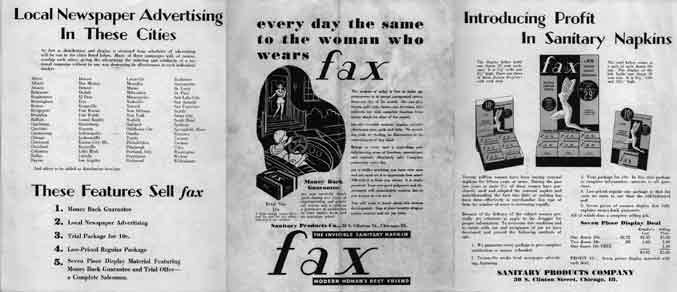
Side 1
|
|
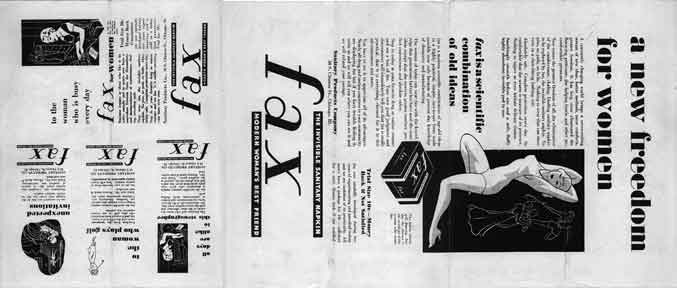
Side 2
Click on the page you want
enlarged.
The two folds on sides
1 and 2 don't line up
because I trimmed the
the pictures of the
sheets (not the real
sheets). Both sides are
printed on coated (heavy
and semi-shiny) paper in
dark brown ink, with
orange added on the
upper right page
("Introducing Profit in
Sanitary Napkins"). The
sheet measures 10.9" x
25.5" (27.7 x 65.1 cm)
and folds into thirds.
Advertising folks at
publications could cut
out the ads on side 2;
the ones at the left
were designed probably
to fit single and double
newspaper columns of the
time. Clip sheets were
common before computers
took over publications
because ads supplied by
companies could be cut
out and pasted into page
layouts, then
photographed, enabling
plates to be made to
print the newspaper or
magazine. Small
publications probably
still do this (2001). As
an art director and
graphic designer I had
done it both ways.
|
|
|
©2001 Harry Finley. It is
illegal to reproduce or distribute
work on this Web site in any
manner or medium without written
permission of the author. Please
report suspected violations to hfinley@mum.org
|
|