Marjorie May, three booklets, 1935 main page
See a Kotex ad
advertising this booklet.
See Kotex items: First ad (1921;
scroll to bottom of page) - ad 1928 (Sears and Roebuck catalog)
- Lee Miller ads
(first real person in a menstrual hygiene ad,
1928) - Marjorie May's
Twelfth Birthday (booklet for girls, 1928,
Australian edition; there are many links here to
Kotex items) - Preparing
for Womanhood (1920s, booklet for girls;
Australian edition) - 1920s booklet in Spanish
showing disposal
method - box
from about 1969 - "Are you in the know?"
ads (Kotex) (1949)(1953)(1964)(booklet, 1956) - See
more ads on the Ads for
Teenagers main page


|

THE MUSEUM OF
MENSTRUATION AND WOMEN'S HEALTH
Growing Up
and Liking It
(Final
Part)
A Primer of
Period Pedagogy, 1868 - 1996
by Lynn Peril
|
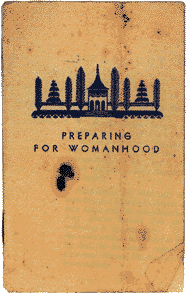
ABOVE: A menstruation education
booklet by Kotex from Australia,
probably from the 1920s, shown here by
the kind
permission of the Curator of Health
and Medicine at the Powerhouse
Museum, Sydney, Australia.
(Please direct any further enquiries
to Megan Hicks at meganh@phm.gov.au) Click to see
more of the booklet.
|
A decade later, Mary McGee Williams
and Irene Kane took up this line of
argument with a vengeance in On
Becoming a Woman (New York:
Dell Publishing, 1958; some thrift
stores for not very much money).
Employing the just-between-us-girls
technique we've already observed, the
authors ask, "So what's so joyful?
Well, let's stop and think what
menstruation . . . means." Which
sounds oh-so-cozy, except that what it
means, according to Williams and Kane,
"is that for perhaps the first time in
your active, tomboy life, you must
accept that you are a girl":
For most girls, this acceptance is
an exciting, who-wouldn't-want-to-be
kind of thing, something you've
looked forward to since you saw your
mother nursing a baby brother, or
dreamed about a kitchen of your own,
or imagined yourself a well-loved
wife . . . .
The girls who resent menstruation,
who talk about "the curse" and the
bother of "being sick," who get all
mixed up about this time in their
lives, are those who may have emotional
doubts about being a woman . . .
.Here's a time for some real
soul-searching, if you find yourself
deeply disturbed about being "stuck
with" the role of a woman. It's a time
for re-evaluating the role of women in
the world.
Do not, for an instant, imagine this
was a feminist re-evaluation of
women's role:
When you know the deep, true love
a woman feels for a man, when you
experience the tremendous joy of
comforting, sustaining and
understanding a man you love, when
you know the happiness of childbirth
- you will be acting the role you
were created for. To know this
fulfillment, you must want it, learn
about it and be ready for it. The
teen years are the perfect time for
learning to be a woman . . . for
turning from dolls and and sandlot
ball games to the feminine skills of
cooking and sewing and prettying
yourself (for this too is a feminine
art). It's the time to practice the
feminine role of the woman pursued
by a man - by your first dating
experience, by practicing your newly
discovered womanliness on boys your
own age.
|
Now, who could possibly feel
"disturbed" about that, unless it was
one of those female inverts discussed
in an earlier chapter ("Teen Age
Crush") or some kind of heathen
communist. Few materials were as
explicit as On Becoming A Woman
in delineating the adult sex roles
that girls would be expected to to
fill once they started menstruating.
But most hinted that the menarche was
the great demarcation between girlhood
freedoms and the restrictions placed
upon adult women.
Like the other manufacturers of
feminine hygiene products, Tampax
viewed the classroom as an incubator
for consumers, and in 1958 produced a
teacher's guide on menstruation and
"menstrual health" called From
Fact to Fiction ($2.50 at The
Magazine). Allegedly "written in
response to countless requests from
teachers," From Fact to Fiction
describes itself as "a workable
teaching guide for all who are helping
girls grow into healthy womanhood." To
this end, FFF focused on
"fiction" (menstrual "superstitions
and taboos" of "Primitive people")
versus "scientific facts"
(particularly the development of
Tampax-brand tampons, started in 1936,
as the apex of sanitary protection). FFF
(and one would assume, the students'
booklet, It's Natural, It's
Normal) broke little new ground,
stressing that menstruation's "purpose
is to prepare the body for the
biological function of all women -
reproduction," and the need for a girl
to accept "herself as a growing
woman." It did, however, include
something that few other guides dared
to - a drawing of the external female
genitalia that showed the location of
the clitoris. (Unfortunately, I don't
have a copy of It's Natural, It's
Normal to see if the little
troublemaker was pointed out to
students!) Nevertheless, it was soon
back to the same-old-same-old in the
section entitled "typical questions
your students may ask," a
disproportionate number of which
concerned tampon usage.
Similar sales tactics were employed
in the 1966-67 edition of Modess's Growing
Up and Liking It booklet.
"You'll feel more confident if you
know you can trust your sanitary
napkin," it told readers, "see pages
20 and 21 for more information on
choosing the right sanitary protection
for you." These pages - surprise! -
advertised Modess's product line,
including a "Teen-Age" size which
purported to be "narrower-shaped to
fit younger figures." All totaled, GUALI
devoted four full pages to advertising
Modess products and provided
coupons for a "Sanitary Napkin Purse
Kit" or more copies of the booklet
itself.
Along with its shameless promotion
of Modess products, GUALI
displayed characteristics common to
most pamphlets produced by
manufacturers of feminine hygiene
products during the 60s. "This is what
you've been waiting for," it cooed as
it assured readers that "someday when
you fall in love and marry, you will
want to have children." Menstruation
was "part of being female . . .part of
growing up . . . part of the wonderful
process of changing from a child into
a woman." And, in a fit of perkiness
probably not matched before or since
in menstruation education materials,
it boldly declared just inside the
front cover that "the fun is just
beginning!" - leading me to doubt that
the author ever menstruated. Photos
depicted teenage girls dancing,
shopping, playing ping-pong, hanging
out with other smiling teens at the
beach. Everyone fairly glowed with
happiness imparted by proper menstrual
education. Additional illustrations
showed cross-sectional views of the
uterus, ovaries and fallopian tubes,
and represented the ova's monthly
meanderings. Good grooming and proper
diet were discussed, and it showed a
series of exercises for "shaping up
and staying that way," as well as to
provide relief from cramps (though the
text constantly minimizes both their
severity and occurrence). Finally, GUALI,
like most booklets, included a
calendar where girls could plot their
periods.
The women's liberation movement of
the late 60s left little, if any,
immediate mark on menstrual education
pamphlets. After 1970, GUALI
may have no longer suggested that the
fun was just beginning, but
nevertheless proclaimed that "it's
wonderful being a girl . . . And even
more wonderful to become a woman." The
booklet also advertised Modess's
"award-winning film, 'It's wonderful
Being a Girl'," in which Libby and
Jean, two close friends, help each
other to understand about growing up."
Otherwise, most of the earlier text
was retained, although Modess bowed to
changing mores by including a black
girl on the cover, and tried to get
hip with a photo of a white girl
playing twister.
Kotex, on the other hand, was quick
to incorporate new ideas and lingo
into Very Personally Yours.
While the 1973 edition (by the way,
this was probably the the same edition
of VPY that I got at school
and later threw away in a fit of
shame) is pretty much interchangeable
with GUALI, the products
advertised in the booklet include
Kotex's nod to the women's movement -
New Freedom, the "revolutionary
self-attaching napkin." If that wasn't
enough to seal the company's "with it"
status, girls could order a "tampon
introductory kit" that came with a
booklet called Tell It Like It Is.
The "revolutionary" nature of the
New Freedom napkin aside, the sanitary
products industry was slow to come to
grips with changes in social attitude
brought about by the women's movement.
They were hastened along by books like
Period (San Francisco: Volcano
Press, revised edition, 1981;
Community Thrift, $1.00). Written by a
health educator and a clinical
psychologist, Period presented
menstrual information in a radically
different way from its predecessors.
Instead of gushing about the
wonderfulness of womanhood, impending
marriage and motherhood, Period
explained adolescent bodily changes in
a down-to-earth manner, neither
talking down to its audience nor
assuming an artificial intimacy. On
the other hand, Period also included
life-size diagrams of girl- and
woman-size uteruses, which the text
suggested readers cut out and "hold .
. . up to your stomach . . . [to] get
a better idea of how big your uterus
is." (You know, I just can't help
thinking that if a young Ed Gein only
had access to Period's
cut-outs, his victims might be alive
today.)
Period was so influential
that Kotex actually listed it as
"Recommended Further Reading for
Parents and Daughters" in Becoming
Aware - their menstrual
educational booklet for the 1990s. At
first glance, the 1992 edition of Becoming
Aware bears little resemblance
to Very Personally Yours. BA's
narrator is 12-year-old Sarah, who's
bummed out because she hasn't gotten
her period yet. Then her best friend,
the motherless Roxy, gets hers. This
leads to a wacky sit-comish situation
when Sarah's mom, Mrs. Schuler,
catches Roxy and Sarah rummaging
through her "off-limits closet shelf."
Of course, everything ends happily
with hugs and Kotex-brand panty-liners
for everyone. Nevertheless, if you
overlook the TV movie quality of the
writing, Becoming Aware offers
less advertising and more information
than Kotex's earlier pamphlets. In
fact, if I had read Period and
Becoming Aware, I would have
been better prepared - intellectually,
at least - to face my own menarche.
I wonder how many young women
anticipate menstruation the way the
girls in these books and pamphlets do
- with barely concealed enthusiasm? As
for myself, I related to a character
in The Long Secret, Louise
Fitzhugh's sequel to Harriet the
Spy. Beth Ellen wakes up one
day feeling "extremely odd." She goes
to the summerhouse and sits alone in
shameful silence. "It was all a
mistake," she thinks. "She would get
up, go inside, and know it was all a
dream." Later, she and her friends
decide the only advantage menstruation
might offer is the possibility of
skipping gym. I doubt that the shame
Beth Ellen felt about her changing
body would have been assuaged by Very
Personally Yours 's saccharin
assurances. I know mine wasn't. END (Click for Part
1 and Part
2)
Mystery
Date costs $1.50 each for
the five so far. Order from
Lynn
Peril, P.O. Box 641592, San
Francisco, CA 94164-1592
and this is the Mystery
Date
Web site.
|
|