Marjorie May, three booklets, 1935 main page
See a Kotex ad
advertising this booklet.
See Kotex items: First ad (1921;
scroll to bottom of page) - ad 1928 (Sears and Roebuck catalog)
- Lee Miller ads
(first real person in a menstrual hygiene ad,
1928) - Marjorie May's
Twelfth Birthday (booklet for girls, 1928,
Australian edition; there are many links here to
Kotex items) - Preparing
for Womanhood (1920s, booklet for girls;
Australian edition) - 1920s booklet in Spanish
showing disposal
method - box
from about 1969 - "Are you in the know?"
ads (Kotex) (1949)(1953)(1964)(booklet, 1956) - See
more ads on the Ads for
Teenagers main page


|

THE MUSEUM OF
MENSTRUATION AND WOMEN'S HEALTH
Growing Up
and Liking It
(Part 2)
A Primer of
Period Pedagogy, 1868 - 1996
by Lynn Peril
 |
One volume in the series, "What A
Young Girl Should Know," was still in
print in 1936 having undergone few, if
any, revisions from its original 1898
edition. Its author, Dr. Mary
Wood-Allen, set the pace for
menstruation instruction materials for
years to come. Written in an insipid,
pseudo-intimate tone, the narrative
cozies up to the reader posing as a
long-lost best friend, while the
chapters take the form of "Twilight
Talks" between mother and daughter.
Little brother's arrival causes Nina
Grant to wonder where babies come
from, which leads mother to expound
upon plants, animals and finally
humans. Unfortunately, mother tends to
long-windedness, droning on about how
before "1810 there were no varieties
of pansies, but by 1835 four hundred
varieties had been produced by
selection and cultivation." Nina and
the reader perk up during Twilight
Talk XVII, when Mrs. Grant lets it
slip that "Certain bodily changes must
take place in order that you may be a
woman." She explains that Nina might
experience "a strange weariness,
perhaps a headache or a backache" as
she approaches puberty.
But this only means that Nina is
"getting to be a woman." In fact, Mrs.
Grant points out that "a little
housework is a very good occupation"
for weary, achy adolescent girls, and
offers the following homey remedy for
PMS: "Dishwashing is especially
beneficial as the hot water calls the
blood to the hands and so helps to
relieve the headache or backache."
|
At the critical moment, however,
Mrs. Grant drops the buck, cryptically
telling Nina that "there are some
physical changes which take place at
puberty of which I will more fully
tell you as the time approaches." But
she has many other important things to
tell Nina right now. For example, "the
battle of Waterloo was lost because of
a badly cooked dinner and a consequent
indigestion. You see it is possible
that the fate of a nation might depend
upon a woman's ability to prepare a
wholesome meal." Shades of home
economics texts to come! (See Mystery
Date #2)
*What A Young Woman Ought to Know*
continues the story, albeit without
Mrs. Grant and Nina. And no wonder Dr.
Wood-Allen didn't let Mrs. Grant tell
Nina the details of menstruation at
her young age! According to Dr.
Wood-Allen, menstruating women
shouldn't consider themselves
semi-invalids or be "fussy" about
their person, but should nevertheless
"remember that at this time the uterus
is heavy and engorged with blood and
therefore susceptible to become
congested by cold or undue exertion."
Come to think of it, my womb's feeling
a mite stuffy right now.
As in the earlier work, there's a
good dose of moralizing, and readers
were warned that a young woman who
permitted "caresses and unbecoming
familiarity . . .may be directly
responsible for arousing a passion in
the young man that may lead him to go
out from her presence and seek the
company of dissolute women, and thus
lose his honor and purity." Dr.
Wood-Allen did not, however, advocate
that these young men run home and wash
dishes, the better to draw blood away
from certain pesky body parts.
Later authors advocated telling
younger girls the facts about
menstruation. "The Mother's Book" (New
York: The University Society, 1927;
St. VdeP, S.F., $1.00) included a
section on What Mothers Should Tell
Their Daughters, in which author Della
Thompson Lutes bluntly described the
"perils of ignorance":
I knew a girl whose mother had
neglected to tell her anything
regarding the menstrual period. The
girl was of a reticent, solitary
disposition, had never been on
intimate footing with other girls,
and had never heard any mention of
what would happen. She was "kept
innocent" with a vengeance. The
menstrual flow came on suddenly and
very profusely. The child was
frightened, went into hysterics and
then convulsions. It took her three
years to recover, and then she was
nervous and excitable as she had
never been before.
I knew another girl who also was
"kept innocent." When her time came
she went to her room, bathed in cold
water, took cold and died.
Then Ms. Lutes provided a narrative
wherein a "Girl of About Ten" learned
all about "The Monthly Sabbath" from
her mother. After explaining about
fish, birds, kittens and
"seed-babies," mother takes a step up
the evolutionary ladder:
"It's a wonderful story, isn't it
dear?"
"Yes, mother. And is it just the
same with babies?"
"Just the same - only more
wonderful and beautiful . . . The
uterus is filled with tiny
blood-vessels which will feed and
nourish the baby's body from the
mother's body. But when there is no
baby ... there is no use for this
surplus blood, so nature has taken
care of it by passing it out of the
body every month, or about
twenty-eight days. This is called
the menstrual flow. It begins when a
girl is about twelve years old, or
sometimes a year or two later.
Before this a girl could not be a
mother."
Which, barring the wonderfulness
factor, seems somewhat straightforward
and informative. Then, not more than
two pages later, all hell breaks
loose:
[The mother] has taught her
daughter the sacred office of the
genital organs, and that to tamper
with them will bring upon her
slavery to a habit, undermining of
health and vigour.
She has taught her how to care for
herself during the menstrual period;
not to get her feet wet; not to
allow the bowels to become
constipated; not to over-exercise;
not to read too much [!!! - ed.],
nor dance or play tennis unless she
is a very normal girl indeed, which
the majority of our girls are not .
. .
Well, you get the idea.
According to Harry Finley at the
Museum of Menstruation, a disposable
menstrual pad was available as far
back as 1896 [Hartmann's?, here]. Few
publications would advertise Lister's
Towels, however, and they soon
disappeared from the market. It wasn't
until 1921 that Kotex marketed the
first widely successful sanitary
napkin, after World War I nurses
discovered that bandages made from
wood pulp made a menstrual pad that
was both absorbent and cheap enough to
be disposable [ad here].
Prior to this, women used strips of
fabric toweling which they washed and
re-used (see
note 3). Think about that. Now
let's pause a moment to thank those
inventive nurses of the Great War!
At any
rate, Kotex wasted little time in
producing several booklets aimed at
young girls and their mothers. During
the mid-1930s, Marjorie May Learns
About Life and its companion
booklet, Marjorie
May's Twelfth Birthday (both
by Mary Pauline Callender) were
available by mail from the
International Cellucotton Products
Company of Chicago, Illinois. MMLAL
explained the facts of life, not of
menstruation; the
information revealed to Marjorie May
on her Twelfth Birthday was imparted
in much the same chatty manner. Using
the same tried and true narrative
technique as its predecessors, MMLAL
allowed readers to eavesdrop as
Marjorie May and her mother ask Mrs.
Sherman and her baby "in for a cup of
tea [and] sunshine cake." Soon Mrs.
Sherman and child depart, gorged on
goodies, and the subject of "where do
babies come from" arises.
While the booklet more or less
answered that question, MMLAL served
most importantly as an advertisement
for Kotex products. "When I was a
girl," narrator/author Callender
intones, "it was no wonder that
menstruation days were annoying. We
didn't have Kotex then, and we didn't
have the narrow, invisible Kotex
Belts." Of course, while Kotex was a
great step forward in convenience,
then as now there was little to
differentiate one feminine hygiene
product from another. They all
basically performed the same function
in the same way. Thus manufacturers
had to find other ways to instill
brand loyalty in consumers. One result
of this need was the drive to "get 'em
while they're young," via specialized
advertising that masqueraded as
"information" which every girl needed
to know.
By the 1940s, Kotex was advertising
its free booklet, As One Girl to
Another [here],
in teen magazines such as Miss America
and Calling All Girls. "To A Lady In
the Dark," began one 1944 ad, "Why be
in the dark about the do's and don'ts
of 'difficult days'?" Of course, all
the reader had to do was clip and send
the accompanying coupon for a copy of
a "fact-crammed handbook" which
provided the low down on "bathing,
dancing, swimming, sports at certain
times of the month." More importantly,
it promised to set the reader "right
on social contacts; mental attitude."
And if that wasn't enough, the ad told
girls that using Kotex "improves your
poise." Alas, just how the sanitary
napkins went about doing this was
never adequately explained.
The connection between "poise" and
hygiene was also made in another
series of Kotex ads. Each featured
several quiz-type questions and an
accompanying illustration. Oddly
enough, whatever the question, Kotex
brand sanitary napkins somehow figured
in the answer. Table-seating etiquette
decreed that ladies be seated across
from one another. Thank goodness they
didn't have to worry about "tell-tale
outlines . . . thanks to those special
*flat pressed ends*." "Jilted janes"
could "fight off 'calender' blues,
too, with the self-assurance" Kotex
brought.
Kotex's competitor, Modess, also
advertised a booklet aimed at
pubescent girls during the 40s. A
series of ads boldly asked "True or
False?" and featured a period-related
statement for readers to ponder. The
answer was provided, and the reader's
attention drawn to a coupon at the
bottom of the page, by which she could
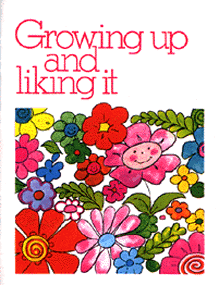
receive a copy of Growing Up and
Liking It [complete booklet,
1944]. Like Kotex's booklet, GUALI
promised "fascinating tips on beauty,
poise and health," in addition to
information on menstruation. While the
booklet itself may have provided more
than re-hashed old wives' tales, at
least one ad suggested that "most of
us find [roller-skating] too strenuous
for the first few days of the period."
Girls who weren't out roller-skating
could read a special article in the
October 1948 issue of Calling All
Girls. "What Girls Want to Know" was
written by a practicing psychiatrist,
Dr. Marynia F. Farnham, co-author of Modern
Woman: The Lost Sex (a work
whose thesis, by the way, was that
"contemporary women ... are
psychologically disordered"). Not
surprisingly, considering the way in
which periods and "poise" were
intertwined in the menstrual
literature, the article appeared in
Calling All Girls' "Teen Beauty
Issue." "Menstruation," according to
Dr. Farnham, ". . . is not the bane of
your existence, the 'curse' as some
girls call it, but a singular
blessing." After discussing the
mechanics of the menstrual cycle, as
well other physical changes
accompanying adolescence, Dr. Farnham
concluded that "the basic event which
indicates the deep and important
changes in the body - your menses -
remain as a regular part of your life
for as long as you are young enough to
have children. It is the key to the
crowning achievement of your
marriage." (Click here
for the final part)
See more covers of Growing Up
and Liking It booklets.
NOTES:
3. In
fact, Lizzie Borden told police she
had gone down to the basement the
night after her parents' murder to put
used menstrual clothes to soak in a
bucket of cold water. This evidence
was considered to be of such a
delicate nature that both prosecution
and defense agreed not to discuss it
during the ensuing trial.
Mystery
Date costs $1.50 each for
the five so far. Order from
Lynn
Peril, P.O. Box 641592, San
Francisco, CA 94164-1592
Her e-mail is peril at
sirius.com
and this is the Mystery
Date
Web site.
|
|