|
HOMEPAGE


|

Italian washable
menstrual pad, probably from the
1890s
In 1998 an American woman living
in a villa in Italy e-mailed me,
saying she and her hostess, a countess,
had opened a trunk in the laundry
building next to the main house
and found the clothing of a
turn-of-the-century ancestor of
the count, her husband.
Among the clothing of this
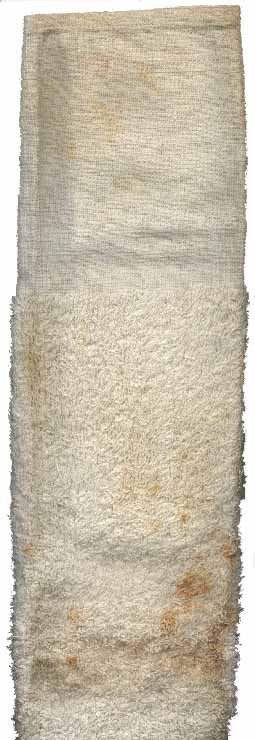
countess was a bundle of what you
see below, menstrual pads, folded
length-wise into thirds (see the
picture below left) and wrapped
with a ribbon. Did I want them?
MUMa
mia! Do Italians eat
pasta?
She mailed five of the washable
cotton pads, each measuring 24.5 x
11 inches (ca. 61 x 28 cm.). Terry
cloth comprises about 14 inches
(ca. 35.5 cm.) of the interior of
each pad, which show stains,
probably from menstrual blood. The
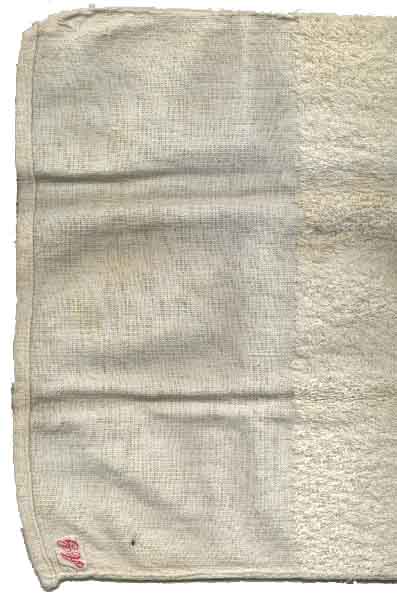
countess's
initials are sewn onto a
corner of each pad (see the
indented comments below).
The size of the pads may
surprise you, but it shouldn't.
The first
Kotex pad - read the ad
describing it - in 1921,
measured 22 inches (ca. 56 cm.)
long, and the filler was 3.5
inches (ca. 9 cm.) wide, just
about what the pad below measures
when folded into thirds, which is
probably the way the countess wore
it. Women wear smaller pads today
because they are much more
absorbent and better designed.
And look at the size of the
"carrier" on a sanitary
apron!
In
2008, a staff member of a Canadian
museum generously wrote me:
I have a couple of extra things
to add to your description,
which I recently learned from a
local Italian textile
specialist. Apparently Italian
textiles were often sold in
lengths. You could buy a bolt of
fabric that was the right width
for hand towels, cloths,
sanitary napkins, table runners,
etc. The person who purchased
the length of fabric could then
hem each piece according to
their needs and finish the edges
with individual embroidery,
tassels, etc. With regards to
the hand embroidered initials on
the sanitary napkins, apparently
many families in Italy relied on
communal village
laundries. All clothing and
linens were embroidered with
initials so that it was possible
to know who each garment
belonged to when being returned,
clean, from the laundry.
I thank the countess and the
American woman for their desire
to preserve an artifact of
women's history, a sorely
neglected subject, and enable
people around the world to see
it.
And I thank the countess who
wore these pads, who would
probably be mortified to learn
strangers were looking at them,
but who might not be
disappointed to know that the
pads were helping people come to
terms with their past - and
present.
|
 |
 |
The whole pad measures 24.5 x 11
inches (ca. 61 x 28 cm). Here we
see about 2/3 of the 24.5" side.
Folded into thirds, as shown, is
perhaps the way the countess wore
it, probably pinned to a belt
around her waist. Worn this way,
the pad approximated the first
Kotex pad (1921) in size.
Menstrual blood created the brown
stains.
|
Sewn on the corner
of each pad are the owner's initials.
You are looking at a complete
short side of the pad, 11 inches
(ca. 28 cm.) high.
|
See nineteenth-century
Norwegian washable pads (which look
much warmer than the Italian one above!) -
See contemporary
washable pads - Women sometimes wore
washable pads with a sanitary apron
© 1999 Harry Finley. It is illegal to
reproduce or distribute any of
the work on this Web site in any manner or
medium without written
permission of the author. Please report
suspected violations to hfinley@mum.org
|