Early 20th-century Japanese
ads from publications - open-crotch drawers,
1890s (U.S.A., from MUM collection) - Modess "Sanitary
Shield" (two-band pad holder in
crotch; 1970s; U.S.A.) - SheShells bikini
(snap open at sides; no special crotch;
possibly for menstrual pads or tampons,
1970s, U.S.A.)
See Kotex ad with a man and no woman
from the Netherlands
Compare the American "Modess,
because . . ." ads, a French Modess ad,
a French ad featuring just a man!,
and ads for teens.
See Kotex items: First ad
(1921) - ad 1928 (Sears
and Roebuck catalog) - Lee Miller ads
(first real person in amenstrual hygiene ad,
1928) - Marjorie
May's Twelfth Birthday (booklet for
girls, 1928, Australian edition; there are
many links here to Kotex items) - Preparing for
Womanhood (1920s, booklet for girls;
Australian edition) - 1920s booklet in
Spanish showing disposal
method - box
from about 1969 - "Are
you in the know?" ads (Kotex) (1949)(1953)(1964)(booklet, 1956) -
See more ads on the Ads
for Teenagers main page


|
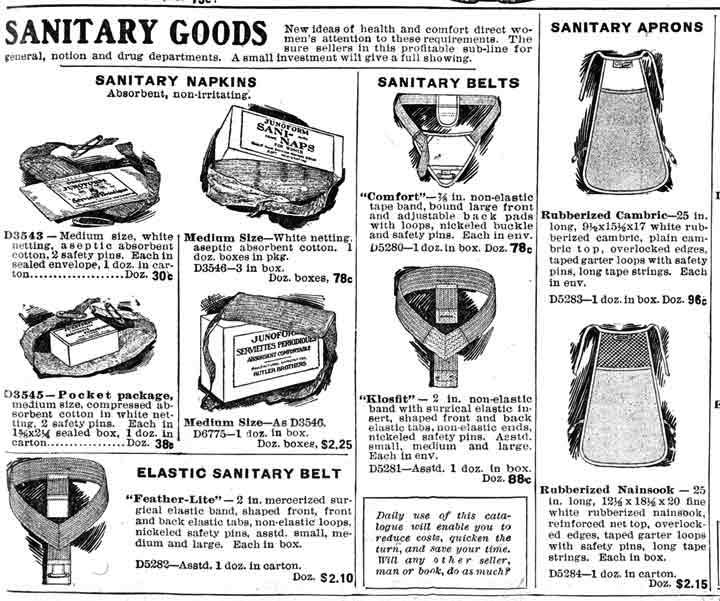
Menstrual napkin belts, pads
& sanitary aprons from the 1916, 1918, 1920 and
1938
Butler Brothers wholesale catalogs
(U.S.A.)
Menstruation was big business in
1916. In America, women could buy
commercial menstrual belts at
least by 1891 (see the Jordan,
Marsh & Co. catalog).
Before that time, women probably
made their own menstrual gear
based on patterns handed down from
mother to daughter or from the
many books advising women how to
run a household (see a German pattern),
the chief occupation of
middle-class women. Or they simply
used old rags or other
absorbent material - or used
nothing at all, but bled into
their clothing.
My eyes popped out at the low
prices until I realized that
Butler Brothers was a company
that sold its products to
stores, which then increased the
prices to its customers - that
is, it was a wholesaler.
"Butler Brothers originated in
1877 as a wholesaler selling
general and variety-store
merchandise by mail. By the
early years of the twentieth
century the company served about
100,000 customers through the
United States and was the
largest firm of its type in the
country. Rising chain store
competition induced the company
to establish in 1927 a chain of
franchised variety stores under
the Ben Franklin name." It sold
this chain in 1959. [Text from
http://sdrc.lib.uiowa.edu/lucile/publishers/butler/butler.htm]
See washable
pads and ads for them, early
Kotex, "sanitary underpants
& panties" and more belts.
I thank again the generous
contributor from Oregon for
these scans!
|
Below:
Everything a woman could want for
menstruation in 1916! Well, she
might have also wanted Midol or
other patent
medicine for discomfort.
Commercial tampons specifically
for menstruation didn't appear
until the early
1930s, maybe about the same
time as cups;
both seem to have had a tough time
in sales.
At top: "New
ideas of health and comfort
. . . ." probably refers to germ
theory and the rediscovery of the
value of bathing.
"The sure
sellers . . . ." reminds
me of later
pitches to stores on what
and how to sell. See also How to sell
Kotex page for trade
publications, probably early
1920s, U.S.A.
"Quicken the
turn" in the box at
bottom must mean hasten the
turnover. Nice phrase!
See how women wore a sanitary
apron.
At least one of the items is
named "serviette," French for
napkin, another early name for
menstrual pads (napkins).
|
 |
© 2007 Harry Finley. It is
illegal to reproduce or distribute
any of the work on this Web site
in any manner or medium without
written permission of the author.
Please report suspected violations
to hfinley@mum.org
|
|
|