See Kurb,
a Midol competitor from Kotex.
Midol booklet
(selections), 1959


|
Midol menstrual pain reliever
newspaper ads, U.S.A.,
1911-1961
Midol started out to relieve
headaches, then hiccups, then -
well, I'll let the retired teacher
who found these ads speak:
Midol started out as a headache
tablet, then it was advertised
as a cure for hiccups, then
finally, it was advertised for
menstrual pain and competed with
Kotex Kurbs tablets. I can't
help but wonder if the
ingredients changed along the
way. . . . The first price in
ads was 10 tablets for 25c then
10 tablets for 50c then the
price went down to 40c for 12
tablets in 1940 and stayed the
same price and box until 1960.
The new box started in 1961 (see
ads) and continued at least
through the 60's but I don't
know when it changed again. I
remember that box myself: it had
a blue paper liner, plus I
remember the series of ads I
attach that rotated different
pictures and names through the
basic ads. Other names that were
used besides all these I
attached were Donna, Anne,
Bonnie, Rachel and Betty; (and
probably more) sometimes they
were bright, gay, radiant, up,
glad or sharp and they mixed up
these names, images and words.
These ran from the early 50's
through the 60's at least
although they dropped gay as it
gained a new meaning. [For "gay"
see this
page.]
I thank the genealogist and
retired teacher who generously
sent these scans!
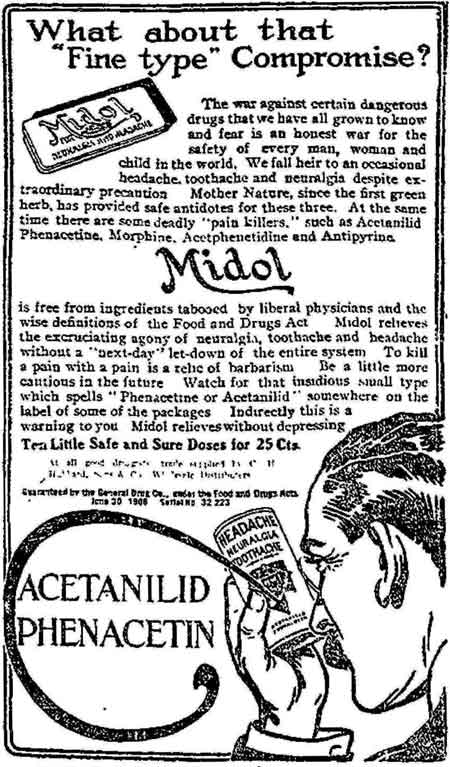
BELOW: Hey,
what's a MAN doing in
a Midol ad?! (And
what's a man doing in
a panty
pad ad with
no women?!) Below:
from the Syracuse [New
York] Herald, Dec. 17,
1911. The ad revolves
around the Pure Food and
Drug Act of 1906. U.S. History.com has
this to say about the
legislation (I added the
color):
Provisions of the
measure included the
following:
· Creation of
the Food and Drug
Administration, which
was entrusted with the
responsibility of
testing all foods and
drugs destined for
human consumption
· The
requirement for
prescriptions from
licensed physicians
before a patient could
purchase certain drugs
· The
requirement of label
warnings on
habit-forming drugs.
Passage of the
measure in Congress
was not assured. The
lobbying association
representing the
medicine makers was
vocal and well-funded,
as were
representatives of the
"beef trust" and other
food producers. Some
members of Congress,
especially a number of
Southern senators,
opposed the bill as
constitutionally
unsound.
The active
involvement of
Theodore Roosevelt,
who was repulsed by
slaughterhouse
practices described in
Upton Sinclair's The
Jungle,
successfully overcame
the lawmakers'
reluctance.
The
first casualty of
this legislation was
the patent medicine
industry; few of the
nostrums gained
certification from
the FDA. The
law was strengthened
in 1911 when
additional provisions
were added to combat
fraudulent labeling.
Interesting, isn't it,
that we have similar
concerns today,
including the concern
about fine type? But
note: the ad doesn't say
what's in Midol!
|
 |
|
Other Midol ads (magazine): 1938, 1939, 1948, 1960 - Midol booklet
(selections), 1959
© 2006 Harry Finley. It is
illegal to reproduce or
distribute any of the work on this
Web site in
any manner or medium without
written permission of the
author. Please report suspected
violations to hfinley@mum.org
See also
Australian
douche ad (ca. 1900) - Fresca
douche powder (U.S.A.) (date ?) -
Kotique
douche liquid ad, 1974 (U.S.A.) -
Liasan (1)
genital wash ad, 1980s (Germany) -
Liasan (2)
genital wash ad, 1980s (Germany) -
Lysol
douche liquid ad, 1928 (U.S.A.) -
Lysol
douche liquid ad, 1948 (U.S.A.) -
Marvel
douche liquid ad, 1928 (U.S.A.) -
Midol
menstrual pain pill ad, 1938
(U.S.A.) - Midol
booklet (selections), 1959
(U.S.A.) - Mum
deodorant cream ad, 1926 (U.S.A.)
- Myzone
menstrual pain pills ad, 1952
(Australia) - Pristeen
genital spray ad, 1969 (U.S.A.) -
Spalt
pain tablets, 1936 (Germany) - Vionell
genital spray ad, 1970, with
Cheryl Tiegs (Germany) - Zonite
douche liquid ad, 1928 (U.S.A.)
The Perils
of Vaginal Douching (essay
by Luci Capo Rome) - the odor page
|
|