See more Kotex items: First ad
(1921; scroll to bottom of page) - ad, 1928
(Sears and Roebuck
catalog) - Lee
Miller ads (first real person in a
menstrual hygiene ad, 1928) - Marjorie May's Twelfth
Birthday (booklet for girls, 1935,
American/Canadian edition) - Preparing for
Womanhood (1920s, booklet for girls;
Australian edition) - 1920s booklet in
Spanish showing disposal
method - box
from about 1969 - "Are you in the
know?" ads (Kotex) (1949)(1953)(1964)(booklet, 1956) -
See more ads on the Ads
for Teenagers main page
See Australian douche
ad (ca. 1900) - Fresca
douche powder (U.S.A.) (date ?) - Kotique douche
liquid ad, 1974 (U.S.A.) - Liasan (1) genital
wash ad, 1980s (Germany) - Liasan (2) genital
wash ad, 1980s (Germany) - Lysol douche liquid
ad, 1928 (U.S.A.) - Lysol
douche liquid ad, 1948 (U.S.A.) - Marvel douche liquid
ad, 1928 (U.S.A.) - Midol
ad, 1938 - Midol
booklet (selections), 1959 (U.S.A.) -
Mum deodorant cream
ad, 1926 (U.S.A.) - Myzone
menstrual pain pills ad, 1952 (Australia) -
Pristeen genital
spray ad, 1969 (U.S.A.) - Spalt pain tablets,
1936 (Germany) - Sterizol
douche liquid ad, 1926 (U.S.A.) - Vionell genital spray
ad, 1970, with Cheryl Tiegs (Germany) - Zonite douche liquid
ad, 1928 (U.S.A.)
The Perils of
Vaginal Douching (essay by Luci Capo
Rome) - the odor
page
More Midol: Midol
booklet (selections), 1959, and Midol
ad, 1938


|

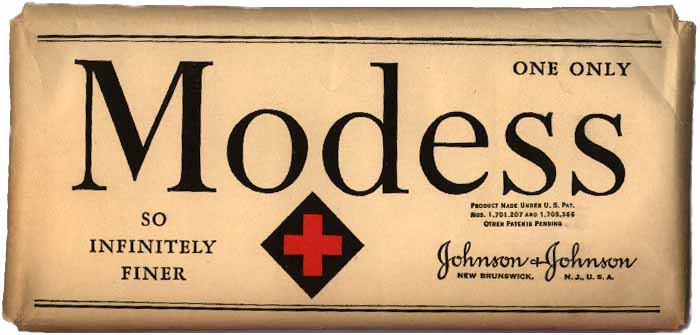
Wrapped Modess menstrual
pad for a dispenser, U.S.A.,
1930s?
Kotex probably pioneered the use
of dispensers for pads, but other
companies quickly followed (see old
dispensers at the
Smithsonian Institution,
Washington, D.C.).
I can't help but wonder if the
lack of information on the back of
the package foreboded Modess's
losing its competition with its
main competitor, Kotex,
which covered the back of its
packaging with information. It
also reflected the "Modess . . .
.because" ad campaign of the
following decades in its
taciturnity.
|
|
|
The package measures
8.75" long by 4.25" high
(about 22 cm by 10.5
cm), an inch shorter
than the wrapped 1930s
pad from Kotex.
Note the cross.
Johnson & Johnson
was known for its
bandages, as was
Kimberly-Clark (in World
War I), the creator of
Kotex; it too flaunted
the cross. But the
crosses were probably
intended to boost the
pads' credibility among
a public that had
increasing faith in
doctors after the medical
inadequacy of the
19th century, especially
in America.
|
|
|

|
Back of package.
The back of the wrapped Kotex pad
is covered with information.
|
© 1999 Harry Finley. It is
illegal to reproduce or distribute
any of the work on this Web site
in any
manner or medium without written
permission of the author. Please
report suspected violations to hfinley@mum.org
|
|