These paintings are part of a
series inspired by a year-long
study of menstrual superstitions.
I am a senior illustration
student, about to graduate from
the Massachusetts College of Art
and Design [in 2008], and the
topic of menstrual superstitions
was my senior thesis. I was
attracted to this subject almost
by chance, stumbling upon a few
web sites (including this one
[MUM]) that described a seemingly
endless flood of myths that were
arguably the most shocking and
insanely comical beliefs I had
ever read. Oddly enough,
I
was told that I was the only
person in the history of that
class that chose menstrual
superstitions. My study,
although endlessly fascinating
to me and many of the women in
my class, was unfortunately
met with long
uncomfortable silences in the
beginning, and I had a
difficult time getting
feedback from my colleagues. But, the more I
talked about it, the less
uncomfortable everyone became. [That was my
experience when people visited
the museum in my house.] It was
interesting to see the
progress and change of both my
own work and the class's
involvement in it. What began
in silence, ended in constant
encouragement to push the
boundaries of what to show
visually - to be more graphic,
more disturbing, more
unflinching in my statement.
The paintings themselves were
inspired by specific
superstitions, like the accounts
of "displaced bleeding," and the
Greek philosopher Pliny's remark
that fruit will rot and fall from
the trees upon encountering a
menstruating woman.
Most of the superstitions I was
most inspired by were ancient or
indigenous, but they are also what
I felt most contributed to current
taboos about menstruation.
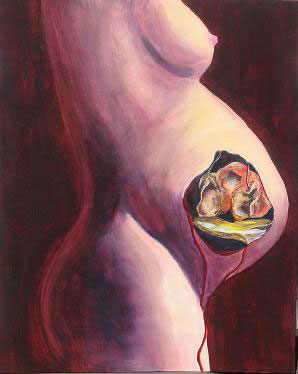
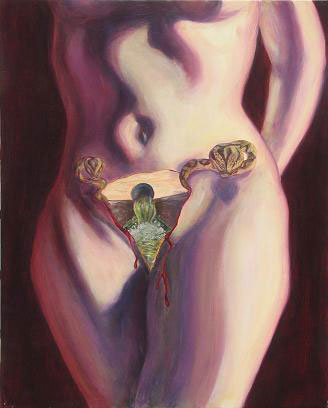
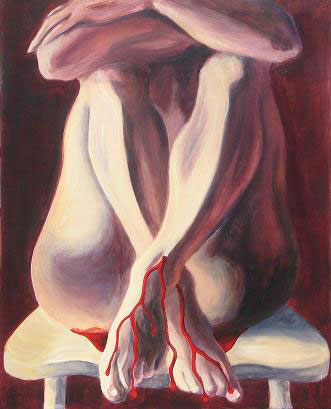
In this series of paintings, I
sought to confront the viewer with
both the repugnance of the
superstitions while still
maintaining a bit of beauty in the
figure. They are each 24" by 32",
acrylic on wood. The first, "The
Contaminated," was
meant to show the human
reproductive organs of a
dismembered and faceless women, as
the pollution beliefs may
literally have imagined them to
be. The second: "To Bleed
Without Wound,"
juxtaposes stigmata with
menstruation, as both instances,
whether real or not, can be broken
down to the same thing (bleeding
without a wound) but one is
revered as godly, the other as
ungodly. And the third,"Strange Fruit,"
references superstitions about how
menstruation causes decay, while
also juxtaposing it to the
life-bearing torso of a pregnant
woman.