Looking at the overlooked
By Becca Costello
Photo By Larry Dalton
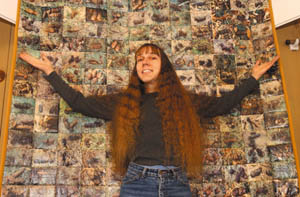
When I arrived at M. Parfitt's
house, the first thing she did was
unroll the poop quilt. The piece,
titled Wilbur's Opinion
after a cherished pet, is composed
of hundreds of photos of dog
droppings. She explained that she
documented her dog's backyard visits
for a year to get the pictures and
that no two are alike. She chose
only the most interesting shapes and
even fed Wilbur corn and carrots to
influence his "artistic process."
Once I got over my initial "I can't
believe I'm studying poop" reaction,
I started to appreciate the
astonishing variety of shapes and
textures, which is exactly the
point. Parfitt's art, created with
hair, blood, forgotten photos, lint
and other typically discarded
objects, invites the observer to
take another look at things that
almost never get a second glance.
It's an approach that won her the
$1,000 first prize at the 73rd
Crocker-Kingsley exhibition last
month at the Crocker Art Museum.
Were you surprised you won first
prize?
I was totally shocked. I wasn't
even sure my piece was in the show.
First, there's a round of judging by
slides. Then, they tell you to bring
your piece in for the second round,
so I did, and they said, "If we
don't accept it, we'll let you
know." I never heard from them. I
assumed it got in, but I didn't
really know. I thought maybe I'd
missed a phone call. So, we went to
the reception, and they handed us
the catalogs, which we didn't even
open. If we'd opened them, we'd have
seen a picture of the piece right
inside. We wandered back, and there
was my piece. I said, "Oh, there it
is! It actually made it in." Then, I
noticed the sign that said first
prize, and I just dropped
everything. I couldn't believe it. I
never thought I would win,
especially with Gladys Nilsson being
the juror. I've admired her work for
years. She's an excellent painter
and a very interesting artist. For
her to pick my piece just shocked
the hell out of me.
What was the winning piece?
I collect old photographs and
books. I took about 70 old
photographs of women, and I found
little bits of text to put under
each one. I tore the pages and
smeared blood all over them, so a
lot of it's blocked out and other
words are emphasized. You can't get
a complete story out of each piece
of text, but you can get an idea by
reading a couple of words. Each
piece of text was about constrictive
behavior--how you're supposed to
dress, how to wear your corset, how
to do your housecleaning, how to
behave for your husband, how to
behave in public. It's all about
behavior women were supposed to fall
in line with. I combined the two and
added rows of lint vertically,
throughout the piece. I like working
with lint because it's something
people throw away. They don't notice
it, but it's really interesting
material, the colors and the
textures. It ties in with how these
women were treated. They were sort
of ignored and invisible, unless
they followed these behaviors. Their
lives were insignificant, just like
the lint. But, if you look at the
lint, it's really interesting, so
maybe these women had interesting
lives, too. So, I sewed all that up
as a quilt.
Victoria Dalkey, who reviewed
the Crocker-Kingsley exhibition
for the Sacramento Bee, criticized
the use of text in art. Why do you
use text in your work?
I think it adds another dimension.
You can read as much as you want.
You can look past the blood and try
to figure out what the words are.
You can glance at it and read a few
words or just look at it visually,
as part of the composition. I like
to hint at ideas from books, throw
in ideas that might not be apparent
if it was just photos and color.
What's the most unusual thing
you've used in your art?
I used to save my dog's nail
clippings. I used them in a house
sculpture. They kind of formed a
path and looked like pebbles.
You use a lot of blood.
I started using it maybe seven
years ago. I wanted to make a quilt
that looked like it was stained with
blood. I tried acrylic paint, silk
paint and watercolors. Nothing
looked like blood. It looked like
paint. Finally, one day I had my
period, and I thought, "Well, why
not try blood?" and it worked. I
like the way it looks. You get thick
clots and little runny bits and
chunks. It changes color when it
oxidizes. It's fun to work with
because you really can't control it.
Do people assume you're going
for "shock value" in your art
because of the blood?
Some people don't even know what
they're looking at. Other people
don't know it's menstrual blood, and
they assume I cut myself to do it.
It doesn't have any real deep
significance for me other than the
fact that I like the color and the
texture.
What inspires you?
I like looking at things that
people throw away or overlook. I
pick things up from the gutter on my
way to work--scraps of paper and
stuff. I've always liked ... the
idea of recycling things and making
them useful again.
What is the role of the artist
today?
Art, to me, is fun. I don't believe
in suffering for it. Artists who are
tortured should be a in a different
business, obviously. I make what's
fun to me, and I hope people like
looking at it. I like to see people
laugh at my work. That's my
role as an artist, to have fun.
copyright 2002 Sacramento News
and Review
|