More ads for teens (see also introductory page for
teenage advertising): Are
you in the know?
(Kotex napkins and Quest napkin powder,
1948, U.S.A.), Are you in the know? (Kotex napkins and belts,
1949, U.S.A.) Are
you in the know?
(Kotex napkins, 1953, U.S.A.), Are you in the know? (Kotex napkins and belts,
1964, U.S.A.), Freedom
(1990, Germany),
Kotex (1992, U.S.A.), Pursettes (1974, U.S.A.), Pursettes (1974, U.S.A.), Saba (1975, Denmark)
See more German Carefree
ads.
More ads for teens (see also introductory page for
teenage advertising): Are
you in the know?
(Kotex napkins and Quest napkin powder,
1948, U.S.A.), Are you in the know? (Kotex napkins and belts,
1949, U.S.A.) Are
you in the know?
(Kotex napkins, 1953, U.S.A.), Are you in the know? (Kotex napkins and belts,
1964, U.S.A.), Freedom
(1990, Germany),
Kotex (1992, U.S.A.), Pursettes (1974, U.S.A.), Pursettes (1974, U.S.A.), Saba (1975, Denmark)
See ads for
menarche-education booklets: Marjorie
May's Twelfth Birthday (Kotex, 1933), Tampax tampons (1970, with
Susan Dey), Personal
Products (1955, with Carol Lynley), and
German o.b. tampons
(lower ad, 1970s)
And read Lynn Peril's series
about these and similar booklets!
See more Kotex items: First ad (1921) -
ad 1928 (Sears and
Roebuck catalog) - Lee
Miller ads (first real person in
amenstrual hygiene ad, 1928) - Marjorie May's Twelfth
Birthday (booklet for girls, 1928,
Australian edition; there are many links here to
Kotex items) - Preparing
for Womanhood (1920s, booklet for girls;
Australian edition) - 1920s booklet in Spanish
showing disposal
method - box
from about 1969 - "Are
you in the know?" ads (Kotex) (1949)(1953)(1964)(booklet, 1956) - See
more ads on the Ads for
Teenagers main page


|

THE MUSEUM OF MENSTRUATION AND WOMEN'S
HEALTH
|
Carefree ads for menstrual
panty liners, Germany,
Freundin ("Girlfriend")
magazine, 1989 & 1990
We see how popular English
is in Europe in this ad for
a German panty pad for
teenagers. But couldn't the
ad agency have hired a
native English speaker to
write the large words, which
sound slightly wacky (but
which a non-English-capable
reader might not notice)?
And the two ads are not in
teenagers' magazines, but
women's, making the words
"boys" and "Jungs" (a
colloquial word for boys) a
strange choice.
I
can't explain the switch
between the two languages.
Are they flaunting their
sophistication by using
English? I doubt if there
are more Freundin readers
who can read English; the
same people, roughly, read
both.
"Carefree. Vorrecht der
Frau. Jeden Tag," at the
bottom of the ad, means
"Carefree. The woman's
prerogative. Every day."
See more German Carefree
ads.
|
|
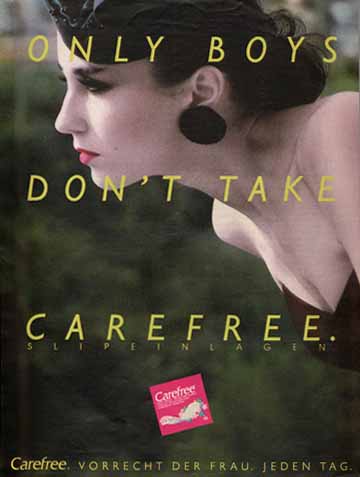
issue
22/1989
|
|
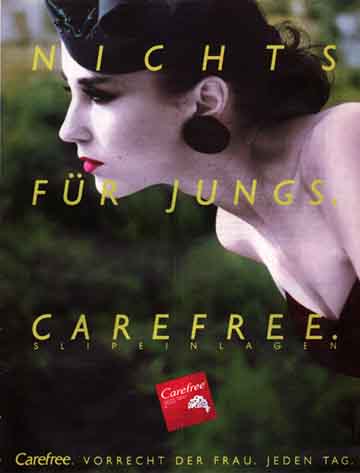
issue
7/1990
|
|
© 1998 Harry Finley. It is
illegal to reproduce or
distribute any of the work
on this Web site in any
manner or medium without
written permission of the
author. Please report
suspected violations to hfinley@mum.org
|
|
|