(Johnson & Johnson) Modess ads: "Silent Purchase," June 1928; another from 1928, 1931,"Modess . . . . because" ads, the French Modess, and the German "Freedom" (Kimberly-Clark) for teens.See other marketing devices: Ad-design contest for menstrual products in the United Kingdom; B-ettes tampon counter-display box and proposal to dealers, with contract; (U.S.A., donated by Procter & Gamble, 2001); "Your Image is Your Fortune!," Modess sales-hints booklet for stores, 1967 (U.S.A., donated by Tambrands, 1997)See a Modess True or False? ad in The American Girl magazine, January 1947, and actress Carol Lynley in "How Shall I Tell My Daughter" booklet ad (1955) - Modess . . . . because ads (many dates).CONTRIBUTE to Humor, Words and expressions about
menstruation and Would
you stop
menstruating if you
could?
|
Ad for Nupak menstrual pads
|


Most women seem not to like menstruating very much, and manufacturers of menstrual products have tried to make their products reduce the discomfort, mental and physical, that these women experience."Daintiness" is not usually associated with menstruation, but many women want to feel connected with this very feminine trait, perhaps especially when menstruating (the ultimate association, by name anyway, is the "Daintette" menstrual cup, from Dainty Maid, Inc.; inserting, removing, emptying and cleaning a menstrual cup are not the daintiest acts in the world, in spite of the name, which "euphemizes" the acts.)Read Dr. Lillian Gilbreth's report to Johnson & Johnson about what women looked for and avoided in pads and related apparel in the 1920s in America, and how this changed pad design (American women apparently couldn't buy commercial tampons until the early 1930s.)I don't believe we see "dainty" very much today in advertising for women's products, probably because it sets women off too much from the rough world of work, which they are more a part of, and want to be a part of (at least many of them do), nowadays. |
|
|
|
|
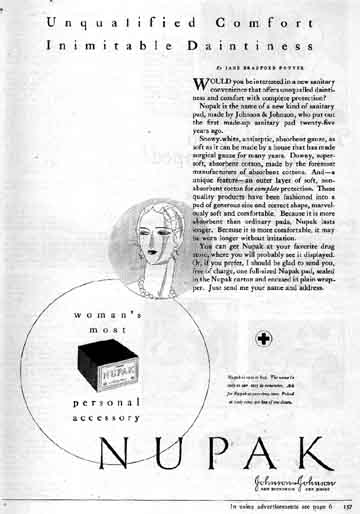
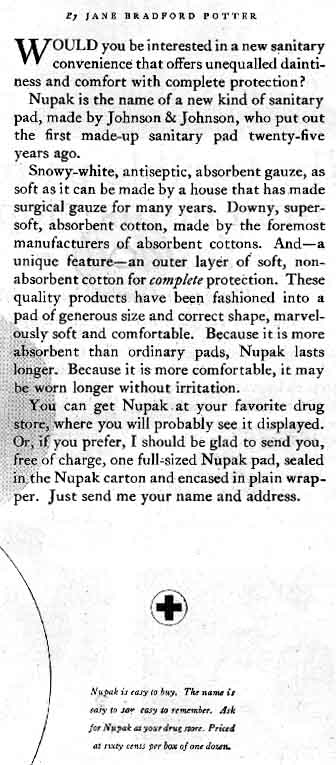
"Daintiness" is in the
headline and the body of the text. I
think the word, which no one would
associate with menstruation, tries to
elevate the subject to comfort women.
The woman's stylized Art-Deco face, of
course, has nothing to do with
menstruation, but with being in
fashion.
|
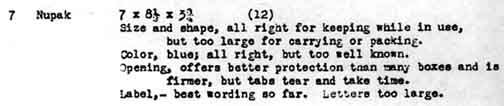
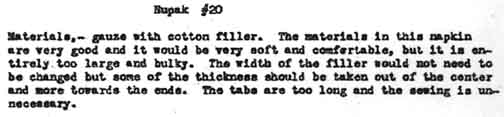
In 1927, Dr. Lillian Gilbreth gave a report to Johnson & Johnson (read two excerpts, below) about what women wanted in menstrual pads and accessories. She rated Nupak better than many, music to J&J ears, since it made them. I have a feeling nothing got by her, and she didn't write to please. |
|
|
|
|
For more daintiness, see a Nupak ad from 1927 and a Kotex ad from 1932. (Johnson & Johnson) Modess ads:
"Silent Purchase," June 1928; another from 1928, 1931,"Modess . . . . because" ads, the French Modess,
and the German "Freedom" (Kimberly-Clark) for teens.