Some Camelia ads:
1920s (Germany),
1930s
(Germany), 1940/42
(Germany, with underpants made from sugar
sacks, 1945/46), 1952
(Australia), 1970s
(France), 1990
(Germany) - Underpants
directory
Booklets
menstrual hygiene companies made for girls,
women and teachers - patent
medicine - a list
of books and articles about menstruation - videos
See a Kotex ad
advertising a Marjorie May booklet.
See many more similar booklets.
See ads for
menarche-education booklets: Marjorie May's Twelfth
Birthday (Kotex, 1932), Tampax tampons (1970,
with Susan Dey), Personal
Products (1955, with Carol Lynley),
and German o.b.
tampons (lower ad, 1981)
And read Lynn Peril's series about
these and similar booklets!
Read the full text of the 1935 Canadian edition
of Marjorie May's Twelfth Birthday, probably
identical to the American edition.
More ads for teens (see also introductory page
for teenage advertising): Are you in the know? (Kotex napkins and Quest
napkin powder, 1948, U.S.A.), Are you in the know? (Kotex napkins and belts,
1949, U.S.A.)Are
you in the know?
(Kotex napkins, 1953, U.S.A.), Are you in the know? (Kotex napkins and belts,
1964, U.S.A.), Freedom (1990, Germany), Kotex (1992, U.S.A.), Pursettes (1974, U.S.A.), Pursettes (1974, U.S.A.), Saba (1975, Denmark)
See early tampons
and a list of tampon
on this site - at least the ones I've
cataloged.


|
Camelia, early disposable
menstrual napkin
Booklet (incomplete), the
Netherlands, 1928(?)
Nurse Thekla
vs The Lady of the
Camellias
Camelia was probably the first
really successful disposable
menstrual napkin in Germany and
probably Europe (in spite of Hartmann's)
and women can buy it even now.
Today it's part of Kotex,
interestingly enough, the first widely
successful pad in America,
which appeared in the early 1920s,
right before Camelia.
Typical of an older kind of
advertising (see a page from the
often eye-popping 1928 Johnson Smith
& Co. catalog, from
America), the booklet below goes
on and on about how the pad
developed and what its advantages
are, with extensive quotes from
letters. Most people today have
little patience for so much
reading. I and the Dutch
contributor translated small
portions from the Dutch, which is
itself a translation from the
probable original German since the
product was German.
Two
seemingly opposite women are
locked into Camelia: the
woman on the cover (below) and on
boxes is a prostitute,
the Lady of the Camellias (I
suggest sitting down while reading
the fascinating
explanation); but the
booklet's author is allegedly one
Nurse
(zuster in Dutch, below, Schwester
in the original German) Thekla Buckeley,
a name that's a puzzling
combination of German and English,
as the contributor noted. (It
might be no puzzle: a Nurse Ellen Buckland
pops up on a Kotex order
blank at this time.) The
nurse, here,
wears a uniform derived from a
nun's habit, making a great
contrast to the lady of the night
(and camellias). Other women's
names associated with early
menstrual products perhaps
identify real people (here),
perhaps not.
The Dutch contributor of these
scans writes, in part:
As you see, Thekla is her
first name; her family name:
Buckeley!! I have never read
that before, also not on your
site.
I think they have chosen this
only for the Dutch because of
the English feelings and to
counter the German name of
Thekla.
In the booklet there is an
letter dated 14 December 1925. I
have reasons to believe you can
date the Dutch version of the
booklet [below] at about 1928,
maybe with the start of sales in
the Netherlands. In that year
some ads appeared in the Dutch
newspaper NRC with a remark
about the booklet and with the
company Fa. C.F. van Dijl &
Zoon. In 1929 the prices were
lower (it became the time of
prices getting lower and lower:
the very bad years we called
here the Crises-jaren) and
another company takes care of
the business of Camelia in the
Netherlands.
NB: Firma Hunkemoller was then
but also now a famous supplier
of panties, bras, etc. and in
those days (you have mentioned
it over and over on your site)
they also have bandages and so
on to catch the menstrual flow.
Later also the disposable kind
of it.
Camelia was that kind of
disposable: see e.g. page 15 for
all the advantages. It was
really disposable: it was
soluble in water and you could
put it easily into the toilet.
(Now everywhere in Europe as
U.S.A. water authorities try to
forbid putting things into the
toilet!! [See some allegedly
disposable-in-the-toilet
pads])
In the left corner of the
front is printed: 24e
vermeerdere oplage (24th
enlarged edition): maybe this
is only making it interesting,
to give it an appeal of very
popular booklet. But maybe
this is true, but then so many
editions!
I had never heard of this
booklet or seen it before I
saw it early this month [July
2007] at a big second-hand
book market [in the
Netherlands] (and bought it as
you can expect).
As with all advertisements
not printed in a paper or
magazine: this sort of old
advertisement booklet is rare
because everyone thinks it is
(after a while) rubbish and
does away with it. Second, the
subject was (and is in some
way) taboo and third: a
booklet maybe nearly eighty
years old has with all the
war/water/cleaning/house
improvements and so on little
chance of surviving into 2007!
I thank again the kind
Dutchman who scanned and sent
these pages; he's sent MUM
scores of scans and original
documents. He has rescued in the
Netherlands many items that
somehow survived World War II,
including those about the
military and other subjects.
We're indebted to him for his
work!
|
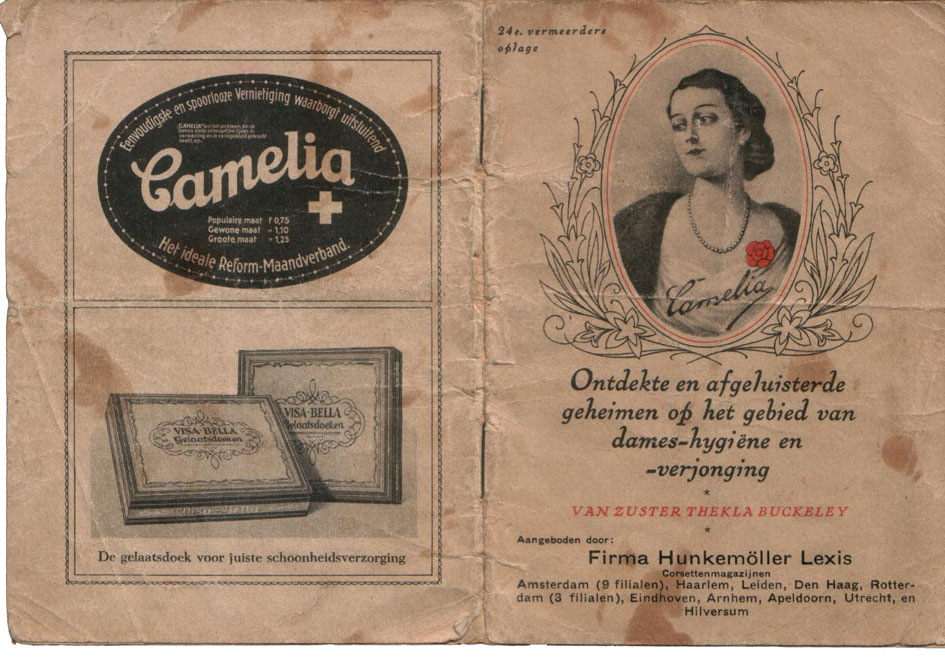
Below:
Back (at left) and front covers.
The pages measure 10.6 x 14.5 cm
(4.17 x 5.71"), 4 pages front,
inside front, back inside, back
and 48 numbered pages. Only the
pages dealing with the Camelia pad
are shown in the following pages.
|
 |
|
My translation: (left
page)
[in Camelia ellipse]
Simple and traceless
destruction (?)
exclusively guaranteed
popular size 0.75 gilders
gewone (?) size 1.1
gilders
large size 1.25 gilders
The ideal reform
menstrual pad
[on the boxes] VISA-BELLA
(beautiful face) facial
cloth
The facial cloth for
proper beauty care
|
(right page)
24th enlarged edition
Uncovered and
overheard secret in the
area of women's hygiene
and rejuvenation
by Sister Thekla Buckeley
(Sister Thekla appears here
too)
offered through
Hunkemöller Lexis firm
corset shops
Amsterdam (9 branches),
Haarlem, Leiden, Den Haag,
Rotterdam (3 branches),
Eindhoven, Arnhem,
Apeldoorn, Utrecht, and
Hilversum
Read
the story
behind the flower.
American commercial
printed material
associated with
menstruation almost
never uses red - the
very thought! But
see an exception.
|
|
|