More Camelia ads:
1920s (Germany),
1930s
(Germany), 1940/42
(Germany, with underpants made from sugar
sacks, 1945/46), 1952
(Australia), 1970s
(France), 1990
(Germany) - Underpants
directory
Booklets
menstrual hygiene companies made for girls,
women and teachers - patent
medicine - a list
of books and articles about menstruation - videos
See a Kotex ad
advertising a Marjorie May booklet.
See many more similar booklets.
See ads for
menarche-education booklets: Marjorie May's Twelfth
Birthday (Kotex, 1932), Tampax tampons (1970,
with Susan Dey), Personal
Products (1955, with Carol Lynley),
and German o.b.
tampons (lower ad, 1981)
And read Lynn Peril's series about
these and similar booklets!
Read the full text of the 1935 Canadian edition
of Marjorie May's Twelfth Birthday, probably
identical to the American edition.
More ads for teens (see also introductory page
for teenage advertising): Are you in the know? (Kotex napkins and Quest
napkin powder, 1948, U.S.A.), Are you in the know? (Kotex napkins and belts,
1949, U.S.A.)Are
you in the know?
(Kotex napkins, 1953, U.S.A.), Are you in the know? (Kotex napkins and belts,
1964, U.S.A.), Freedom (1990, Germany), Kotex (1992, U.S.A.), Pursettes (1974, U.S.A.), Pursettes (1974, U.S.A.), Saba (1975, Denmark)
See early tampons
and a list of tampon
on this site - at least the ones I've
cataloged.


|
Camelia disposable menstrual
napkin, cardboard ad from a former
drugstore in Saxony, Germany,
1936-37
This beautiful ad consists of
two pieces: a cardboard
background and another piece of
cut-out cardboard - the
ladies, box and information at the
bottom - that casts a real shadow
on the landscape. It's 700 x 950 x
6 millimeters (roughly 2'4" x 3'1"
x 1/4"). German drugstore windows
today are still often riveting.
Hiking - wandern in
German - has always been popular
in Germany, at least in the last
100 years.
I spent most Saturdays from 1974
to 1984 hiking in the hills around
Heidelberg, walking paths marked
with stones sometimes chiseled
with dates from the 1700s. We
could hear cuckoos
in the silence - they sounded just
like the clocks!
Just a half hour from the oldest
university in today's Germany we
could cross a river the Romans
sailed and amble through the
unattended, wrecked rooms of a
medieval monastery that perched on
top of a hill a short walk from an
amphitheater that enclosed band
concerts by the Nazis.
Down the river within an hour's
walk loomed castle after castle,
guarding the approaches from
forgotten invaders or making them
pay tribute. I once compiled
1500 note cards on the
construction of German castles
with the idea of making a
booklet a Wandererin
could slip into her back pocket.
It would enable her to roughly
date any ruin and figure out what
the features were. (But after 2
years I lost confidence and tossed
the cards.)
Most of Germany's 15,000 or so
castles are deserted and half
rubble. You can even buy many of
them if you fix them up.
But, wonder of wonders, I've
wandered from menstruation!
I gleaned the picture and
information from the catalog
"Menstruation: Monatshygiene im
Wandel von 1900 bis heute," Text
und Katalog: Sabine Zinn-Thomas
und Walter Stolle. Eine
Ausstellung des Hessischen
Landesmuseums Darmstadt in der
Außenstelle Lorsch,
26.11.1998 bis 31.7.1999. My
translation: "Menstruation:
Changing menstrual hygiene [in
Germany, mostly] from 1900 to
today [1998]." Text and catalog:
Sabine Zinn-Thomas and Walter
Stolle. An exhibition of the
Hessian State Museum, Darmstadt,
in the branch at Lorsch, from
November 26, 1998 to July 31,
1999.
|
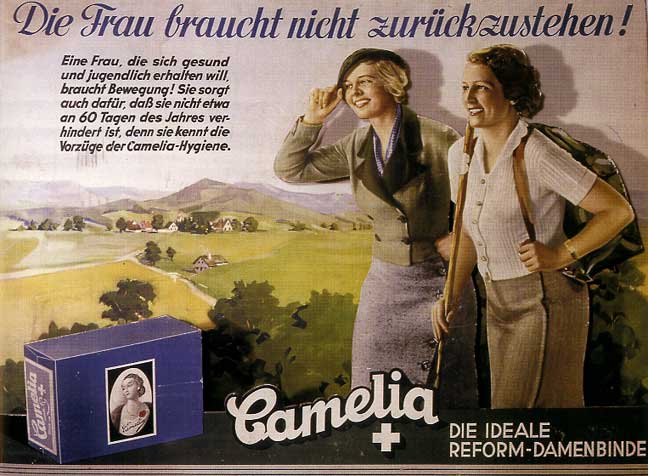 |
I translate the text as: "A [really
'The,' but that doesn't sound
right in English] woman doesn't
need to hold back! A woman who
wants to keep healthy and
youthful needs movement! She
takes care also that she's not
hindered for c. 60 days a year
because she knows the advantages
of Camelia. Camelia, the ideal
reform menstrual pad."
"Reform" in Germany means
something that's improved through
careful thought; the word
decorates many stores and product
descriptions in Germany, even
today. Camelia is a Reform product
because it's disposable, not like
the old-fashioned
German
washable pad.
Many drugstores in Germany still
show ads in large windows; the
stores in my area of the U.S.A.
seem to have abandoned window
advertising. Maybe it's because
people seldom walk anymore - they
drive.
See a close-up
of the box and woman in the
picture on the box - and read her
story.
|
More Camelia ads:
1920s
(Germany), 1930s
(Germany), 1940/42
(Germany, with underpants made
from sugar sacks, 1945/46), 1952
(Australia), 1970s
(France), 1990
(Germany) - Underpants
directory
© 2006 Harry Finley. It is
illegal to reproduce or distribute
any of the work on this Web site
in any manner or
medium without written permission
of the author. Please report
suspected violations to hfinley@mum.org
|
|