See Japanese instructions for making menstrual belts and pads at home in the early 20th century.More belt topics
|
Early Japanese ads for menstrual belts, part 1
(part 2, 3)
|



|
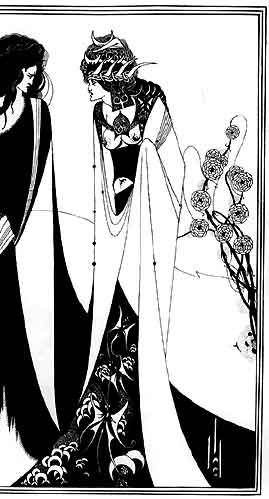
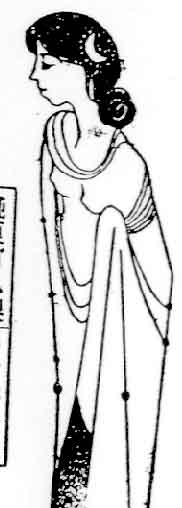
In 1998 a Japanese college student, Tomoko Maeno, kindly sent a copy of her study of the history of Japanese menstrual products to this museum. Below and on the following pages I reproduce several ads for menstrual hygiene from the early 20th century from her thesis. Unfortunately, apart from a few of the student's notes and a summary, everything is in Japanese. Hello? So what did I expect? But I did commission Mrs. Akiko Roller, of Washington, D.C., to translate part of the text about underpants and homemade pads. One ad, below, rang a bell; it looked like a drawing from the English artist Aubrey Beardsley, who died at 25 in 1898 from tuberculosis. (I think he's England's greatest artist.) So I flipped through my Beardsley books and found, amazingly, the exact drawing the ad's based on (below, right)!Japanese wood-block prints called ukiyo-e ("images of the fleeting [or floating] world," which meant the world of pleasure: theater, geisha, prostitutes, etc.), published for a wealthy merchant class, influenced Beardsley and other European artists after the pictures arrived in European ports in the mid-19th century as stuffing in boxes of merchants' goods. They captivated Impressionists and, near the end of the century, artists of the Art Nouveau ("New Art" in French) movement, who made many Japanese features their own, including flatness, few or no shadows, bold crops of subject matter, and astounding lines.Here's one of my interpretations of what's happening below. The Japanese artist based his or her drawing on a Beardsley drawing, thus allowing Art Nouveau artist Beardsley, himself greatly influenced by Japan, to in turn influence the Japanese artist! I wonder if the fact that the belt has an English name, Victoria (also the name of the beloved British queen who died in 1901), means that the belt itself is an English import (see an American ad for The New Victoria belt and pad holder), maybe even carrying with it the Beardsley influence. Later Japanese menstrual products also often bear English words (Elldy - L D - tampons, for instance, and Hello Kitty).Or maybe the artist was British and remade the Beardsley drawing in England for the English brand, which was then sent to Japan.As you see, right below, the belts look like American and European models of the time, maybe meaning they were imports or copies of Western belts. On the other hand, Japan had its own traditional belt called the pony (see a later version of it), a homemade belt preceding the commercial model, which looked like the Victoria. There aren't too many ways to make a belt and pad. |
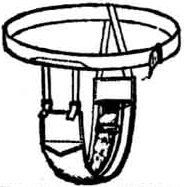
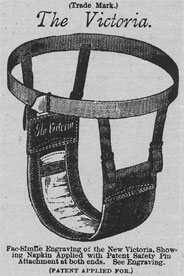
Compare and contrast these Japanese and American commercial belts dating from before 1920. |
|||
|
 |
 |
|
The Japanese Victoria
Band (belt), for which you
will see many ads on these next
pages.
|
The American Venus, or
Sanitary Protector, from
Sears, Roebuck, 1902.
|
But see the American ad, above, for The New Victoria menstrual pad & belt from about this time.Are these last two copied from one another? |
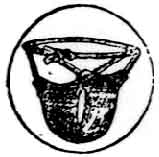
Below: A Japanese belt ad derived from an Aubrey Beardsley illustration.
|
|
|
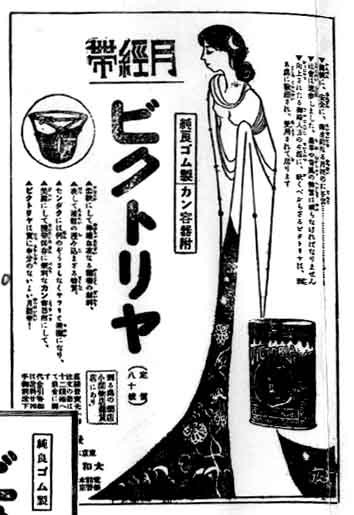
An ad for the Victoria menstrual pad belt (in the circle), 1921, from an unknown Japanese publication.The artist seems to have adapted the Beardlsey drawing, right, for the picture of the woman. Not only is the whole drawing similar, the details, below, are too. |
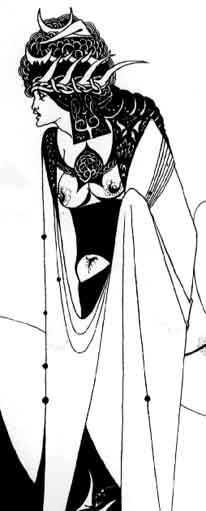
John the Baptist and Salome, published in 1907, by Aubrey Beardsley, a detail of one of the drawings illustrating Oscar Wilde's play Salome. |
|
|
|
|
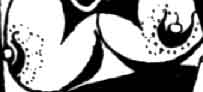
Look how the breasts tilt at different angles in the two drawings, "reversed" in a sense, as are the ends of the two fold lines in the fabric falling from her hand near the right breast. The Japanese artist made the breasts appear nude, as the Beardsley breasts are, although they are covered.A crescent moon sits on the hairdo of each. |
The four large "dots" on the line forming the left boundary of her clothing, as well as elsewhere, are identical in position.Among the differences
is the Beardsley navel, unique
as are many of Beardsley's touches in
his art.
|
|
|
Left: Beardsley dots dance around the areolas of Salome, making them flowers with nipples for stamens.More flowers grow, below. |
|
|
|
The flowers - chrysanthemums (the flower of the Japanese royal family, I believe)? roses? - creep to the Japanese ad fabric, above, from behind the Beardsley figure. |
The Beardsley flowers, above, suitably thorned, writhe to the right of Salome. |
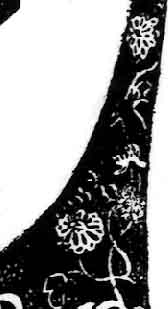
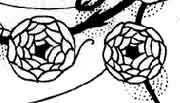
|
|
|
The ad, above, repeats the Beardsley crescent moons, right. |
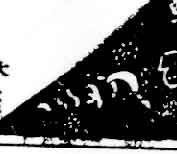
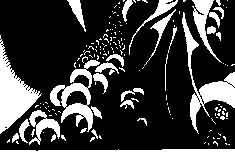
|
|
|
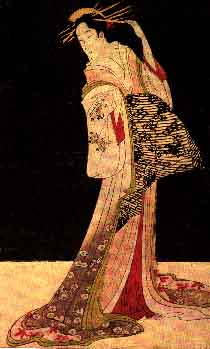
Detail from The Courtesan
Takihawa of Ohgi-ya, from the
series Selected
Beauties in the Gay Quarters
(gay meaning pleasureful, not
homosexual, although it possibly could
include that), about 1795, by Eishi.
|
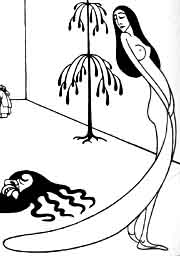
This detail from an illustration (1908) for Friedrich Hebbel's Judith, by Thomas Th. Heine, shows a similar pose.Heine (this is not
Heinrich Heine, the 19th century
writer) was part of the German Art
Nouveau, called Jugendstil, meaning
"in the style of the magazine called
'Youth'" (Jugend), an extraordinary
magazine of the era.
|
| Below: two
more pose examples: while visiting
the Freer Gallery in Washington
recently (2013) I saw Utamaro's
hanging scroll Moonlight Revelry
at Dozo Sagami (probably late
18th century), showing "an elite
pleasure house" according
to the wall sign. These
are portions of that scroll. |
|
 |
 |
NEXT
page 2, 3
© 1999 Harry Finley. It is illegal to reproduce or distribute work on this Web site in any manner or medium without written permission of the author. Please report suspected violations to hfinley@mum.org |