See more Kotex items: First ad (1921) -
ad 1928 (Sears and
Roebuck catalog) - Lee
Miller ads (first real person in
amenstrual hygiene ad, 1928) - Marjorie May's Twelfth
Birthday (booklet for girls, 1928,
Australian edition; there are many links here to
Kotex items) - Preparing
for Womanhood (1920s, booklet for girls;
Australian edition) - 1920s booklet in Spanish
showing disposal
method - box
from about 1969 - "Are
you in the know?" ads (Kotex) (1949)(1953)(1964)(booklet, 1956) - See
more ads on the Ads for
Teenagers main page
And read Lynn Peril's series
about these and similar booklets!
See more Kotex items: First ad (1921) -
ad 1928 (Sears and
Roebuck catalog) - Lee
Miller ads (first real person in
amenstrual hygiene ad, 1928) - Marjorie May's Twelfth
Birthday (booklet for girls, 1928,
Australian edition; there are many links here to
Kotex items) - Preparing
for Womanhood (1920s, booklet for girls;
Australian edition) - 1920s booklet in Spanish
showing disposal
method - box
from about 1969 - "Are
you in the know?" ads (Kotex) (1949)(1953)(1964)(booklet, 1956) - See
more ads on the Ads for
Teenagers main page


|

The Museum of Menstruation
and Women's Health
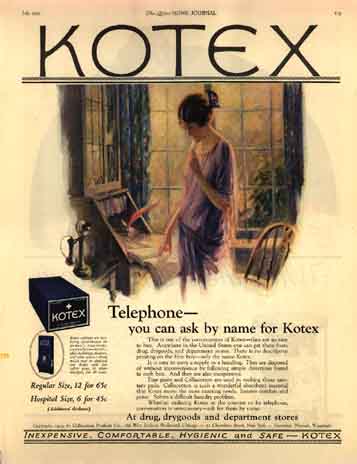
Kotex ad, July 1923, (with proof), U.S.A.
This early, beautiful Kotex ad shows
themes running through the whole
history of menstrual products
advertising: concealment, shame, comfort
and ease of disposal. (See discussions
of other ads
for these topics.) The ad mentions laundry; most
women used washable
pads or rags before Kotex
appeared, in 1921, and many did for
decades to come, because of cost.
Contrary to what the ad says, Kotex
was expensive, over five cents a pad,
perhaps 35 cents in today's money.
|
|
|
|
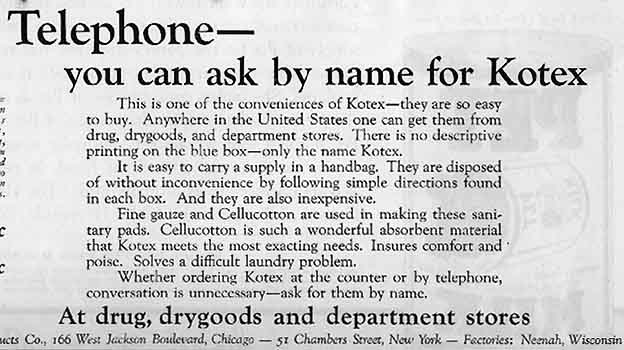
We read the themes that
appear for decades in
menstrual hygiene
advertising: concealment and
shame.
In 1923, Kotex advised women
to take the used Kotex apart
and flush it down the toilet
(see a demonstration in an early
booklet in Spanish).
Other companies have sold flushable
pads, not always
successfully.
|
|
|
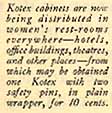
This enlargement of the
text to the left of the
above text shows that dispensers
for Kotex appeared in the
early 1920s. A University of
Maryland student recently
(October 1999) complained to
me that she couldn't find a
dispenser on campus. I
suspect the small size and
increased absorption of pads
and tampons today enable
women to change them less
often, necessitating fewer,
or no, dispensers. The
companies probably figure it
isn't worth the money to
keep them. Certainly
menstrual cups
can make life easier, for
some women, anyway.
|
|
© 1999 Harry Finley. It is illegal to
reproduce or distribute
any of the work on this Web site in any manner
or medium
without written permission of the author. Please
report
suspected violations to hfinley@mum.org
|