See early tampoms Dale,
Wix and B-ettes and a bunch of other
earlier ones.
See San-Nap-Pak sanitary napkin ads
from 1932 and 1945 and Ads for teenagers.
See the roughly contemporary Cashay tampon, box,
instructions. (Procter & Gamble
donation, 2001), and
Dale (U.S.A.,
1930s?-1940s?) Tampons, box, instructions.
(Procter & Gamble donation, 2001)
And, of course, the first Tampax AND -
special for you! - the American fax
tampon, from the early 1930s, which also
came in bags.
See a Modess True
or False? ad in The American Girl
magazine, January 1947, and actress Carol Lynley in
"How Shall I Tell My Daughter" booklet ad
(1955) - Modess . . .
. because ads (many dates).


|

Cashay tampons (1930s-1940s?, U.S.A.)
Instructions
Procter & Gamble kindly
donated the box and contents as
part of a gift of scores of
menstrual products.
|
|
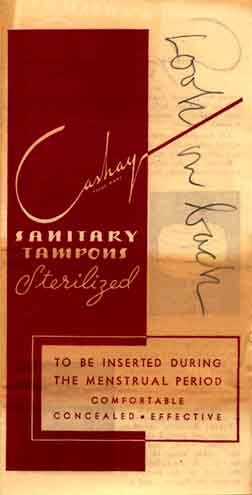
Companies
continually examine competitors'
products, or should, and a
vigilant eye at Tampax spotted
something worthy of passing on.
See the last item, below, for the
find, a clue I think to this
product's failure.
|
|
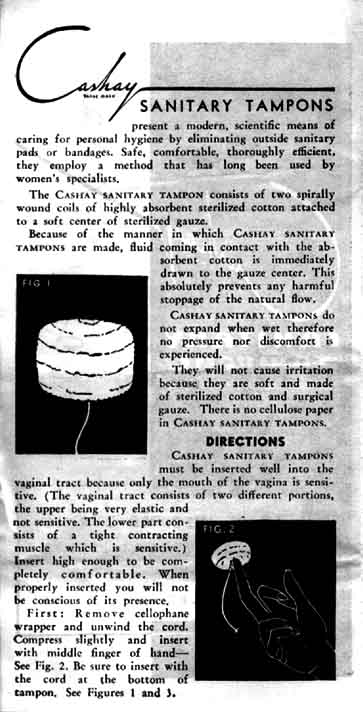
Note the word
"bandages," an old term (in the
singular) for menstrual pad.
Menstrual products used to sit in
the same section of the American
patent office as bandages for
wounds, which in a sense they are.
Kotex
started life as a bandage in World
War I; Johnson & Johnson made
bandages before it made pads and
tampons.
Cellulose and cotton seem to be
the main constituent of tampons
since their modern commercial
beginnings. I pulled the tampon
apart to show the interior, here.
|
|
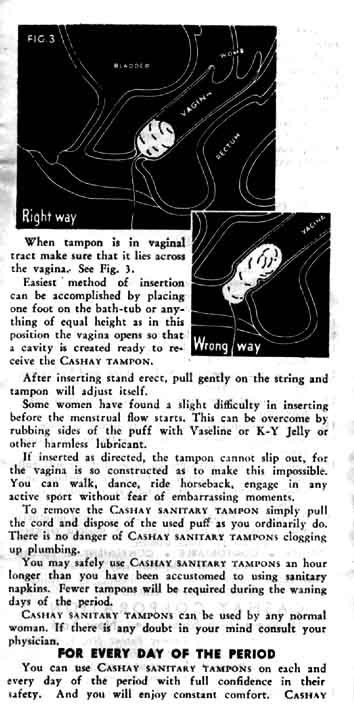
The instructions
mention only "bath-tub" by name as
the place for a woman to put her
foot when inserting the tampon. If
she were at work a toilet would be
much more likely. I wonder if this
indicates a prudish avoidance of
the word "toilet" or a hint that
the user would most likely be at
home - that is, not working.
|
|
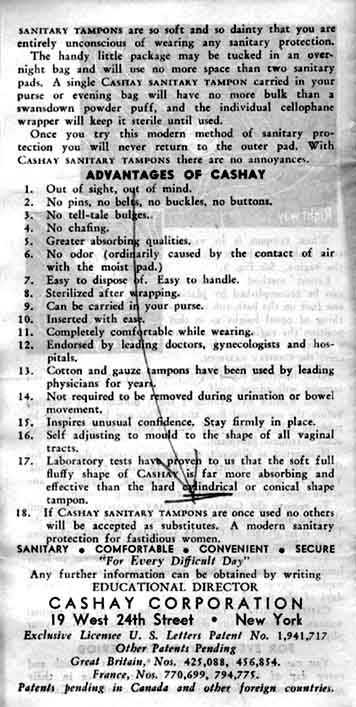
A Tampax hand -
Procter & Gamble, which bought
Tambrands, the maker of Tampax,
donated the box - probably drew
the arrow, reacting to the affront
of having its own tampon possibly
mentioned for not being as
effective as Cashay. I suspect
women found Tampax easier to
insert than this brand because of
its very hardness.
I believe women
still prefer pads to tampons in
America; the optimistic statement
that once having used Cashay you
will never use "outer pads" again
is wrong (and the company no
longer exists), especially, I
suspect, after having tried to get
the darned thing into a dry or
mostly dry vagina and without some
lubricant, which you left at home.
Other companies have lubricated
their tampons, Pursettes,
for example.
|
END See
the box and tampon.
See early tampoms Dale,
Wix and B-ettes and a bunch of other
earlier ones.
See San-Nap-Pak sanitary napkin
ads from 1932
and 1945
and Ads for
teenagers. See the roughly
contemporary Dale
tampon, and very early Tampax
and fax.
© 2001 Harry Finley. It is
illegal to reproduce or distribute
work on this Web site in any
manner or medium without written
permission of the author. Please
report suspected violations to hfinley@mum.org
|
|