See also Australian
douche ad (ca. 1900) - Fresca douche powder (U.S.A.)
(date ?) - Kotique douche liquid ad, 1974 (U.S.A.)
- Liasan (1) genital wash ad, 1980s (Germany)
- Liasan (2) genital wash ad, 1980s (Germany)
- Lysol douche liquid ad, 1928 (U.S.A.) - Lysol douche liquid ad, 1948 (U.S.A.) - Marvel
douche liquid ad, 1928 (U.S.A.) - Midol menstrual
pain pill ad, 1938 (U.S.A.) - Midol booklet (selections),
1959 (U.S.A.) - Mum deodorant cream ad, 1926 (U.S.A.)
- Myzone menstrual pain pills ad, 1952 (Australia)
- Pristeen genital spray ad, 1969 (U.S.A.) -
Spalt pain tablets, 1936 (Germany) - Vionell genital spray ad, 1970, with Cheryl Tiegs (Germany)
- Zonite douche liquid ad, 1928 (U.S.A.)
The Perils of Vaginal Douching (essay by Luci
Capo Rome) - the odor page

|

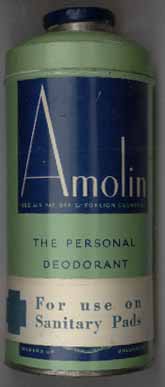
Amolin, The Personal Deodorant Powder, for menstrual pads
(U.S.A., 1930s?)
Disguising the odor of menstrual discharge is an important task for
women in America and many other countries. Not only is it thought objectionable in itself, the odor lets on that a
woman is menstruating, a fact which, for some
reason, must be concealed to avoid shame and discrimination. Menstrual
huts, on the contrary, advertise that women are menstruating, although
they segregate women. (Read what Prof. Sally Price says about menstrual
segregation.)
Does our culture conceal menstruation so that
women are not segregated - at least for that reason? Why would menstruation
require segregation? Why does America so dislike body odor? Why don't I
make any money doing this?
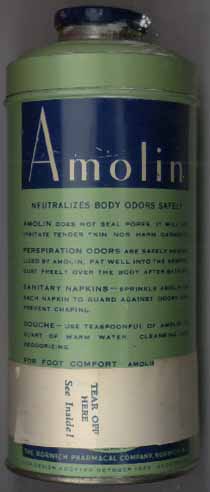
Amolin powder - it might be baking soda - covered many bases in the
odor department: feet, armpits,
vagina (by douching with it), menstrual pads,
and, the can says, the whole body, actually.
In April, 2005, an e-mailer wrote the following:
Your description says it might have been baking soda. It may have had
baking soda as a base, but the deodorizing effect was enhanced by adding
something from the amole (soap) plant. It was around until the early 1960s.
Women used it for feminine odor and men and boys used it for foot and
underarm odor. In the 1950s and 1960s I believe its manufacturer was Norwich
(Pharmaceuticals?).
|

Above: front of can
See the white paper band, on
the lower part, below
Right: back of can
|

|
 |
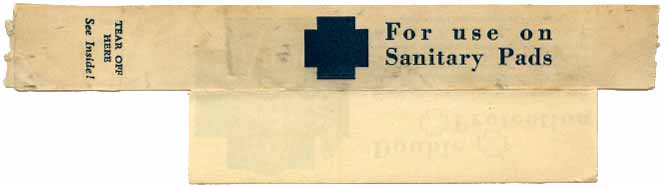
The paper band surrounding the can. In
my capacity as the director of MUM - hey, I bought it at auction! - I opened
the band, intact for maybe 60 years. A bold move, but how are you gunna
find out what's on the other side if you don't? You can sense my guilt.
I should have steamed it open, darn it!
|
|
 |
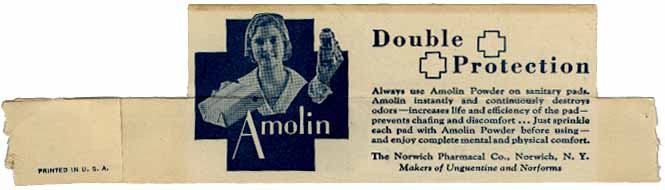
The inside of the band; the smaller top
section folded up from beneath the band.
The woman looks suspiciously like a nurse.
If so, that would complete the medical impression started by the crosses,
thus socking the user in the jaw with doctor/nurse credibility, common at
that time and today! Both Kotex and Modess used crosses at one time or another to enhance
their credibility.
|
|
See the Kotex Quest menstrual pad deodorant
But read what really causes menstrual odor - you won't
like it. See also Australian
douche ad (ca. 1900)
© 1999, 2005 Harry Finley. It is illegal
to reproduce or distribute work
on this Web site in any manner or medium without written permission of the
author.
Please report suspected violations to hfinley@mum.org
|