Read a Personal Products booklet for older
girls from about this time, The Periodic Cycle
(1938). See similar
booklets on this site.
See a Kotex ad
advertising a Marjorie May booklet.
See many more similar booklets.
See ads for
menarche-education booklets: Marjorie May's Twelfth
Birthday (Kotex, 1932), Tampax
tampons (1970, with Susan Dey), Personal Products
(1955, with Carol Lynley), and German o.b. tampons (lower
ad, 1981)
And read Lynn Peril's series
about these and similar booklets!
Read the full text of the 1935 Canadian edition
of Marjorie May's Twelfth Birthday, probably
identical to the American edition.
More ads for teens (see also introductory page for
teenage advertising): Are
you in the know?
(Kotex napkins and Quest napkin powder, 1948,
U.S.A.), Are
you in the know?
(Kotex napkins and belts, 1949, U.S.A.)Are you in the know? (Kotex napkins, 1953, U.S.A.),
Are you in the know? (Kotex napkins and belts,
1964, U.S.A.), Freedom
(1990, Germany), Kotex (1992, U.S.A.), Pursettes (1974, U.S.A.), Pursettes (1974, U.S.A.), Saba (1975, Denmark)
See early tampons
and a list of tampon
on this site - at least the ones I've cataloged.


|

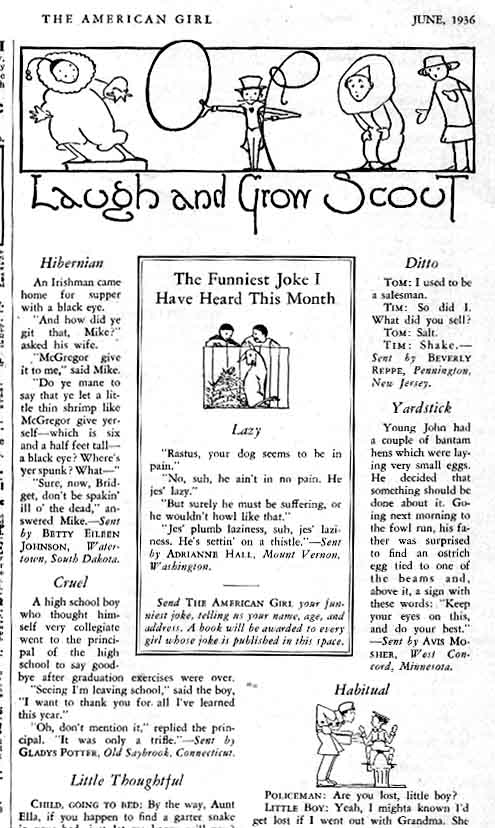
Ethnic Jokes in The American Girl Magazine,
June 1936
This has nothing to do with women's
health - physical, at least - but is
so extraordinary, and it reminds us of
another era in America, when drinking
fountains had "whites only" signs.
Girls, probably Girl Scouts - the
Girl Scouts of America publishes this
magazine - sent in the jokes below,
including the three using supposed
speech patterns of the ethnic groups
in question. All three stories
("Hibernian," "The Funniest Joke . . .
" and "The Reason," the latter from
the May issue) illustrate alleged
traits of American minorities: the combativeness of the
Irish, laziness of the blacks and
stupidity of the Swedes.
I suspect jokes about Jews had
stopped receiving support from
mainstream magazines by this time.
"Nice" girls sent these in and THE
Girl Scout magazine published them.
How times have changed! I wonder when
blacks first became Scouts. And there
must have already been Swedes and
Irish girls as members. How did they
feel about such stories?
How many Girl Scouts today or anyone
else know what Hibernian
means? Do you?
Why do these jokes feature males (except
for Aunt Ella)? Do they challenge a
society much more male oriented than
today's America? Or maybe girls were
traditionally not featured in humorous
stories.
|
|
|
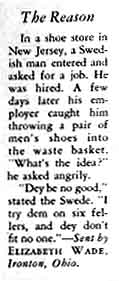
Above: from
the May 1936
The American
Girl
|
Above: from the
June 1936 The
American Girl
|
|
© 1999 Harry Finley. It is illegal to
reproduce or distribute any of the work
on this Web site in any manner or medium without
written permission of the author.
Please report suspected violations to hfinley@mum.org
|