See a roughly contemporary
pad, Society, and
a "silent purchase"
ad for Modess, 1928.
Other Modess ads:
1931,"Modess . . . . because"
ads, the French
Modess, and the German "Freedom"
(Kimberly-Clark) for teens.
See a prototype
of the first Kotex ad.


|

The perfect menstrual pad 4 (1 2 3 4a 5):
Conclusions and
recommendations
"Report of Gilbreth,
Inc.," to Johnson & Johnson
Company, 1 January 1927, about
how to improve the company's menstrual
products, especially with regard to
competition with Kotex pads
Dr. Gilbreth's report changed
the way companies made and
marketed pads. Although I have
just hinted at her findings, I
will quote her conclusions and
mostly summarize her
recommendations. I did not report
on the second
part of her paper dealing
with contributing to the "health problem,"
but some of her comments refer to
that.
Dr.
Gilbreth's Recommendations for
Napkins (menstrual pads)
[partly my summary, partly quotes]
|
|
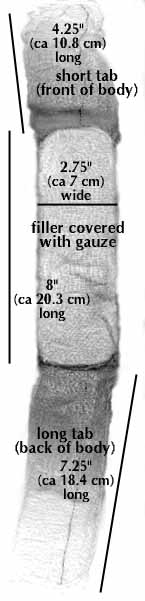
Above: The
improved Modess pad (from the MUM
collection), probably
from the 1930s, mostly conforming
to Gilbreth's recommendations.
Note the rounded
corners of the filler and
the different
lengths of the tabs. But
the tabs do not taper, as
recommended, and the filler is the
same thickness throughout rather
than being thicker in the center.
|
Tabs
(see the
almost-perfect 1930s Modess, at
right [in more detail,
here]:
tabs are gauze, the long, flat
ends of pads that had no filler
and attached to a holding device,
like a belt)
1. The front tab should be
shorter than the back. (See why.)
2. The tabs should be shorter
than they are now in Modess.
But tabs can't be made to
fit every woman because some
women wear belts at their
waists, some at their hips.
Because the quality of gauze
in sanitary napkins is not
good enough to use with safety
pins or grips, the wearer must
fold it and this requires
extra length.
3. Tapered tabs would be good
if the quality of gauze
improves; women achieve this now
by folding.
Filler
(the thick part in the center of
the pad that absorbs the menstrual
discharge)
1. The center of the filler
should be thicker than any other
part.
2. The thickness should be
graduated toward the ends.
3. If the corners are cut off
or rounded, the present length
of the Modess filler is all
right, but it would be more
satisfactory to many if it were
0.5 inch shorter (ca. 1.25 cm)
4. If the corners are left
square, the filler could be one
inch shorter (2.54 cm)
5. The sides of the filler
should be rounded
6. The lower fold of should
reach completely over to the
edge of the filler, and the
upper fold should go completely
over the filler so that even
with the outer edge folded in,
the filler is completely covered
twice. By covering twice, we
mean that only the back of the
filler should have two layers of
gauze.
7. The raw edge of the gauze
should be folded in so that
there will be no danger of loose
threads raveling out.
8. The gauze should be softer
in quality than that in the
present Modess napkin. Flimsy
gauze over a fiber filler is
especially harsh.
|
General
Conclusions of the Report
[directly quoted from the report]
1. A general health campaign
on the subject of menstruation
is advisable.
2. This should address the
fact that the normal woman can
safely pursue her usual program
and profit by so doing.
3. The woman who is not normal
in any respect should have
expert advice. This in most
cases takes the form of special
exercises, corrective work,
abdominal supports, etc. These
may be combined with psychiatric
treatment of some sort to remove
fears and worries.
4. Such a health campaign
could best be conducted probably
by some institution which has
already gained the confidence of
the public and especially of the
women and which is not suspected
of a commercial bias.
5. No one type of sanitary
napkin can possibly meet all
needs. Where price is no object,
a cotton napkin is preferable to
the product made of fibre or
paper. At least three sizes are
indicated.
General
Recommendations of the Report
[mostly my summary]
1. The health campaign should
be carried out
2. Combine the results of this
report with others that J &
J may have to find similarities
and dissimilarities, and why
3. Study carefully the number
of types of pads J & J needs
to make to meet all needs.
Continue Nupak and continue
Modess in its smaller form. It's
questionable that a large fiber
[fill] napkin should be made to
compete with Kotex. College and
young business women like the
small Modess, but older women
may want to continue with a
large Kotex-like pad, but
cheaper.
4. Advertise anything, but not
disposability. "Heads of
dormitories" and others would
welcome a campaign stressing
that in the present situation,
pads clog plumbing
5. Use people who are already
established for future research
6. [Not readable in my notes.]
7. People who filled out
questionnaires are more likely
to want to try out new pads
8. Don't make changes in the J
& J laboratory before all
reports have been studied and
compared
9. Make these changes in the
Modess pad:
a. Rounded sides with cotton
wrapping
b. Soft filler with soft
gauze covering
c. Gauze of sufficient body
to insure a feeling of safety
d. Gauze folded completely
over the filler and its raw
edge turned under
10. Women demand that the pad
be inconspicuous; this must be
done! Cut off the corners if it
is not too expensive or
difficult
11. Comfort is the first
requirement, according to the
questionnaires
The copy of the report that I
read, which may be unique, rests
in the special collections of
Purdue University, West
Lafayette, Indiana, U.S.A. Dr.
Gilbreth was the first woman
engineering professor at Purdue.
©
2000 Harry Finley. It is illegal
to reproduce or distribute work
on this Web site in any manner
or medium without written
permission of the author. Please
report suspected violations to hfinley@mum.org
|
|