Camelia
(early German disposable still widely sold)
The camellia (English spelling of the
flower) of the brand has a exceptionally naughty
history and would have never been
tolerated in the U.S.A. I can imagine the
torchlight processions of enraged citizens.
Dutch booklet (excerpts)
describing the pad and its origin (probably
1928). Ads: 1920s
(Germany), 1930s
(Germany), 1930s
box, etc., terrific
1930s ad!, 1940/41
(Germany), 1952
(Australia), 1973
Germany (shows the new adhesive pad through
panties), 1970s
(France), 1990,
also 1990 (white
pants) (Germany), 1992
(Germany) using white pants, 2003 (Austria)
Booklets
menstrual hygiene companies made for girls,
women and teachers - patent
medicine - a list
of books and articles about menstruation
See early tampons
and a list of tampons
on this site - at least the ones I've
cataloged.


|
Camelia
self-adhesive 2000 menstrual
pad ad, 1973, Germany
Camelia 2000 selbst-sichere
Binde Werbung, Deutschland
menstruation, women, health
Camelia was the first widely
used disposable menstrual pad in
Germany (1928)
although that country was a
pioneer in disposables (Hartmann;
America made an early disposable
called Lister's
pad). Kotex
sold the first widely successful
disposable in America - and later
absorbed the Camelia company!
To say Camelia enjoyed a colorful history
understates it; torch-carrying
Americans would not have
tolerated making the company's
early logo a p-. well,
you see
and read about it.
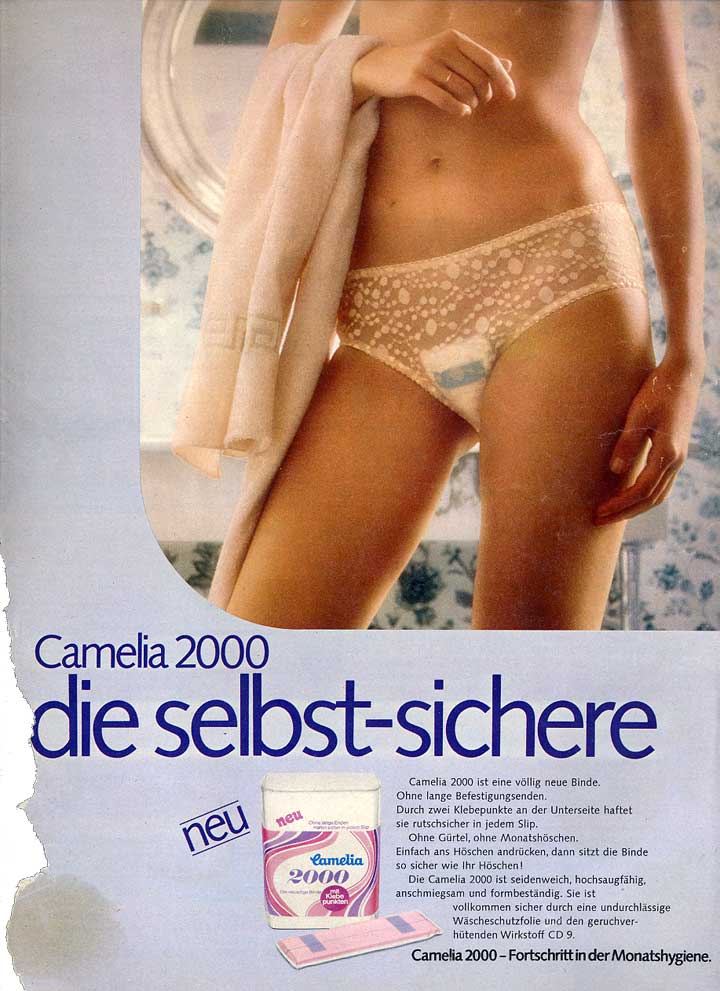
This magazine ad promoted the recently
developed adhesive pad,
which supplanted the hated belt and huge pad
that encumbered women for probably
thousands of years in various
manifestations.
An earlier
Dutch ad compared the new
adhesive pad with the old
belt-and-pad.
And an early
Dutch booklet contains a
great picture of Camelia's earlier
amusing logo.
The French published a similar ad
for Camelia in the 1970s.
More
Camelia: The camellia
(English spelling of the flower)
of the brand has a exceptionally
naughty history and would
have never been tolerated in the
U.S.A. I can imagine the
torchlight processions of
enraged citizens. Dutch booklet
(excerpts) describing the
pad and its origin (probably
1928). Ads: 1920s
(Germany), 1930s
(Germany), 1930s box,
etc., terrific
1930s ad!, 1940/41 (Germany),
1952
(Australia), 1973
Germany (shows the new adhesive
pad through panties), 1970s
(France), 1990,
also 1990
(white pants) (Germany), 1992
(Germany) using white pants, 2003
(Austria)
|
Below:
Camelia ad, 1973, about 9 x 12
3/16" (about 22.8 x 31 cm).
See a similar
ad for Camelia in a French
magazine (1970s).
My
translation lies below the ad.
|
 |
Translation:
Camelia 2000
the self-securing
Camelia 2000 is a completely new
menstrual pad.
Without long attachment ends [as
in the old pad-and-belt
combinations].
Two adhesive strips hold without
slipping in all panties.
Without belt, without sanitary
panty.
Simply press into the panty; the
pad sits as securely as your
panties!
Camelia 2000 is as soft as silk,
adapts to your form, and retains
its form. It's
completely secure because of a
impenetrable underwear
protection layer and the odor
preventative substance CD 9.
Camelia 2000 - progress in
menstrual hygiene
new [to the left of the
Camelia package]
|
More
Camelia exceptionally
naughty
history Ads: 1920s
(Germany), 1930s
(Germany), 1930s
box, etc., terrific
1930s ad!,
1940/41 (Germany),
1952
(Australia), 1973
Germany (shows the new adhesive pad
through panties), 1970s
(France),
1990, also 1990 (white
pants) (Germany), 1992
(Germany) using white pants, 2003 (Austria)
© 2010 Harry Finley. It is illegal to
reproduce or distribute any of the work on
this Web site in any manner or medium
without written permission of the author.
Please report suspected violations to hfinley@mum.org
|