

|

Anna Health Sponge for
menstruation (and contraception?)
(U.S.A., 1940s?)
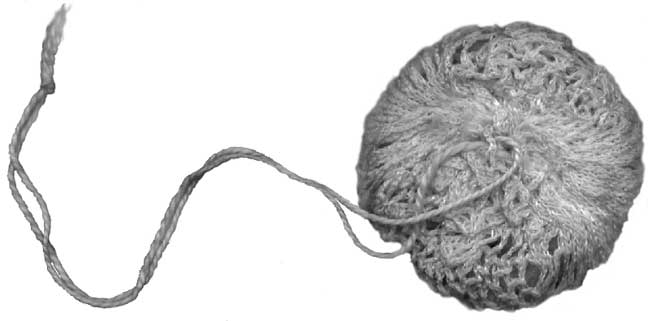
This sponge, judging by
typography possibly from the
1940s, is very similar to the
other sponges in the museum in
size (see some dimensions),
suggesting
that there was one source for the
cans and contents.
The words "requires no belt" on
the side of the can (see below)
put it in the pre-self-adhesive
era, thus before the early 1970s.
(See some American belts and
an early self-adhesive
pad).
This is the only sponge the
museum has that seems to
explicitly promote its use for
menstruation - "requires no belt,"
on the side of the can, below -
although that would not prevent
its use for contraception.
In
January, 1999, I received this
e-mail from the grandson of the
woman for whom the sponge is
named:
Dear
H. Finley:
You
ask if anyone
remembers the Anna
Health Sponge.
Well, yes, I do.
My
grandfather Harry Z.
Cohen was a partner
in the American
Sponge and Chamois
Company, which
manufactured the
article. He named it
after my grandmother
Anna B. Cohen.
It
has long been a
family joke that our
grandmother's name
was on thousands of
women's lips.
Sincerely,
Lewis
H. Rubman
|
See another
menstrual product that took the
similar name of a real person,
this one famous - and also a
Jew.
And toward to bottom
of this page read the name of
the STREET the company was
located on! There's a conspiracy
afoot!
NEXT:
The contemporary Sea Pearls
(from the U.S.A.) menstrual
sponge
The contemporary Gynotex
(from the Netherlands)
menstrual sponge
Beautiful
(Australian?) sponge can
with sponge lacking a
net.
Anna
Health Sponge
(U.S.A., 1940s?)
Cardboard
American sponge can with
sponge.
Orange-design
can
with sponge. Black
can and sponge.
Main sponge page
Procter
& Gamble kindly donated
the sponge to the museum in
2001.
|
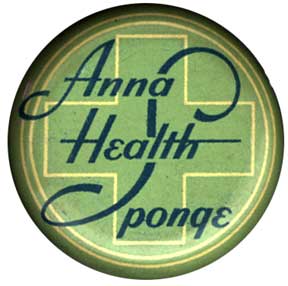
Above:
top of can
|
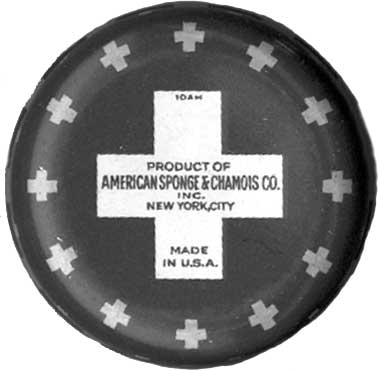
Above:
Bottom of can
|
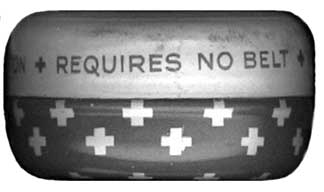
The words
around the side, above,
read, " REQUIRES NO BELT
- INVISIBLE - COMPLETE
SANITARY PROTECTION." Belts,
of course, held a
menstrual pad between
a woman's legs in
the pre-adhesive-pad
era, although a few
women still use them.
|
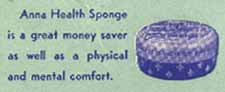
In
October 1997 Tambrands
gave the museum this
instruction sheet for
the sponge. Read above
about who named this
sponge for whom - supposedly;
ruminate on the name
of the street
on the can, below.
|
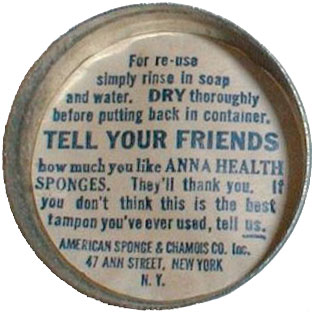 |
Above:
A frequent contributor
sent this scan of the
interior of the cap of a
case, not the one shown
here. Very
strange that the
company is on ANN
Street.
I think by calling it
a tampon the
notice predates, say,
1940, since the first
commercial tampons
appeared in the early
1930s; it actually IS
a tampon, a small
absorbent object
inserted into the
vagina to deliver a
drug or to absorb
something, maybe
menstrual discharge.
The company perhaps
wanted to join the
bandwagon of the then
new fabric commercial
menstrual tampons.
|
|
|
|
|
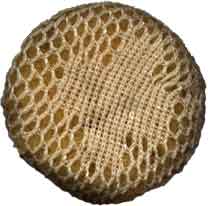
Look at the cross
in the fabric! Manufacturers
stopped at nothing to make a
medical connection.
|
NEXT:
The contemporary Sea
Pearls (from the U.S.A.) menstrual
sponge
The contemporary Gynotex (from
the Netherlands) menstrual sponge
Beautiful
(Australian?) sponge can
with sponge lacking a net.
Anna Health Sponge
(U.S.A., 1940s?)
Cardboard
American sponge can with sponge.
Orange-design can
with sponge. Black can and
sponge.
Main
sponge page
© 2007 Harry Finley. It is illegal to
reproduce or distribute work on
this Web site in any manner or medium
without written permission
of the author. Please report suspected
violations to hfinley@mum.org
|