See Cameo and Ortex Gold tampons, the
same tampon in different packaging for
different countries.


|
Anshin
origami menstrual tampon (Japan,
1977) (the same as Ortex in the
Netherlands and, earlier, Cameo in
Japan)
Irony
as you like it!
The Japanese tampons on this site
surprise you by their originality,
which might have been to avoid
patent conflicts with Tampax and
other applicator tampons.
I suspected this might have been
an early Japanese tampon because of
the English writing (and Caucasian
models) and because the Japanese
seem to much prefer pads.
But this is
actually a British tampon - Cameo - adapted to the
Japanese market just as the
packaging for Tampax has been
changed for markets outside the
U.S.A. I thank a Dutch
contributor for pointing this out
and sending proof, which I add here. But
the tampon also appeared under its
original name in Japan, Cameo (gift
from Tambrands)! A menstrual
melodrama (or something)
and known as Ortex Gold Soft in The
Netherlands! I'll show proof of all
these claims.
We know how talented the Japanese
are folding paper into interesting
shapes - origami (literally "bending
paper") - and the user of Anshin got
plenty of practice doing this. It
would have helped if she read the instructions
first.
Another tampon came with finger cots.
Read some comments about the
Japanese Elldy
tampon.
In 1997 Tambrands gave the box
to this museum as part of an amazing gift
of 450 boxes of tampons dating to
the founding of the second Tampax
company, 1936, plus hundreds of
other items. And thanks to a Dutch
contributor for pointing out the
British connection and sending
proof.
|
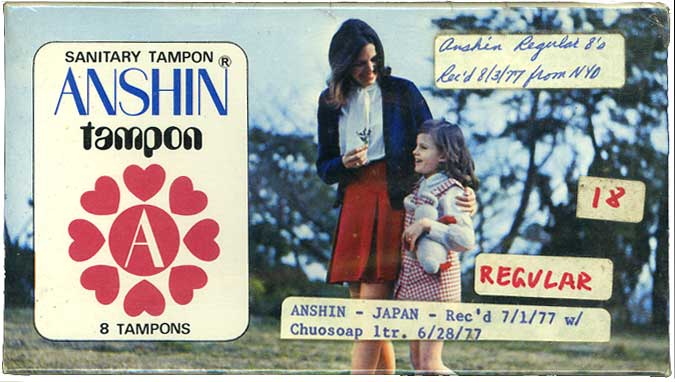
Below:
Both large sides of the box are the
same. Note the non-Asian people,
probably reflecting the original
manufacturer,
an English company. People at the
former Tambrands (which made Tampax)
marked the box. The box measures 6
1/8" x 3 3/8"
x 7/8" (15.5 x 8.5 x 2 cm).
|
 |
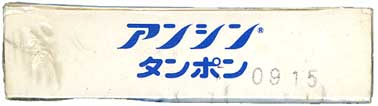
Below:
The two long, narrow sides are also
identical. Below this is an
enlargement in case you want to
freshen up your Japanese.
The blue
characters say Anshin
tampon (actually taNpon, I
believe) in katakana, one of the two
Japanese phonetic scripts.
|
 |
 |
Below:
The ends are indentical.
|
 |
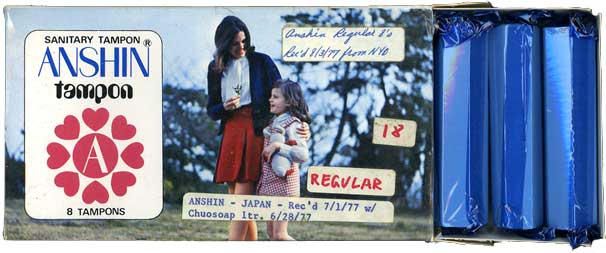
Below:
Open an end and pull out a drawer of
tampons in colorful wrappers!
|
 |
Below:
When written in Chinese-Japanese
characters (kanji) the name of the
tampon looks like the picture below.
In commerce, companies
sometimes use phonetic symbols
rather than kanji, probably to
eliminate any question of
pronunciation - how could you
sell something if you couldn't
pronounce it? -, which can confound
even the Japanese. And you thought
English was bad!
|
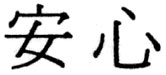 |
"AN"
is one pronunciation of the
character at left. In one of
the greatest
ironies of
menstrual hygiene (keep
reading!) it means restful,
easy or cheap -
restful in this case. It
suspiciously comes from an
original Chinese character
created thousands of years
ago showing a woman sitting
on a menstrual pad - no,
really! See more explanation.
"SHIN"
and "kokoro" are
pronunciations of the
character at right and it
means heart
or feelings.
Together, the characters in
Japanese (ANSHIN)
mean peace
of mind or relief.
THIS IS IRONY IN
ITS HIGHEST FORM!
See how you
feel as you read the
instructions!
|
|
© 2006 Harry Finley. It is illegal to
reproduce or distribute any of the work on
this Web site in any manner or
medium without written permission of the
author. Please report suspected violations to
hfinley@mum.org
|