See ads
for menarche-education booklets: Marjorie May's Twelfth
Birthday (Kotex, 1932), Tampax tampons (1970,
with Susan Dey), Personal
Products (1955, with Carol Lynley),
and German o.b.
tampons (lower ad, 1981)
And read Lynn Peril's series about
these and similar booklets!
Read the full text of the 1935 Canadian edition
of Marjorie May's Twelfth Birthday, probably
identical to the American edition.


|

The Kotex
puberty & menstruation booklet
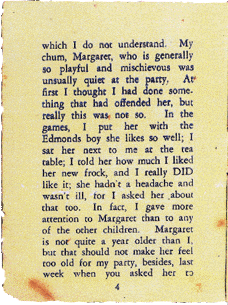
Marjorie May's Twelfth Birthday, 1929
Next page
(cover, pages 3, 11, 12-13, 14-15)
|
In pages 5-10, Marjorie May's
mother explains that Marjorie's
chum is experiencing a purification,
an interpretation proposed by Hippocrates
thousands of years ago, and alive
today in the thesis of MacArthur Fellow
Margie Profet, who opines
that menstruation is partly the
body's way of ridding the uterus
of pathogens brought by sperm from
the vagina, which contains
billions of bacteria and other
micro-organisms. But menstruation
neutralizes the acidity of the
vagina, enabling fecal bacteria to
invade and feed on the discharge,
causing the characteristic odor of
menstruation. (See the odor page.)
Using the word purification
calls forth cleanliness,
health
and whiteness, which the
Kotex manufacturer promoted. The
company also put a cross on its
boxes, reinforcing the medical
connection: Kotex developed from
bandages made by Kimberly-Clark
during World War I. But it also
played on the public's respect for
physicians. (Tampax, in the late
1930s, claimed an endorsement by
the American Medical Association;
it later abandoned this under
pressure from that association.)
The Cellucotton Products Company,
which made Kotex and which
Kimberly-Clark owned, changed the
size "super" to "hospital" (which
persists today with some
manufacturers) to firm this
connection; and women at the time
felt embarrassed to ask for
"super" because of its
implications.
This copy of Marjorie May's
Twelfth Birthday is in the
collection of the Powerhouse
Museum, Sydney, Australia, and
is reproduced here with the kind
permission of the Curator of
Health and Medicine at that
museum.
© 1999 Harry Finley. It is
illegal to reproduce or distribute
any of the work on this Web site
in any manner or medium without
written permission of the author.
Please report suspected violations
to hfinley@mum.org
|
|