See Kotex's first successful tampon, Fibs; early Kotex tampon attempts; and an early Tampax.


|

A.C.C. Tamponettes menstrual tampons
(1939, The Absorbent Cotton Company, U.S.A.)
Instructions
The explanatory leaflet in the
packaging, below, mentions that
tampons "have
been in use in European countries
for over thirty years." To
the best of my knowledge these were
not commercial tampons but homemade. Dr.
Robert Dickinson mentions many
American women making their own
tampons in 1942.
A friend told me that a well-known
German man she once worked for in
America told her that his mother had
made her own tampons, sewing them at
home, in late 19th-century or early
20th-century Germany. Americans I
believe introduced commercial tampons
to Europe, and before World War II
(Tampax; see three
1938 Dutch ads), the first
indigenous brand being (I think) the
German o.b. ("ohne
Binde,"
"without a pad" - see a German folder
from the early 1950s). Tambrands gave
this museum a box of Tampax in French
and dated the box to the late 1930s.
The text (below) also says, "In the theatrical
profession tampons have long been a
necessity but have been mostly of
home-made construction . . .
." Compare this to what the authors of
Zur Geschichte
der Unterwäsche 1700-1960
(discussion)
write about early menstrual protection
in Germany, that virtually only those
in the theater used such protection
before roughly 1900 (they mention
close-fitting pads and sponges, but
not tampons).
"[M]ostly of home-made construction"
might indicate that the only other
tampons were medical
ones that doctors used. Or were
there commercial ones before the
earliest American ones from the 1930s
(see some
the museum has)?
Procter & Gamble kindly
donated the box and contents as part
of a gift of scores of menstrual
products.
|
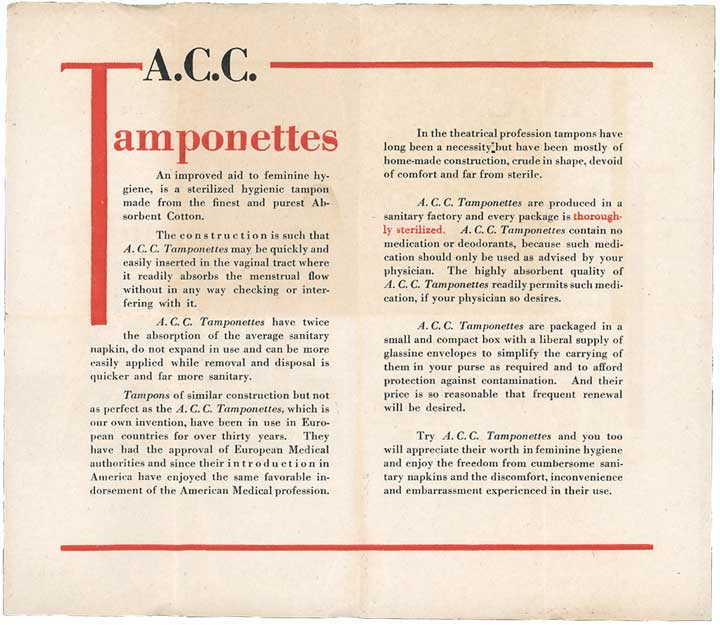
Below:
The opened introductory leaflet (it
folds in half heightwise) measures 7
1/8 x 6 1/4" (18.1 x 15.9 cm).
Fear of blocking
the menstrual flow is an old concern
and probably stopped many women from
trying tampons.
Note the mention of European tampons;
read the commentary at the top of this
page. Didn't Americans in
the theater use tampons? This leaflet
is from the older box but seems
identical to that of the 1939 one.
The manufacturers write that the
tampon contains
no deodorants or medication,
a fact that puts them
ahead of many current products.
Read a slightly later (1945) comparison
between tampons and pads, which
favored tampons.
|
 |
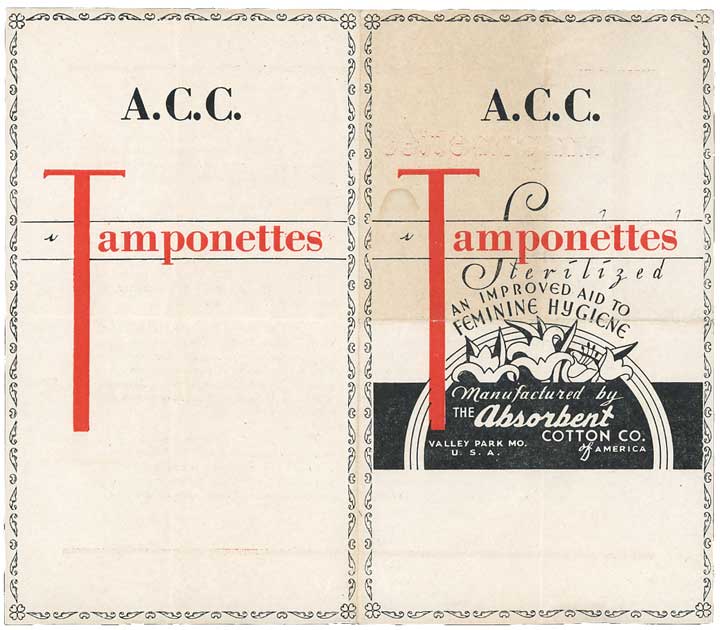
Below:
The back and front sides of the
leaflet. That's a bold red! The
art-deco half circle
(à la Chrysler Building) at
right shows the menstrual
flowers often associated with
menstrual products.
Flowers in menstrual usage probably
derive from the French flueurs, flow
(read more).
And art deco
itself comes from French;
Merriam-Webster online writes, "French
Art Déco, from Exposition
Internationale des Arts Décoratifs
et
Industriels Modernes, an
exposition of modern decorative and
industrial arts held in Paris, France,
in 1925 [emphasis added]."
|
 |
|
The last and first
pages of the instructions (3.25 x 7"
[16.5 x 8.2 cm) opened), which show
the red, a
color seldom found today on
menstrual packaging, and much more
often on these early boxes.
|
|
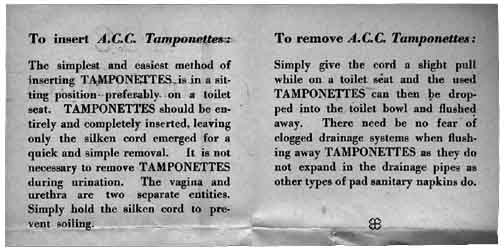
The cord may be silken,
but it looks like cotton to me; this
might be an attempt to dignify the
topic.
In spite of the
assurance, tampons and pads clogged
drains everywhere. Read the comments
and anecdotes in Dr. Lillian
Gilbreth's Johnson & Johnson
report (1927).
|
© 2008 Harry Finley. It is illegal to
reproduce or distribute any of the work on this
Web site
in any manner or medium without written
permission of the author. Please report
suspected
violations to hfinley@mum.org\
|