|


|

Continued to next earlier News & Notes
NEW
this month (news & letters BELOW):
Would you stop menstruating if you could?
Words and expressions about menstruation: New: Australia:
Drain the sump, Raising the Japanese flag, Riding the
white surfboard; England:
Full stop; Germany: I'm
working on something, You're homemade; Jamaica: I'm having my
ladies' period [more comments]; U.S.A.:
(Employing the) Doubled barreled technique, Menestrate
What did European and
American women use for menstruation in the past?
Humor
Low-ranking monkeys become depressed,
lose estrogen, and die earlier, but still menstruate
The online edition of New Scientist
magazine (www.newscientist.com, 5 February)
reported,
"Lower-ranking females were more
likely to become depressed, the researchers found:
they slouched around staring at the floor and lost
all interest in their environment. They were also
more likely to die prematurely. Five out of the nine
most depressed animals died before the end of the
experiment. The team's results appear in The
Journal of Biological Psychology (DOI:
10.1016/j.biopsycho.2004.11.006).
"The most depressed monkeys had
earlier lost body fat, developed higher heart rates
and become less active. Their blood accumulated
fatty components linked with heart disease, they had
increased bone loss and their stress hormones were
disrupted. Levels of oestrogen and progesterone both
dipped, indicating impaired ovarian function.
'That's five or six major systems in the body that
are dysregulated by depression,' [Carol] Shively [of
Wake Forest University School of Medicine] told New
Scientist. We tend to think of depression as
purely psychological, but there is more to it than
that. 'Depression really is a whole-body effect,'
she says."
"[Barr] fails to mention frequent and
sometimes substantial bleeding, the FDA . . . said"
Barr Pharmaceuticals makes
Seasonale, a hormone drug that allows women to
have only four periods a year - at least that was
the plan. But read on . . . .
"FDA Warns Barr Over Seasonale
Commercial
"Fri Dec 31, 2:49 PM ET Health -
Reuters
"WASHINGTON (Reuters) - A television
commercial for Barr Pharmaceuticals Inc.'s Seasonale
misleads consumers by excluding risk information to
make the birth control pill seem safer, U.S. health
regulators warned in a letter released on Thursday.
"The commercial suggests use of the
oral contraceptive leads to only four menstrual
periods a year but fails to mention frequent and
sometimes substantial bleeding, the FDA (news - web
sites) said in the Dec. 29 letter.
"Barr's advertisement plays down the
risk of irregular menstrual bleeding that can be as
heavy as a regular period by suggesting it would
subside with continued use of the pill, the letter
said.
"The FDA posted the letter Thursday
on its web site at www.fda.gov/cder/warn"
(a pdf from December 2004)
Read more about suppressing your
period here.
Buzz off if you're menstruating!
How often does this happen? Caitlin
Flanagan writes in the New Yorker magazine ("The Price
of Paradise," 3 January 2005) that she was a guest in
a mega-luxury hotel in Hawaii, The Grand Wailea, and
"During our first night there, a
letter from the concierge was slipped under the
door, informing us of the next day's roster of fun
and also instructing us not to go to breakfast in
bare feet or to the Napua cocktail reception in a
bathing suit. The fine print on the sumptuous Spa
Grande brochure forbids 'ladies on their cycle' from
sullying the Jacuzzi."
Does anyone know of other hotels,
resorts or such public areas prohibiting menstruating
women from doing something, like entering?
If so, write me and I'll
put it on this news page.
"Menstrual blood" makes "terrorists"
talk?
An American woman interrogating an
allegedly terrorist Muslim man imprisoned in
Guantanamo, Cuba, smeared menstrual blood on his face
to help him fess up. Apparently the blood was not
real. I suspect the technique would have worked almost
as well, if it worked at all, with Christian men.
("Demütigende Verhöre im Minirock," Spiegel
Online, www.spiegel.de, 28 January)
Australian Museum opens menstruation
site
The largest museum in Australia, the
Powerhouse, shows some of its collection of
menstruation items ("The Rags: an unmentionable
history") at http://www.powerhousemuseum.com/rags/
, which includes menstrual anecdotes gathered
from around Australia.
The Powerhouse will get this museum's -
MUM's - roughly 5000 items if I fail to find a
permanent public place for it in America. Its
menstruation guru, Megan Hicks, visited me and MUM in
2000. Read about the visit here.
Tax on menstrual products might end in
New York
The Albany (New York) Times Union
newspaper ran the following (I print just an excerpt)
on 20 December 2005 (Web site here)
"In New York state, condoms and hair
loss remedies used by men are tax-exempt medical
necessities. Menstrual products are not, meaning the
5.2 million New York women who use them are paying
more than $10 million a year in sales tax to state and
local governments for tampons and sanitary pads.
"Two dozen members of the state
Legislature want to change that. Three bills to exempt
tampons and sanitary pads from sales tax are pending,
and one in each house is sponsored by a majority party
member with several male co-sponsors."
Letters to your
MUM
Tampaction for healthy menstrual
products
Hi,
I love your Web site, and wanted to
recommed another site to add to your links page: www.tampaction.org
. It is a national student run campaign to bring
healthy menstrual products to menstruators in our
communities. Hope you find it interesting! If you
would like more info, please feel free to contact
me!
Andrea Mickus
Tampaction Campaign Coordinator
215-222-4711 (SEAC office)
amickus@temple.edu
"How Bill Gates cured my PMS"
Australian group thinking of reading
MUM words
Our moonblood circle is considering
the idea of doing an impromptu reading and
discussion of some of the more colourful
expressions [in Words and
expressions about
menstruation] It's a fantastic list. Keep it up!
****
She likes the Instead menstrual cup
Dear Mr. Finley,
Great site! As an active feminist,
I am certainly impressed by your knowledge of and
comfort with menstruation. Kudos!
I write because I've been using
menstrual cups for years now; I first bought the
Instead cup [http://www.softcup.com]when
it came out. (I was in junior high at the time). I
used it and loved it, but found it too expensive
for general use, so I switched back to tampons
until I came across the DivaCup several months
ago. I absolutely love it. I am quite comfortable
with my body, and I have found little difficulty
with the cup. One thing I did discover after some
investigation is that to ensure that it doesn't
leak, it is important for the cup to completely
cover the cervix. (I check by sticking my index
finger back into my vagina after inserting the cup
and making a circle around the cup with my finger
to see if I feel my cervix. If not, I'm good to go
for 8-12 hours with no leaks!) I had minor
discomfort on occasion when the little "stem" on
the cup stuck out my vagina and poked me (much
like a tampon not inserted in far enough), but I
solved that by snipping off maybe 1/8th of an inch
of the stem. I have had no problems since.
I can't say enough good things
about the cup, especially for overnight use. I
also find it a moving experience to interact with
my own blood, if that makes sense. I feel more
connected to my body and more of a participant in
my moon-time. (It's also a good way to save blood
for making menstrual artwork, but that's another
story.) :)
Thanks for your great site!
****
And more about Instead: "[T]here's no
way in hell that sucker's gonna fit up there," but
it did
I've used tampons since I started
with my period, because I hated the bulky
nastiness of pads. Tampons were better than pads,
but tampons still leaked, tampons have a certain
odor, and tampons have that nasty little string
dangling out all the time. Plus, after a friend
went through toxic shock syndrome, I was a little
bit frightened.
I saw Instead [menstrual cup] at a
Walgreen's near my house, came home, did a bit of
research, went back and bought a box. When I first
opened the package, my initial reaction was
"there's no way in hell that sucker's gonna fit up
there." The female body's a miraculous thing
though, and with a little bit of poking and
prodding, I felt... nothing. I can't tell it's up
there. It hasn't leaked yet, through sleeping,
swimming, horseback riding, and sex. This is
miraculous. I haven't had a single problem with
insertion or removal.
****
Read about and see a new tampon
I received the following e-mail:
What is Gynotex?
Discover the advantages of the
tampons of the new generation.
\No woman of today can feel that
having her period is particularly pleasant. Even
without the - only too frequent - physical
discomforts, menstruating all too often gets in
the way of daily life and of cherished pursuits.
You know: the weekend you were looking forward to
is spoilt, once again, by your being unable to
take part in sports, to go swimming, or to visit a
sauna. And, maybe worst of all, during
menstruation, sexual intercourse very often looses
all its attractions.
After I asked about its Web site,
I received this, in addition to samples later:
We do have a Web site www.gynotex.com.
For several countries we are looking for
distributors. If you would like to receive
samples, please let me know.
Best regards,
Mark Dujardin
Flushaway products available
Hi, there,
Thanks for putting the info up
regarding the Flushaway biodegradable pads and
liners. Your visitors might like to know that
they are now available at www.drugstore.com.
Thanks,
****
Now 89,
she started douching with Lysol when she was 17!
Good morning,
I happened to be checking the 'Net
just to see if good old Lysol would be safe to use
on some new Pergo floors my hubby recently
installed in a couple of rooms.
I'm going on 89 years YOUNG . . .
LOL . . . and was very amused by the Lysol douche ad. I don't
know if I'm "still the girl my husband married" as
I have pretty bad osteoarthritis (could it have
been the Lysol?), but used Lysol as a douche and
contraceptive ever since I married at age 17!! I
had two children, both sons who turned out very
well, in spite of the Lysol!! LOL
It's rather funny as I used it
every day for many, many years because back in the
early days, we didn't have the "Pill" and Lysol
was used after "the act" to prevent unwanted
pregnancies by just about every lady I knew,
including my mother and grandmother who had just
ONE child each.
Oh, well, we must have been TOUGH
as I don't recall any problems!! LOL. Just thought
I'd drop a line as I got a big kick out of your
site and the old info.
Sincerely,
****
Toilet sign directs her to MUM
Hi there,
I saw a sticker on a toilet door at
uni and decided to investigate . . . And it landed
me here!! I was amazed at the amount of feedback
on menstrual cups on your Web site!! The only
problem for me is that I am from Australia and
there are NO manufacturers of such products here
(or I have found none so far).
Although they appear similar to the
Keeper, has anyone commented on the "Mooncup" (www.mooncup.co.uk)
or "Divacup" (www.thedivacup.com)?
Or better still - know somewhere I can get one in
Oz? [Click back through the earlier news pages,
where there are scattered comments. And I have
collected comments from 1996-1998 here.]
I am determined to get a cup now -
but now I have to weigh up which will be best with
the international postage and handling costs on
top of the cup itself!!
With delight!
****
Perth, Australia
MUM artist has exhibit in Hungary
This is a late notice - my fault
- but Fanni Fazekas, who exhibits some of her work
on this site, has an exhibit right now in
Hungary. Read her generic e-mail, below the
notice.
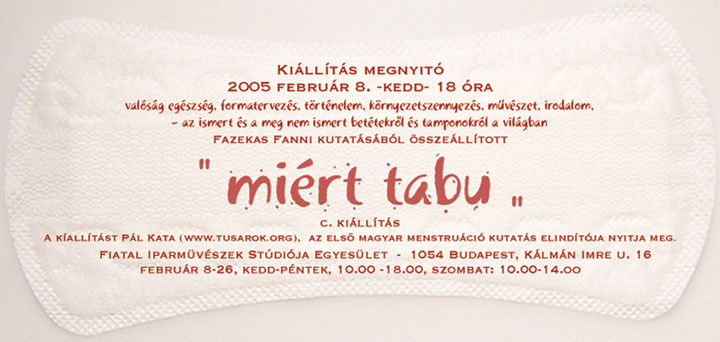
Dear Sir/Madam,
My name is Fanni Fazekas and I am
in my final year of an "Art and Design" degree
course at the University of Bolzano, Italy.
In 2003, I held a very successful
exhibition in south Tirol (northeast Italy)
entitled "The Invisible," concerning female
sanitary wear (ref: www.mum.org/armenff.htm).
The aim of the exhibition was to make users aware
of the different types of sanitary wear available
with a clearer insight to each product and what it
can offer, allowing the user to choose products
appropriately according to personal needs and
requirements.
I have also been invited to repeat
the exhibition in Budapest, Hungary (population -
2.5 million) from 8 to 26 February, 2005. The
exhibition will be held at "The Studio of Young
Artists and Designers."
I therefore invite you to offer
your brand-name and product samples in order that
visitors can view your design and take a sample
away with them to try out. This would clearly be
both a marvelous marketing opportunity for
yourselves as well as a chance for me to further
my studies.
Thank you very much for giving your
time and attention to this letter and I look
forward to hearing from you and receiving your
samples. Please send them to "The Studio of Young
Artists and Designers" in Budapest at the
following address:
For: Fanni Fazekas
" lathatatlan " kiallitas
Fiatal iparmuveszek studioja
egyesulet
'Studio of Young Artists and
Designers'
H 1054 Budapest, Kalman Imre
u. 16.
Hungary
Camelia scion wants information about
his family and the company
Camelia was the first large
commercial maker of disposable pads in Germany in
the 1920s; a German predecessor was the Hartmann company,
maybe the first commercial maker of disposables in
the world. See a Camelia ad
from the 1940s.
Dear Sir:
My name is Peter W. Obermeyer, Jr.
and I am an heir to the original owners of the
Camelia Company in Nuremburg, Germany.
I am beginning research regarding
the history of the company and would greatly
appreciate any information you can offer.
My father, Peter Obermeyer, Sr.,
died at the age of 41, when I was 9 years of age,
and my grandparents (his parents) are long gone as
well.
I have many photographs of the
original and bombed factory after WWII and am
interested in finding out more about my family
history.
Thank you in advance for your kind
reply.
Respectfully yours,
Peter Obermeyer
The History of Contraception Museum -
the only such one in the U.S.A.? - opens
Percy Skuy, a former president of
Ortho Pharmaceuticals, Ontario, Canada, donated
his collection of contraception artifacts to case
Western Reserve University, which is displaying
them in its medical library.
In the Los Angeles Times, Stephanie
Simon, writes (2 January),
"It is a lonely obsession. And a
frustrating one. As Skuy, a retired pharmaceutical
executive, points out with some sorrow, 'there's
really no motivation to save an old
contraceptive.'"
Hm, sounds like this museum.
Visit the museum Web site here.
Making her own rags for menstruation
Hello,
A friend found your site and I am
fascinated. I have been talking openly about
bleeding for thirty years even though it makes
many people uncomfortable. I began using rags in
California in 1977, as a result of hanging out
with feminist hippie dykes in the country who were
doing that. Some were also choosing to bleed into
their clothes or let it run down their legs, as we
were outside most of the time. [My guess is that
many women through history have done this; read What did European and
American women use for menstruation in the past?
See an old Italian
washable rag and more on washable pads and rags.]
I began with a bandana wrapped
arrangement tied to a belt, but eventually began
simply folding up pieces of cloth (ripped up
remnants of old clothes) and wearing them inside
my underpants. It is a really good system with
much better results than commercial paper and
plastic products.
I am glad more women are turning to
cloth, but I want to tell them all you don't need
to buy anything and you don't need to sew
anything. Simply fold up two layers of cloth (one
piece, inside, shorter, to add fullness in the
middle section). The cloth can be any cotton --
old underpants, flannel nighties, sheets, towels,
t-shirts, literally anything that is worn out and
can be recycled. I cut it into pieces suitable for
folding into the right shape for me. You don't
have to hem the edges. It is a rag! Every woman
can figure out the right shape for herself, and it
is variable for different flows. Sometimes I use
heavier cloth, sometimes lighter.
Each rag gets unfolded after use
and tossed in a soak pail. At the end of my period
I wash them at the laundromat (and no one has yet
dared ask what all those stained cloths are for).
[The 2003 movie The Magdalene Laundries shows the
punishment of washing others' menstrual rags meted
out to unfortunate women in the Catholic Magdalene
Sisters' laundries in Ireland.] They do stay
stained, but I don't care. They're bloodrags! When
I go out for the day I carry as many as I need in
a plastic bag, with another bag for the dirty
ones. It is simple. I think when paper products
first arrived on the market it must have seemed
like a convenient alternative, but consider that
(a) they didn't have washing machines; (b) they
didn't have plastic bags; and (c) everything about
menstruation had to be hidden from view. They
couldn't even hang up their pads on an outside
drying line because someone might see them. At my
grandmother's boarding school they had to do their
"linen" washing at night in the basement at
allotted times, and hang them up down there.
I think rags are quite manageable
with modern washing and carrying facilities and
they are so much more comfortable and effective,
never mind the environmental and health benefits.
I didn't intend to write an essay
on it, but I do get frustrated with the
commercialization of the "alternatives."
In the mid nineties I wrote an
analysis of menstrual product advertising in
Chatelaine magazine from the twenties through the
sixties, for a history course. I am not sure it is
electronically accessible any more as it is
probably on some low density Macintosh diskette,
but I do have hard copy somewhere. I would be
pleased to show it, along with the pics I took
from the microfiche, if anyone is interested. What
I found particularly interesting were the ads from
the second world war period, with admonitions to
not be a "stay-at-home Sue" and to send for their
booklet to learn how to cope with war work and
menstruation.
Anyway, it is late and I should
sign off. Thanks for an interesting site.
****
Ottawa, Ontario
She questions my ideas on what women
used for menstruation in the past
It seems to me that many women in
the European past, maybe a majority, used nothing
special for menstruation, bleeding into their
clothing. Read more here.
Dear Mr. Finley:
I have read your site with interest
and amusement. The Museum of Sex was recently
opened in New York City and when I visited it,
seemed to have quite a bit of unused space. I
am uncertain whether or not this space is intended
for future use, but would think that even a
temporary exhibit under their umbrella might well
be an interesting option. They do have a Web
site and a Google search is sure to uncover
it.
My observation is actually an
argument against women bleeding into their clothes
in previous centuries. I am an avid amateur
researcher in the history of fashion and
dressmaking and my knowledge in these areas
prompts me to disagree with you regarding the use
of the crotchless bloomers and the overall utility
of women bleeding into their clothes.
First, what we now think of as
crotchless underwear was so designed with
urination in mind, not menstruation or the
evaporation of female emanations. The
physician you quote is an aberration. The
crotchless option allowed women to simply lift
their skirts when they had to "go to the
necessary" as it was termed, without having to
take down or draw drawers. When you consider
the amount of clothing that women wore in every
period except the regency and the most
contemporary, this will make sense. Holding
up several layers of skirts and petticoats and
attempting to untie the drawstring waistbands
(remember - no elastic waists) and lower the
pantaloons would already require more hands than
the usual standard issue of two and would leave
none free to devote to the task at hand.
In addition, most women had very
few clothes and what clothes they had had to be
handmade in the home and in some cases the fabric
had to be handwoven as well. Women would be
extremely reluctant to ruin clothing in this way
for practical, social and aesthetic
reasons. Menstruation has always been a taboo
topic and women would be reluctant to advertise
their menses by both active bleeding on their
clothes and the stains that would be left even
when menstruation was not present.
Which brings me to my next
objection, namely laundry. The laundering of
clothes was extremely HARD work until fifty years
ago. Nineteenth century laundry required an
additional maid devoted to only this task in
middle and upper class households and each "load"
of laundry required a minimum of eight steps of
huge vats of boiling water and
chemicals. Even in a lower class household,
where some steps might be omitted, laundering
clothing was a huge, labor intensive
undertaking and steps to keep clothing as clean as
possible as long as possible would have been
practical.
So, what did women do? I tend
to approach history thinking about the body and
only the body. It is our one changeless
touchstone; attitudes towards urination,
defecation and menstruation and their concomitant
organs may change, but the organs and their
functions are ceaseless and changeless. So, I
ask myself, what would I have done?
And the answer is that when
menstruating, I would have used rags, padded at
the point of vulval contact with additional rags
and would have basted the ends of the rags to the
fronts and backs of the crotchless and later
crotched pantalets.
Too much trouble you
say? Think about material in an average
household; virtually every scrap was used and
reused until it disintegrated. That which was
not used for clothing, patching clothing, interior
decoration and the mending of that decoration,
quilts, doll clothes and cleaning rags would have
eventually cycled down to use as menstrual
rags. The outer rags used to hold the smaller
rags together may have been dedicated to the
purpose and discarded when they disintegrated or
washing could not cleanse them
adequately. This would also explain why few
or no examples survive.
Ladies of other centuries were also
much more adept with a needle and took care of
much of their bodily functions in their bedrooms
with the help of a chamber pot and a chamber
maid. So, in conclusion, my arguments against
women bleeding into their clothes and for use of
rags are as follows:
1. Clothing was too valuable
a commodity and too time consuming to make to
spoil it in this way. Clothing also
serves a social and aesthetic function and
women would not want to ruin their sole unsung,
sanctioned art form.
2. Laundering of any
clothing, especially bloodstained clothing
(bloodstains are a problem to this day) was so
labor intensive as to be avoided whenever
possible.
3. Menstruation has always
been a taboo and women would not advertise in so
blatant a fashion.
I hope you will think about these
arguments and their solution and possible present
them on your Web site.
Regards,
****
I replied and she sent this:
Dear Harry:
Thanks for writing back. The
bleeding into the clothes could go either way and
you make a good point with the fact that books
warned against it - it is like laws, they don't
make them if there isnt a need. I still stand
though with my idea that clothing construction and
maintenance was so time consuming that women would
be loathe to ruin their clothes in this way and
that even poor women are often proud of their
clothes. It is an interesting topic.
All of this said, I did actually
know a woman who bled into her clothes some years
ago - she had fairly light periods and just bled
into the crotch of her jeans. She was a
pretty free spirit as well. [I know some as
well.]
I also wanted to mention that I
loved the pictures of your cats
on the site. I am a cat lover and as I am
now a cancer patient, my cats have become my
staunchest allies and best company.
Happy Holidays!
****
How can he help with his girl
friend's menstrual problems?
Hello,
I am a 15-year-old male and found
your site by a Google search on "cures for PMS." I
know this is weird, but I just have a few
questions and comments for all the girls out
there, since well, I wouldn't ever be able to
answer them.
First of all, is there anything I
can do for my girlfriend to ease the pain? I know
heat and Advil can, but I want to really help. I
TRY to be extra nice to her when she's on her
period, and give some back rubs, but I feel that
is not enough. Is there anything I can do to make
it easier and less dreaded? If you know anything I
can try, please e-mail me at
davidabunton@hotmail.com so I can start helping
out.
Next, is, I don't understand why
girls have so much pain in their lives when a
guy's life is basically a walk in the park
compared. (Note I am only 15 and haven't had the
full deal.) I don't like to compare girls and boys
since i think they are so distinct from each
other, but, I don't understand it. Why do girls
have so much pain and boys don't? Girls get
monthly cramps, guys may get the occasional one
from sports, but nothing like cramps from their
period.
Next, depression. Most guys my age,
I never see sad or mood swings. Girls, on the
other hand, well, that is much different. I don't
understand why girls have to go through so much
and guys so little. It just doesn't make any sense
to me.
Next, I think girls are much
stronger and well, pretty much better then the
male for a few things. Girls' lives are harder
then males, well, I'm sure you know much better
then me about that, but it's true. Girls have
things in their lives that hurt quite a bit (I
have no idea, and please, please, don't think I'm
saying I do) while guys don't. Period, Pregnancy,
and well, that first time through the hymen. What
do guys have? The only thing I can think of is
getting kicked in the ol' family jewels, and well,
after 5 minutes of so called "pain," it doesn't
quite hurt for much longer. That's about it.
Why though? No one will ever know,
and I won't try to explain. I mean, I can
understand why giving birth hurts (I think this is
obvious to most people of why) but why does the
first time a girl have intercourse (not all girls)
hurt, and why is her period so painful? It just
doesn't make sense to me. Any guy saying that
menstruation is a joke, or thinking it is easy, I
think you have the right to slap him, or better
yet, give him some of his own "menstruation," if
you know what I mean.
Girls deserve all the best, for
help through this time, (again, please don't think
I'm saying it's easy or close, I have no idea, and
never will) and shouldn't have to deal with the
jerk guys in the back row of the classroom making
fun of Sally Sue's red stained shorts. I just wish
I could experience what girls have to go through,
so I could have a better understanding of what it
feels like, so I could help, and actually know
just what I could do. I wish I could be the one
having a period, instead of my girlfriend, and it
makes me sad because I can't experience it, and
have to watch her go through all the pains of
menstruation.
In conclusion, I just want to say
that I think girls are much stronger, and
definitely better then their opposite. I think
that you should be proud that you have to go
through something that someone else doesn't. That
is what makes you strong, and what makes you
better, well, in my opinion at least. I hope you
all can find some way of easing the pain, and
someone, somewhere will help along the way.
Thanks!
More about Kleinerts
Dear Mr Finley,
You were asking recently about
Kleinerts sanitary panties [in a previous news
item].
They were around in the UK in the
early and mid 1960s and were popular with younger
teenagers.
They had a waterproof gusset with a
pocket at each end to hold a sanitary towel in
place. They could also be used with home-made
absorbents such as cotton wool or tissues (Kleenex
etc).
The bikini-style brief was made of
lightweight woven nylon, and was worn low on the
hips, in the "hipster" style fashionable at the
time. The gusset was made of nylon or similar
plastic, not rubber, as was stated.
They disappeared, I think, in the
late 60s when tampons became more widely used, and
adhesive sanitary pads came onto the market.
You are welcome to use any of this
on your site, if it is helpful!
Congratulations on a superb site,
****.
"[M]ost men know next to nothing
about menstruation"
This certain applied to me for
most of my life and partly accounts for this
museum.
A very good site. It resolved a
number of mysteries for me.
One comment: as a man I can testify
with great certainty that most men know next to
nothing about menstruation and the various related
issues discussed on your site. It's all pretty
much a mystery to guys who mostly think of it as a
collection of symptoms that never work out well
for them. But few men, including me, understand
the feelings women have about it, or how a very
significant part of their lives operates. (I
suppose the same might be said about women's
understanding of men's masturbatory habits.)
Perhaps this is because young men
and women are usually separated in sex education
classes, especially in middle school when young
girls are just getting their first periods. We
boys intuitively understood the separation was for
the benefit of the girls, that something involving
"periods" was discussed, and that we Y-chromosomes
were too immature to be sensitive to whatever it
was that the girls were sensitive about. It all
passed us by and we never once thought about
periods until the first time a woman stopped
sexual contact because she was menstruating. For
some guys this is later than others, so you can
see how ignorance is reinforced. I'm not sure what
the consequences are, but it seems that more
understanding is always better than ignorance no
matter the topic.
Anyway, just a thought I had.
Best,
****
Add section for Eastern religions -
what a treasure trove!
Dear Sir,
I ran into your site while looking
for experiential appraisal of menstruation by women
themselves. I enjoyed finding in short texts an
overview of thethree "major" religions' views on the
subject.
May I suggest that you add a page for
Eastern religious views, taoist, Buddhist, yogic?
Views there span the same positive-negative range.
As in other religions, too, knowledge about women's
experience and practices (physical in this case) has
so been suppressed over the centuries that little is
now known of what archaics and ancients might have
remembered from the matriarchal cultures' knowledge.
Modern women have to rediscover it. Below is a line
to follow.
There is, in all religions, a
"deeper" or "inner" aspect of religious teaching,
knowledge of human nature, and mystic practices. The
quest for "enlightenment" and its problem of
behavioural and mind agitation and pains has roots
in the body and the quest for longevity and
youthfulness, freedom from disease and from being
dependent on external things or people. For women,
some practices involve menstruation. It seems,
though, that these are mostly lost, due to negative
biases and to the progressive psychologizing of
spiritual practices.
Mysticism, spiritual practices, and
archaic "myths" of reversing menstruation for
health:
I know of one Buddhist practice
called "slaying the Red Dragon,"
aiming to stop menses (for
women monks, the body is "just a vehicle" and
menstrual uproars of emotions a hindrance to
meditation). I
cannot trace anyone who actually knows what this
practice involves.
In Chinese and yogic traditions,
there's a lot of sexual practices to "raise spirit" or life
energy, but China has retained a notion that women
could stop their menses and
gain at the same time a healthier body, also more
prone to "spiritual development."
I also think I remember (can't quote)
something in the beginning of the Bible (descendants
of Noah) about a woman who was menopausal, received
the Grace of God, became fertile again, and
pregnant. [Note that scholars increasingly stop
considering ancient texts as mere stories and find
historical validation for their contents, so may be
there is something real to that story].
These remnants of traditions,
apparently often rooted in pre-archaic female
shamanism. go in the same general direction as some
of the books you quote. Namely, that
(1) Menstruation is an
illness-cleansing process, which, however should
not lead to negatively valuing of women, persons
with 'uncleanliness'. 'Illness' is a problem that
must have a solution.
(2) Menstruation blood and
menopause may not be necessary or inevitable at
all. There is controversy about whether it's a
uniquely human phenomenon, and indications that
rich agriculture-based food might cause it in
caged animals - so why not in women- , and its
occurrence seems variable in animal species and
individuals - so why not in women, since most
males do not experience sexual organ failure at
midlife.
(3) Therefore, there might be a way
of not having menstruation, without resorting to
medical drug interference, which I know from
personal experience (contraceptive pill) can wreck
havoc in the hormonal system both short term and
long term - see literature on the effect of
Hormone Replacement Therapy on cancers, for
example, or see literature about the painlessness
of menopause or childbirth in certain cultures. I
could find no theoretical reason to make such
things necessarily impossible.
(4) This would mean there could be
both a way of stopping them without loosing
fertility once they have started, and a way of
maintaining health so they do not start at all.
Most ancient traditions state that there is
knowledge about human nature that has been lost.
Your list of euphemisms and words for
menstruation (here)
supports the idea that menstruation is not pleasant
(and at its worst feels like illness; shall we trust
instincts?) but also the idea that they constitute
an "activation of power," including creative, but
also the "red power" of hormonal uprising as in an
adrenaline or testosterone rush. Such "activations"
have a lot to do with how cells behave in a cancer.
This line of thought has not been explored in
medical or anthropological contexts as far as I
know.
Displaying info on mystic practices
and these unusual health goals might help validate
women's experience as both unpleasant but not
blamable, and a possible opportunity to approach
health in a different way, from a woman's viewpoint.
Hence scholarly and medical studies of possibilities
in women's conditions rather than a mere remedial
"disease'" approach, post- (e.g. PMS) or pre- (as in
one of the books you quote, about ridding the world
of menstruation).
My way of dealing with all this is to
not accept as full truth anything I read, including
scientific knowledge and household knowledge, and to
seek answers for myself, observing my own experience
as it is, rather than through the filters of what
I've learned or of my bodily conditioning, and draw
inspiration and support from archaic texts, less
limiting. Since a couple of scholars have responded
to your site, I'd like to make an appeal to women
researchers to not stay with only objective science
or scholarship, but to include their own experience
in a "first person" research method.
Results of a trial of the new pill to
suppress menstruation, Seasonale: "effective, safe and
well tolerated"
Christine L. Hitchcock, Ph.D.,
Research Associate, Centre for Menstrual Cycle and
Ovulation Research (CeMCOR), Endocrinology, Dept. of
Medicine, University of British Columbia, Vancouver,
BC, Canada (URL: http://www.cemcor.ubc.ca/),
sent this to members of the The Society for
Menstrual Cycle Research (which includes me).
Here is the first article from the
Phase III trial of the higher dose extended
schedule pill (Seasonale).
In Contraception. 2003
Aug;68(2):89-96.
A multicenter, randomized study of
an extended cycle oral contraceptive.
Anderson FD, Hait H.
The Jones Institute for
Reproductive Medicine, Eastern Virginia Medical
School, Norfolk, VA 23501, USA.
fanderson4@cox.net
OBJECTIVE: To assess the efficacy
and safety of Seasonale, 91-day extended cycle
oral contraceptive (OC). METHODS: A parallel,
randomized, multicenter open-label, 1-year study
of the OC Seasonale [30 microg ethinyl estradiol
(EE)/150 microg levonorgestrel (LNG), and
Nordette-28 (30 microg EE/150 microg LNG)] in
sexually active, adult women (18-40 years) of
childbearing potential. Patients received either
four 91-day cycles of extended cycle regimen OC,
or 13 cycles of the conventional 28-day OC with
daily monitoring of compliance and bleeding via
electronic diaries. RESULTS: When taken daily for
84 days followed by 7 days of placebo, the
extended cycle regimen was effective in preventing
pregnancy and had a safety profile that was
comparable to that observed with the 28-day OC
regimen that served as the control. While
unscheduled (breakthrough) bleeding was reported
among patients treated with the extended cycle
regimen, it decreased with each successive cycle
of therapy and was comparable to that reported by
patients who received the conventional OF regimen
by the fourth extended cycle. CONCLUSION: This
study demonstrated that Seasonale, 91-day extended
cycle OC containing 84 days of 30 microg EE/150
microg LNG followed by 7 days of placebo, was
effective, safe and well tolerated.
PMID: 12954519
Continued to next earlier News & Notes
|