|
Store your menstrual blood for
future use for stem cells at
http://www.celle.com/about.aspx
Looking for collaborator in
study about sexual functioning
during menopause
I am proposing a longitudinal
study based on a biopsychosocial
model looking at sexual
functioning during menopause.
This project is designed to look
at primarily social
(relationship and lifestyle)
factors that contribute to
preservation of sexual
functioning during the
progression through menopause.
The population will be African
American (recruited in
Pittsburgh), Hispanic (recruited
in Santa Fe), and Caucasian
(recruited from both sites) to
examine variation based on race/
ethnicity, culture, and
community.
Because of limited work looking
at racial and ethnic differences
especially during the
progression through menopause,
we proposed conducting focus
groups (and are also adding
individual interviews also based
on reviewer comments) to make
sure that the longitudinal
questionnaires addressed the
majority of domains important to
mid-life women. Currently Ellen
Olshansky, whose work has been
in the area of infertility and
branching into the experience of
menopause in women who were
previously infertile, is working
on the qualitative component. We
are looking to add a
collaborator with content
expertise in sexuality,
preferably during menopause, and
racial/ ethnic/ sexuality
variations.
The genesis of the project
comes from my current career
development award, which follows
about 700 women (at this point)
during menopause to look at the
impact of menopause on quality
of life as well as the current
slant of the medical literature
towards testosterone
supplementation to improve
sexual functioning during
mid-life.
The proposal has been through a
first review at NIH. It was
scored, but not fundable. The
reviewer comments were
enthusiastic and addressable so
I'm feeling good about eventual
success.
Rachel Hess, MD, MSc
Center for Research on Health
Care
230 McKee Place
Suite 600
Pittsburgh, PA 15213
412-692-2025 (office)
412-692-4838 (fax)
hessr@upmc.edu
Kotex boxes in brown paper,
washing hair, and being seen
pregnant
I stumbled upon your site as a
link from another site and spent
more than an hour reading
history (and being thankful I
live in the modern era!).
I may have missed this on your
site, but wanted to relate a
memory I had going back to the
early 50's when I was a young
girl. The boxes of Kotex, etc.
were wrapped in brown paper at
the drug store when you
purchased them to hide what you
were buying. It was a shameful
item to buy, I guess, made even
more shameful by the fact you
had to ask for them and have
them wrapped. [Visitors to the
museum in my house
told me the same thing. Read
early reports
of embarrassment in buying
menstrual pads.]
Also, and again you might have
a topic like this on your site
that I missed, is old wives
tales connected to menstruation.
My mother would NOT let me wash
my hair or take a sit down bath
during menstruation. Supposedly,
the water would make you
sterile. [Booklets
companies made for girls often
discuss this.]
As an aside (menstruation is
obviously related to pregnancy),
I also remember my mother saying
that she was glad I was born in
November ('45) so she could hide
her pregnancy under a coat.
Apparently, if a couple walked
down the street and she was
obviously pregnant, the guys
would hoot at the husband. It
meant he had got "some." My
father was in the military, so
don't know if this was a
military town thing or not. [My
mom was mortified when we kids
saw a picture of her standing
next to my military father among
the tourists at Mt. Vernon; she
was visibly pregnant. Maybe it was
a military thing.]
****
Goods 4 Girls project:
Donate washable pads to girls
in Africa.
Do menstrual cups (more about
them) relieve menstrual
pain?
Hi there,
I run Femmecup, a company that
manufactures and retails
menstrual cups. I have for a
long time heard stories about
menstrual cups alleviating
period pains and wanted to
perhaps add a comment or
reference your website? I
noticed that no one has
tried/recommended this as a
remedy yet.
I have had comments from ladies
who have bought Femmecup saying
that their cramps have totally
gone, how it works I am not sure
but am researching this at the
moment.
Anyhow here is a quote from a
happy customer and maybe you
could add something to your
site? It may just help someone
one day.
"I just wanted to say I'm so
happy I went to the Clothes Show
Live in December 07, because I
bought my Femmecup. I'm always
willing to try anything and
particularly as this small
device would lessen cramps, save
me money and help the
environment. For the last 2.5
years I have suffered from
severe cramps (a fact of getting
older I'm told) and took very
strong painkillers for 1-2 days
each month. WOW, I am now using
my Femmecup for the second time
and NO painkillers yet again! No
leaks either and far less mess
and hassle than using towels and
tampons. I am spreading the word
. . . "
Thanks very much in advance.
Kind regards,
Kate Selby
Femmecup Ltd
PO Box 9963, Harlow
Essex, CM20 9EU, UK
0044 1279 329307
0044 7748 757471
www.femmecup.com
She understands
why there needs to be a REAL MUM
Hi there,
Just wanted to let you know
that I think your museum is
amazing in so many ways. The
fact that you're open minded
enough (or 'shameless' enough?
Well, good! - this is no easy
thing, and if that whole bit
about those with strength
walking alone is truth, then you
must be Iron Man by now) - to
put something like this together
is amazing and needed. People
need to know that women's bodies
are part of history, if not more
so because of the subservient
role women traditionally play in
most societies. Your museum
points that out and fuels
knowledge and education where
usually there is fear and
avoidance.
It's probably obvious which
part of your web page I read
right before writing this email
to you, but it's true just the
same, and while this is stuff
you might already know, I think
that this whole project is
interesting and important enough
to give my opinion on. I hope
you're still able to open a
museum-in-real life somewhere. I
think it would also be
interesting and important enough
to catch the public eye. Good women
rarely make history, and same
goes for men - few of
which dive into a history not
based around things that are
culturally accepted and
understood. I'm glad you were
curious and bold enough to give
cultural reactions to the female
body (and ultimately women) the
respect and recognition deserved
- and also for giving people who
don't quite understand a feeling
of discomfort. I mean,
discomfort turns into
discussion, which in turn
becomes questions of 'why' -
something that in this society
we certainly have a shortage of.
Remember that what doesn't
result in all-out fear creates
change, and what does is only a
product of having made a person
question their own understanding
of the world.
Thanks and hope everything is
going well with your cats,
**** and (the no-longer-able
to menstruate feline who lives
with me,) Vendetta. [Great name
for a cat!]
She likes The Keeper menstrual cup,
suggests a way to change cups in a
public restroom, and will probably
buy one for her daughter
Wow - this site has me a little
freaked - I never thought of a
museum on the topic of
menstruation, let alone one run
by a guy. hmm
Anyway - I think it's all
great, and I'm glad for it,
because poor choices based on
lack of info is completely
absurd in this day and age.
Ladies risking TSS is
something I can't comprehend.
The eww factor is beyond
comprehension too, when you
figure at least SOME of the
women have GIVEN BIRTH!!! Get
over the eww thing, having a
baby is plenty messy with
various bodily fluids - during
conception, labor, and for at
least a year after that, in my
experience.
I bought my Keeper
almost 10 years ago, after
seeing an ad in a magazine for
hikers and outdoor people. I was
planning to hike the Appalachian
Trail, and thought I would get
it for the trip. Obviously, if
you are on a trail for a month
or more, what are you going to
do with paper stuff, new or
used? The critters will even
pull up used toilet paper. Now
seeing a rodent unburying a pad
or tampon, that qualifies as
eww!!!
Well, the Keeper showed up, I
tried it out to make sure I
"knew my gear" before getting
out in the middle of nowhere,
and I've been hooked ever since.
I never did get to the hike
(yet) but I have yet to buy any
more paper products. And my
daughter is 11 now, so I'll be
buying another one, I guess. I'm
glad I've seen other women's
comments, because I never
thought much about it. I guess
she'll have to decide if it
'fits,' and I hope it does! I've
had a leak here or there, but no
more of a horror than I ever had
with tampons or pads. The cost
factor is awesome - I'm a
heavy-med-light-off, wait, 2
more days of med-light!! girl,
so I used to have to waste a
couple of days of pads on the
off-wait interval, so I didn't
get caught unprepared, but it
always made me mad to use and
toss expensive, essentially
unused paper stuff every month.
The Keeper is a set-it and
forget-it. I can heartily
recommend to anyone to at least
give a try. (and not to totally
freak anyone out, but when I
have to check on the cup in a
public stall, the easiest method
is to go before you need to pee,
but with a bit in your bladder,
pull the Keeper, tip it out, pee
in the cup to rinse it out, and
yes, you pee on your fingers,
and urine is sterile - possibly
cleaner than the water you are
washing with!! - and by the time
you replace the cup, wipe with a
bit of toilet paper and all,
your fingers are OK to go to the
sink and wash. I mean, ladies
wash after anyway, so what's the
big deal? (not that you, gentle
director, don't - but studies
show women wash more
predictably:-))
Good work, best of luck to you.
(December 2007)
POSTDOCTORAL
FELLOWSHIP in SEXUAL &
REPRODUCTIVE HEALTH:
1-2 year new position available
at The Kinsey Institute for
Research in Sex, Gender and
Reproduction, a vibrant
multidisciplinary research center
at Indiana University.
Responsibilities include research
initiation and collaboration on
several projects involving sexual
health and methods (approximately
80%) and assessment/treatment
(20%) of individuals and couples
with a broad array of sexual
complaints and relationship
distress.
Qualifications: Ph.D. and
internship from APA-accredited
program; strengths in research
skills and clinical knowledge.
Indiana University is an Equal
Opportunity/Affirmative Action
Employer strongly committed to
excellence through diversity.
Please send CV and three letters
of reference by March 1, 2008 to
Julia R. Heiman, Ph.D., Director,
The Kinsey Institute, Indiana
University, Morrison Hall 313,
1165 E. Third St., Bloomington, IN
47405, or email
jheiman@indiana.edu
She's
collecting older
women's
stories about
menstruation.
Kimbrey Pierce, a college student
from southern Maryland (U.S.A.),
has a terrific idea about finding
out what older women (as old as
possible) today can report about
their experiences. She suggests
visiting nursing homes or similar.
She writes, in part:
People could email me the
stories at
kimbreypierce@gmail.com
In particular, I am interested
in stories
about first menstruations,
family
stories of menstruation,
stories
about experiencing
menstruation in the past,
and the
experience of first periods.
These stories could include the
following details:
age
how prepared you were
where you were
your emotional experience and
reaction
actions you took
people you turned to for help
reaction of friends and family
advice you were given
Also, if the reader has a
negative reaction to seeing
this, why they would feel
uncomfortable sharing their
story? I know my mom won't share
her story with me, she feels
like it's a personal "body
issue" but her sister, my aunt,
had no problem discussing it
with me.
Please
contribute before these
stories are lost!
Register for "In the Flow:
Embracing the Cycles of
Womanhood" Sept 29, 2007,
In San Francisco.
"The key to a woman's health
and well-being lies in knowing
her body and its natural
rhythms. Understanding her
hormones, and how they
influence her reality, is the
birthright of very woman and
girl. She is equally entitled
to feel positively about her
body." Ashley Ross, RWF Member
and Co-Founder of Life Cycles
Join The Red Web Foundation
Saturday, September 29
for "In the Flow:
Embracing the Cycles of
Womanhood" held at the
Jewish Community Center of San
Francisco. The day is designed
for girls eleven and up,
teens, women, mothers and
grandmothers who want a
positive relationship with
their menstrual
cycle; have a healthful
peri-menopause; and create new
family traditions. There
are 18 workshops with 6 focus
tracks: Mother/Daughter,
Observing Cycles-Yours and
Nature's, Menopause, Cultural
Experiences, and Celebrate
Your Body.
"When Black Jewel Girl Comes
Running -- Mother-Lines of
Spirit and Flesh" is the
keynote by
critically-acclaimed author
Carol Lee Flinders PhD.
She may best be known as co
author of Laurel's Kitchen.
Her newest book is
entitledEnduring Lives:
Portraits of Women and Faith
in Action. The four featured
women are Jane Goodall, Etty
Hillesum, Tenzin Palmo and
Sister Helen Prejean.
To register or more
information please go to
http://www.redwebfoundation.org/27.html
Lunch is included in
registration
Student $35
General Registration
$60,
First daughter $20,
each additional daughter
$15
Menstruation, brothels and
contraception taboo in museums
What a great museum. I am
writing an essay on museums and
brothels. Why they aren't
exhibited in museums. One reason
given by the scholars who wrote
the article that I have to use
said that museums won't touch
menstruation and contraception.
"Sex is a notoriously sensitive
subject. It forms part of a
triumvirate of especially taboo
topics associated with intimate
aspects of women's bodies, the
other two being menstruation and
contraception. Museum curators,
naturally wary of offending the
public, tend to steer clear of
such subjects." RUBBISH I
thought. I am studying to be a
museum curator.
What is taboo about
menstruation and contraception?
I thought. How stupid. Millions,
billions of women are using and
doing both every day.
Maybe the curators use brothels
and don't want their wives to
know.
So I checked the web and guess
what, a museum of menstruation.
Thank goodness a curator who
will deal with 'real' subjects.
[There IS a museum of
contraception at Case Western
Reserve University and I DID
once have a real museum of
menstruation in my house.
But brothels . . . . (September
2007)
Belts and pads still used in
India
An Indian writes that
menstrual belts and pads are
available in India from Johnson
& Johnson and called
Carefree and Helena. Older women
still use them but the young
mostly switched to ultrathin
pads after 2000. (September
2007)
See two efforts (here
and here)
to get poor Indian women to make
their own pads rather than bleed
into their clothing.
A high school social studies
teacher shares her lesson called
From Bullets
to Blood: Military Technology
and its Impact on Civilian Life
It involves some images from this
museum.
Mr. Finley,
This email is much too long
over due. Below please find the
link to the unit I wrote in 2005
about the history of the
technology behind feminine
hygiene products.
It was a big success and I
wound up presenting it at a few
conferences. I have used parts
of the unit in my own classroom
as have a few other history
teachers at my school. My students
are always floored when I
mention anything to do with
menstruation (which I do
quite often) but I am happy
to report that many enjoy
the lessons, if only because
it's more "under the table"
history that is certainly
not included in their
textbooks.
http://www.usd116.org/ProfDev/AHTC/lessons/kklebbe/Klebbelesson.htm
Again, thank you so very much
for permission to use the info
from MUM and please feel free to
post the link on the MUM website
should you find it worthy.
Sincerely,
****
Social Studies Department
**** High School
E-mailer praises this museum
It's been a long time since I've
written you . . . . MUM has
certainly grown! I was wondering
if some grad student at [a
university] couldn't get some
grant money to organize your
website and catalog things in
preparation for the day when MUM
is once again a brick and mortar
operation.
I hope that your detractors don't
discourage you. I was shocked to
read the bit about someone
actually killing
one of your cats. When did
that happen? How horrible!
My own
opinion of you is that you
have been a great blessing to
all of us, and to women as a
whole, as you have
de-mystified menstruation and
shown it, and women, respect.
****
Where did Kotex REALLY get its
name?
I have (tenuous) associations
with Kotex on both sides of the
family: My father went to school
with the reputed heir to the Kotex
fortune, Rich Kotite (no wonder he
became a football coach when he
grew up!) and my mom says her mom
worked in a Kotex factory.
According to family lore, the
wartime predecessor of the Kotex
pad was not a noble bandage or
wound dressing, as the ads
on your site would lead one to
believe, but a swab for
cleaning a particular gauge
firearm. Also, the "COtton-like
TEXture" balderdash [same
link, enlarged words] is
probably an etymology invented by
ad copywriters. I imagine that
Kotite's dad was probably torn
between the competing urges to
name something after himself, and
distance himself from the taboos
associated with it.
Of course, this is more folklore
than history. If you find archival
evidence to substantiate the
above, please report it on your
site! [Anyone have proof? Write
me.]
Are you a
woman who gets headaches? Read
on!
An Internet-Based Diary Study
of Women with Migraines
This study explores the
experience of women (aged 18-55)
who have headaches. It is not
necessary to have a diagnosis of
migraines, because women will be
screened to see if any of their
headaches meet migraine criteria.
The purpose of the study is to
increase our understanding of
factors that trigger headaches,
and the symptoms that women
sometimes have before headaches
start. The study will recruit
about 100 women.
Each woman will complete a
standard health history form and a
series of short daily diary pages.
The health history and the daily
diary pages are accessed
completely by Internet at the
study web site.
When the study is over, a
researcher will talk with women
about the experience of being in
the study. At this time, we will
also answer questions women might
have about their headaches, and we
will provide any information from
our preliminary data analysis that
might be helpful to the individual
woman.
The study is funded by the
National Institute of Nursing
Research, a division of the
National Institutes of Health
(NIH). It is supported by both
Georgia State University and Emory
University. This is the fourth in
a series of studies that we are
conducting on women and migraines.
If you
think you might be interested in
participating in this study, and
learning more about your
headache patterns and triggers,
please visit our web site at:
https://cfusion.sph.emory.edu/Migraine/index.cfm
The study's Principal
Investigator is Margaret (Peggy)
Moloney, RN, PhD. She is an
associate professor of nursing
at Georgia State University.
Margaret Moloney, RN, PhD, ANP
Associate Professor
Byrdine F. Lewis School of Nursing
Georgia State University
PO Box 4019
Atlanta, GA 30303-4019
Two e-mails about menstrual
cups: Lunette, The Keeper, Diva
Museum of Menstruation (USA)
Dear Mr Finley,
I read your entire history of
menstrual cups with avid
interest.
A few months ago a friend told
me about menstrual cups, and
gave me the website address for
Diva Cup. I immediately bought
one, and had no trouble using it
whatsoever (I use a cap for
contraception so found a cup
easy to insert and take out).
I was so impressed I wanted to
tell every woman about them. I
couldn't believe that I did not
know they existed until I was 40
years old.
Next I discovered Lunette, a
European version (cup made in
Finland). This cup has a couple
of differences. It has been
designed to be easier to clean.
The pin holes that are difficult
to clean out on the Diva Cup are
larger on the Lunette cup and do
not collect blood, and the tag
is solid instead of hollow, and
does not get bunged up either.
In the process of telling every
woman that there is an
alternative to disposable
products, that is easy to use,
environmentally friendly and
healthier (I get less period
pain than I did with tampons) I
have been fortunate enough to be
able to work with Lunette, and
now distribute them in the UK.
So you know that I have a bias
now due to my affiliation with
Lunette. However, would you like
a sample of the Lunette cup for
your museum? If anyone has any
queries about the Scandinavian
version of the menstrual cup we
would of course be very happy to
answer their questions. Please
email info@lunette.fi,
or info.uk@lunette.fi
for enquiries in English. The
website address is www.lunettecup.com
Kind regards,
There are more modern cups
available than just the Keeper,
now. This article lists
them:
http://community.livejournal.com/menstrual_cups/648061.html
I enjoyed your "exhibit"
of the cups' history. I
started using a Keeper 6 years
ago, and have never looked back.
I also have a 2 year old Diva
Cup. I had a baby 4 months
ago, and now need to by the
larger size for after
childbirth.I used pads for after
the birth, and it refreshed my
memory of why I searched for and
found a better alternative!
[I'm behind in updating the
MUM section on cups.]
Her French cousin used a hotel
towel for a menstrual pad
In the early 1970s my French
cousin came to stay with my
family in London. She came from
a small spa town in a semi-rural
community in Southern France
where she worked at a fairly
posh hotel. One morning, I
came down for breakfast to find
my Mum drying what looked like a
child's terry towelling nappy in
front of the oven. It was
actually an off-cut of a old
hotel towel.
To my raised eyebrows my Mum
explained that my cousin used
these napkins for her period as
her mother had done before her.
I have to say I was mortified
and horrified in equal
measure. Surely my cousin
knew better? I did (I was
already using tampons as a young
teenager). I never saw my
French relatives in quite the
same light again! [See an Italian
terry cloth menstrual pad.]
****
June 2007
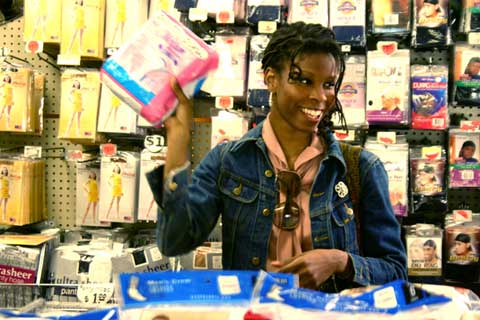
A PERIOD
PIECE
Refreshing Film for Preteens
Contact: Ada Babino/ Camille
Holder-Brown (202)232-3400 /
(347)661-7179.
Email: ABabino@aol.com
or aperiodpiece@gmail.com
http://www.cinemomma.com
New York City - Cinémomma
Pictures new release, "A
Period Piece"
(Film/Comedy 20min, 2005), by
emerging independent filmmaker
Camille Holder-Brown will be
available on DVD in June at the www.cinemomma.com
website. This lighthearted
coming-of-age film focuses on
puberty a subject often
neglected and in need of more
positive communications. "A Period
Piece" will also have a limited
theatrical release in select
cities and is available for
private screenings at schools and
other venues. Tune into the
Cinemomma Pictures website for
more information and updates about
the film and filmmaker.
After winning Best Film at Howard
University's Paul Robeson Awards
in April 2007, "A Period
Piece" made its
national broadcast premier on
Black Entertainment Television
Jazz Channel's (BETJ) program
called "Best Shorts." As part of
this best short film competition,
audiences could vote online for
their favorite short. It has
screened in over 20 film festivals
including the Pan-African Film
Festival in Los Angeles, and the
Cinewoman Screening Series in New
York City.
The film takes us on a journey
with 11-year-old Sionne, played by
newcomer Tweetie Lincoln as she
tries to somehow avoid the
inevitable of starting her
menstrual cycle. Health class
reproductive films, classmate
period testimonials, and even
"tampon hypnosis" can't change her
faith of crossing over to
adolescence.
"Whether you are a young girl or
a grown woman, you will completely
be taken back to that nostalgic
first period experience," comments
Ms. Holder-Brown. This film talks
about the things no one wants to
talk about, but first she makes us
laugh out loud. It is a great tool
to open up communication between
pre-teens and matriarchs. "I made
this film to be shown in the
schools, girls groups and
organizations, especially for
young girls," she commented.
Camille Holder-Brown was recently
recognized, along with Radio One's
Cathy Hughes at the Paul Robeson
Awards in Washington, D.C. She has
won at Best Student film awards
and has also had her work shown on
BCAT in Brooklyn, NY. Teen
Voices and Black press have
also interviewed and written about
her. The film has also premiered
at her hometown middle school in
Florida, then went on to be
screened at Harlem Children's
Zone, and at Women's Health
Conference.
Originally from Daytona Beach,
filmmaker Camille Holder-Brown, a
Howard University alumna, based
this film on her life. However,
she fuses her anthropology
training from the University of
Miami with over ten years in the
film industry to make a film that
has soul and authenticity. She has
worked for filmmakers Spike Lee
and Haile Gerima, and now she
steps out to make a cathartic
films about being a woman, a wife,
and mother of two, all at the
tender age of 28. She has moved to
pre-production for her first
feature-length documentary on
parenting, starring her eccentric
family. Speaking engagements are
available at http://www.blackfilmmakers.net
or contact info@cinemamma.com
or aperiodpiece@gmail.com.
"Thanks for having the vision
and courage"
Hi,
I am just writing to express my
gratitude for the well maintained
site you have. I am currently
writing my thesis about the
cultural construction of
menstruation through magazine
advertisements and magazine
articles. While I haven't
even looked through half of the
site, what I have looked at
so far has been very
interesting and very useful.
Thanks for having the vision and
courage to undertake this project!
Regards,
****
Poll: "Would you try
a cup similar to the Instead if there was a
way to prevent the messy
removal?" Open a pdf file
(thanks to a reader!) or see a
PowerPoint presentation about
this (click on the
downloaded file to open it; it
won't open automatically).
E-mail
your opinion and I'll
forward it to the patent-pending
holder (below). Read what the
inventor wrote:
Hello,
My name is Shonta Gooch I have
a patent-pending idea that I'd
like to take a poll on.
I know that many women have
used and like the Instead
disposable cup but have the same
problem as I did with
removal. I figured that if
the cup could somehow
non-directly absorb the fluids
without interfering with the
normal vaginal moisture they
would be a smash. So I
created a vaginal discharge cup
with an absorbent lining.
My Poll Question:
Would you try a cup similar
to the instead if there was a
way to prevent the messy
removal?
No tax on
tampons!
Hello Mr Finley,
I really like your website and
I would like to bring to your
attention of my myspace http://www.myspace.com/bantaxontampons. Please
check it out and tell me what
you think.
I have your MUM link in my
blog and wondering if you
could possibly put a link of my
website on yours since they are
both related to the same topic.
Thank you for you time!!
****

Hi, Harry!
How exciting to finally be
writing to you. You and your
site have been such an
inspiration to me and my
business partners as we have
been involved in the development
of our new
menstrual product the
last three years. I'm proud to
write to tell you we are ready
to launch CodeRED!
The CodeRED
Starter's Kit is our
first-born! It is for young
girls getting ready to begin
having periods and all the
supplies included in it are made
from organic cottons and are
biodegradable. Our printing is
done on recycled papers with soy
inks and all our manufacturing
is fair labor/wage. In addition
to supplies and support items,
each kit contains an informative
guide called "All Things
Period."
We hope to have our CodeRED
pads and tampons available for
on-shelf sales before the end of
the year.
We are excited about the
CodeRED line and want to share
it with you in the hope that you
will give us feedback and
critiques. We also hope you will
help us get the word out about
this new alternative for women.
Our
website is: fanciepants.com
I look forward to your
feedback.
Regards,
Ellen Fenter
Kotex Security Tampons: "plastic
applicator for sensitive labial
lips to get stuck in"
First, let me say how much I
love your site. Very
interesting, and funny as well.
I notice that there is no
mention of Kotex Security
Tampons (at least, none that I
have found). It was the
first tampon I used as a
teenager, used it for years, and
I am wondering its history.you
can still purchase them today,
plastic applicator and all.
Since growing up, I have
switched to o.b tampons. Why? Well,
they perform much, MUCH better,
fit in my purse or pocket or
even in the palm of my hand
without betraying anything, come
in an Ultra size (for those
super-heavy flow days)but you
want to know the selling
point? No plastic
applicator for sensitive labial
lips to get stuck in.
-eee-
|